Night

welcome to our
SATURDAY EVENING POST
September 4th, 2026
By Diamond Kyle
Written with time, thought, and a human pulse.
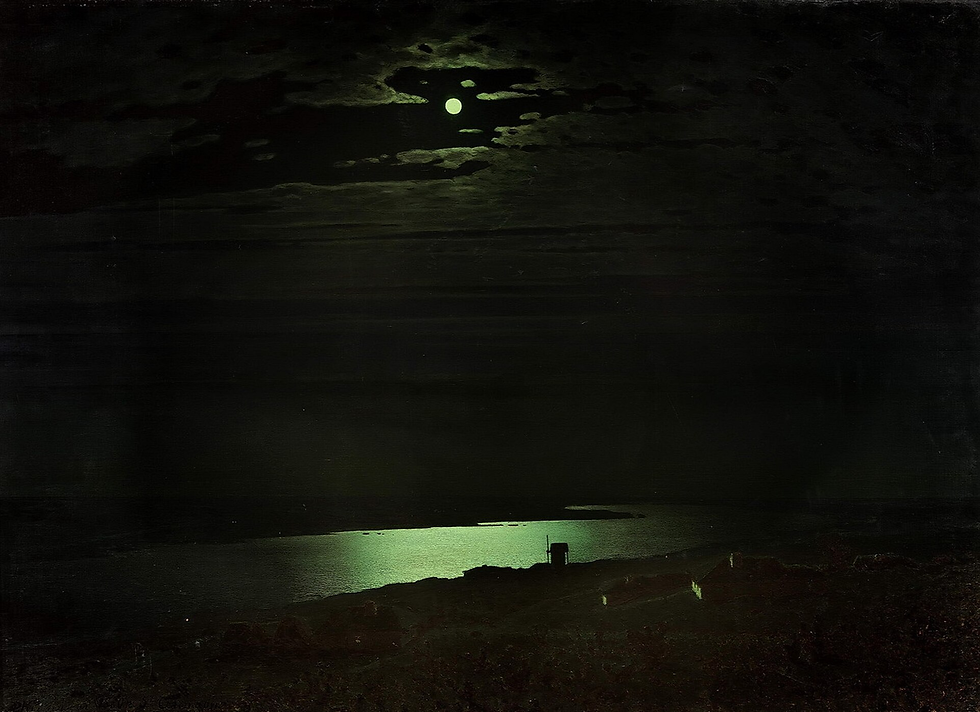
One of the most famous paintings of night is not a painting of night at all. Rembrandt's The Night Watch was never given that title by Rembrandt, and the scene actually takes place in daylight. By the late eighteenth century, however, layers of dirt and darkened varnish had so transformed the picture that viewers began to understand it as nocturnal. The mistake seems strangely appropriate. Night, after all, is partly a condition of not knowing what we are looking at. It removes information, softens boundaries and asks the imagination to complete what the eye can no longer quite establish.

Perhaps that is why artists have so often used night for things that daylight has difficulty containing. In Henry Fuseli's The Nightmare, sleep leaves the rational mind undefended and the bedroom becomes inhabited by creatures that may belong to another world or merely to our own. Goya understood something similar: darkness provided a plausible territory for superstition, fear and collective irrationality. Night does not necessarily create these things; it permits what daylight suppresses to become visible.


For the Romantics, it could also reduce the human being to something very small. In Turner's Fishermen at Sea of 1796, the moon breaks through an enormous darkness while the fishermen's tiny lantern answers it from below. Tate describes that the vast moonlight against the vulnerable artificial flame as an assertion of nature's power over mankind. The sublime is contained in that disproportion: we make a little light and discover, by doing so, how much darkness surrounds it.

Hiroshige’s Night View of Saruwaka-machi offers something entirely different. Edo does not disappear in darkness, it appears orderly, theatrical and strangely spacious. Moonlight, long shadows and receding architecture turn the theatre district into a measured interval between human activity and silence. Night here is not terror but peaceful existence brimming with affluence.

But during the nineteenth century, painters discovered something else. Night could loosen painting from the obligation to describe things precisely. Whistler called his paintings Nocturnes, borrowing the language of music because he wanted painting to operate less through narrative than through tone, harmony and sensation. In Nocturne in Black and Gold—The Falling Rocket, fireworks become flecks and stains suspended in darkness, and darkness had allowed representation to drift remarkably close to abstraction.

Night, however, is never simply black. Van Gogh understood this perhaps better than anyone. While working in Arles he wrote that night seemed to him even more richly coloured than day. In Starry Night over the Rhône, Prussian blue, ultramarine and cobalt surround orange gaslights whose reflections travel across the water. The heavens and the modern city illuminate one another. By 1897, Pissarro could paint a Parisian night without moon or stars at all: the Boulevard Montmartre is illuminated instead by electricity, gas and oil. Humanity was beginning to manufacture its own night sky.


And yet artificial light did not abolish darkness psychologically, and Hopper's Nighthawks may be one of the great demonstrations of that. Fluorescent lighting was comparatively new when he painted it in 1942; the diner glows almost violently against an empty street, but its brightness does nothing to produce intimacy. The people are together and unmistakably separate. Most brilliantly, Hopper gives us no visible entrance. We can see perfectly into this illuminated refuge and still cannot enter it. Modernity had conquered darkness technologically while discovering new forms of loneliness inside the light.

Elsewhere night continued to offer something far older. O'Keeffe reduces Lake George to dark water, mountains and a handful of stars; Munch makes the nocturnal landscape seem almost sentient; Peter Doig turns the Milky Way into something abstractly remembered rather than directly observed. In Canadian art, night often seems inseparable from scale and geography: the aurora of Tom Thomson and Franz Johnston, Maxwell Bates's fractured city, the severe winter of Christopher Pratt. These are very different nights, but all of them make the familiar world temporarily strange.


Cai Guo-Qiang finally reverses the entire history. In Sky Ladder, realized in his hometown of Quanzhou in 2015, darkness is no longer represented on a surface; the sky itself becomes the surface. A ladder of fire rises upward and disappears. For a few moments, the ancient human impulse to connect earth with whatever may lie above it becomes literal.

Perhaps what night exposes most clearly is that vision is partly an act of interpretation. We tend to imagine seeing as a passive process, as though the world simply enters the eye intact, but darkness makes the limits of that assumption obvious. As light diminishes, so does information: colour recedes, edges become uncertain, distances become difficult to judge. So the mind begins to work differently, it starts to recognize outlines, remembers what was there, anticipates what ought to be there, and fills the blank spaces between fragments of visual evidence. We do not merely see the night, because to some extent, we construct it.
This is especially interesting because Western language and thought have so consistently treated light as a metaphor for knowledge. We “shed light” on a subject, arrive at an “insight,” experience “enlightenment”; an idea becomes “clear” when it becomes comprehensible. Darkness consequently inherits the opposite meanings: ignorance, danger, confusion, secrecy, even evil. It is such an old association, but it is not the only way of understanding darkness.
Light gives us detail, but detail is not the same thing as understanding. A brightly illuminated world may be easier to describe without necessarily being easier to comprehend. Night removes some of that descriptive confidence, so it asks us to live, briefly, with incomplete information. And perhaps that is why darkness can feel frightening, intimate, meditative and spiritual at once: it deprives us of the illusion that everything before us is fully available to be known.
There is another tradition, philosophical as much as spiritual, in which darkness does not signify the absence of knowledge so much as the point at which ordinary knowledge reaches its limit. Mystical writers sometimes approached the divine through negation: not by describing what could be known, but by acknowledging what could not. Darkness, in this sense, was not emptiness but excess, like something too vast, too complex or too unknowable to be fully contained by vision or language. The dark was not where meaning disappeared; it was where certainty did.

There is an extraordinary parallel to this in our understanding of the universe. What we call the observable universe is not necessarily the whole universe, but the portion from which light, and therefore information, has had time to reach us. The farther into space we look, the farther backward in time we see, because the light arriving at our telescopes may have been travelling for billions of years.
Beyond a certain cosmic horizon, there may be regions from which no information has yet reached us at all. The boundary between the known and the unknown is therefore, in a remarkably literal sense, a boundary made by light.
And even that boundary is complicated by the continuing expansion of the universe. Space itself has been expanding while the light travels through it, and the accelerating expansion means that some sufficiently distant regions may remain forever beyond our reach. We can infer, calculate and theorize beyond what we can directly observe, but there remains a point where sight gives way to speculation.
Perhaps this is why the old association between darkness and the unknown is more profound than it first appears. Darkness need not mean that there is nothing there. It may mean only that whatever is there has not revealed itself to us, or cannot. What lies beyond the reach of light is not necessarily empty; it is simply unavailable to our vision. In that sense, darkness becomes not the opposite of knowledge, but its horizon.
We conclude Edward Burtynsky’s Human/Nature with profound appreciation, and more than a little sadness. Today marked the final day of the exhibition, and it has been an extraordinary experience for those of us who have had the privilege of living with and handling these works in the gallery, and for the many visitors who came to experience them in person.
What we have shared over these past months is far more than a visually astonishing body of photographs. Burtynsky’s images ask us to look carefully at the scale of human intervention in the natural world, and to confront the extraordinary beauty and the irreparable scars that can exist within the same landscape. They remind us, with remarkable clarity, that this is the only planet we call home, and that our relationship to it is neither distant nor abstract.
Although the exhibition will now be deinstalled, many of the works from Human/Nature remain available for acquisition. If there is a particular work you have been thinking about, or one you would like to revisit, please don’t hesitate to contact us. We would be very happy to share further images, details, and availability.
Thank you all so very much for being part of this extraordinary experience.


CONTACT US
4-258 East 1st Ave,
Vancouver, BC (Second Floor)
GALLERY HOURS
Tuesday - Saturday,
11:30 AM - 5:30 PM
or by appointment
我们提供中文服务,让我们带您走入艺术的界。


