The Bizarre

Updated: Jan 16
welcome to our
SATURDAY EVENING POST
January 10th, 2026
There is a strange comfort in the bizarre, maybe because it is honest about how unstable perception really is. Painting has always been capable of behaving badly, and some of its best moments arrive precisely when it refuses to stay “reasonable.” The bizarre is not an aesthetic side quest, it is one of painting’s oldest strategies for telling the truth sideways, by making the world slightly impossible and then watching us try to live inside it.
One way to say this is that the bizarre is a protest against habit. We do not merely look at the world, we automate it, and the eye learns shortcuts, the mind turns experience into a file system: chair, face, mother, danger, desire. And once something is filed, it is rarely felt again. Viktor Shklovsky, writing in 1917, described art’s job as the recovery of sensation, a reawakening of perception from its trance, by making the familiar strange so we actually see it. The bizarre is one of the most efficient tools for that job. It startles the mind out of recognition and into attention. A head made of fruit is silly for a second, and then it becomes disquieting, because it is also accurate: identity is seasonal, assembled, contingent.
But the bizarre is not only a trick of defamiliarization, it is also a leak in the wall between what we admit and what we repress. Freud’s essay on the uncanny circles precisely this sensation: the dread that arrives when something feels both alien and oddly intimate, when what should have remained hidden returns, not as a confession, but as a feeling that crawls across the skin. In painting, this is why the bizarre can feel more psychologically truthful than realism. Realism reassures us that the world is legible. The uncanny suggests the opposite: that the world is legible only because we keep editing it, cropping out what does not fit our story of ourselves.
This helps explain why the bizarre so often attaches itself to bodies. Not because artists are simply courting shock, but because the body is where order is most fragile. Bodies change, leak, swell, age, desire, fail, and die, and they do not respect the clean categories that polite culture depends on. Mikhail Bakhtin’s writing on the grotesque body tells a map of how “low” imagery can carry serious cultural meaning. In grotesque realism, degradation is not merely ridicule; it is also renewal, a return to the earth, to fertility, to the stubborn cycle of life where endings and beginnings share the same doorway. The grotesque is a way of puncturing false authority, and of acknowledging that nothing high stays high forever.
We live in an age that trains us to flatten experience into hot takes and quick explanations, as if clarity were the highest virtue and complexity a personal failure. The bizarre does something deliberately uncooperative, it slows interpretation down, it makes looking feel risky again, and it returns us to a more honest condition, where meaning is not delivered, it is negotiated. The bizarre reminds us that reality is not only what is measurable, but also what is sensed, feared, desired, projected, and misremembered. In other words, the bizarre is not the opposite of truth, it is often the price of admission.
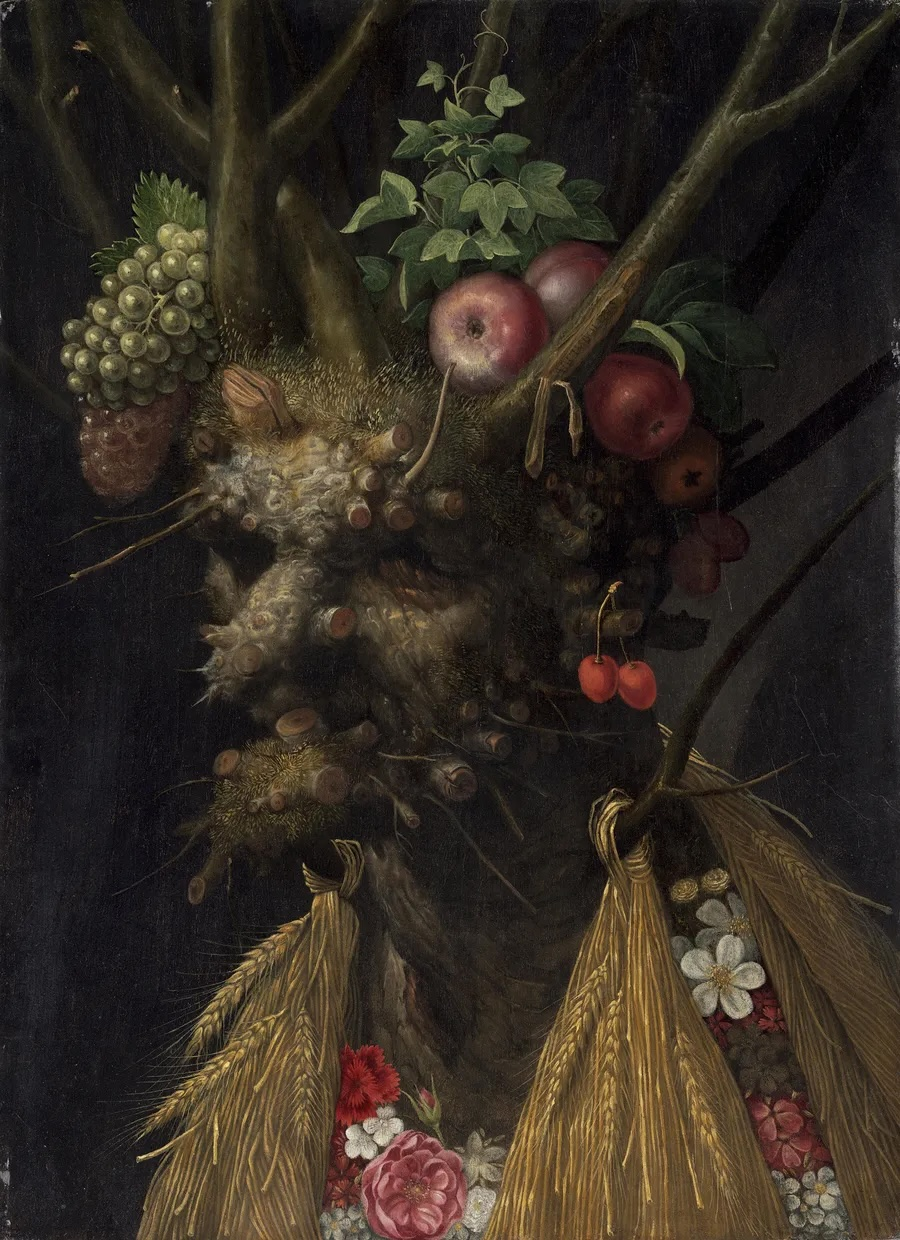
Giuseppe Arcimboldo’s Four Seasons in One Head is often described as witty, but the wit is only the doorway. Here, a portrait becomes a climate system: bark, fruit, leaves, blossoms, and rot assemble into a human likeness that is also a timepiece. The bizarre is not a rejection of realism; it is realism redirected. Arcimboldo records the conditions that make a face possible: seasonality, harvest, decay, abundance, loss. If the image unsettles, it is because it refuses our preferred fiction of a stable self, identity appears not as essence, but as arrangement, provisional and contingent.

Pere Borrell del Caso’s Escaping Criticism stages the bizarre as a literal breach in representation. A child climbs out of the painted world into ours, turning the picture frame into a threshold rather than a boundary. Trompe l’oeil here is not a technical flourish but a conceptual device. The urgency of the child’s movement gives the image its charge, the work suggests that images, when fully alive, press back against the systems that try to contain them, and that the act of representation itself may be insufficient to hold lived experience.

René Magritte’s Personal Values demonstrates how little needs to change for the familiar to become philosophically unstable. Everyday objects swell to monumental scale, while a private bedroom opens improbably onto the sky. The bizarre arrives through proportion rather than spectacle. Magritte asks a quiet but devastating question: how do we decide what deserves importance? The domestic becomes a testing ground for thought, and the viewer is forced to confront how easily comfort turns into domination when scale, context, and meaning slip out of alignment.

Giorgio de Chirico’s The Song of Love is bizarre not because it is chaotic, but because it is too calm. A classical bust, a rubber glove, a green ball, and a distant train sit in an architectural space bathed in stillness. Meaning feels present yet inaccessible, as though the painting knows something it refuses to explain. De Chirico’s metaphysical strangeness arises from precision rather than excess, where objects become emblems whose language we almost recognise, and the unease comes from that near miss.

Dora Maar’s Hand-Shell offers a quieter, more intimate form of disturbance. A hand and a shell merge into a single hybrid object that is sensual, uncanny, and meticulously constructed. The surreal does not appear as fantasy but as a deliberate pressure placed on bodily certainty, because the work destabilises the boundary between self and world, suggesting that the body is less contained than we imagine, and that touch itself can become strange when it is made visible.

Salvador Dalí’s Lobster Telephone is often reduced to a visual joke, yet its persistence suggests a deeper intelligence. By replacing a functional object with an animal form, Dalí reassigns meaning at the level of instinct. Communication becomes tactile, absurd, and faintly obscene, The bizarre operates here through displacement: when objects refuse their assigned roles, we are forced to confront how much of “normality” is simply agreement maintained by habit.

Joan Miró’s Object occupies a liminal space between sculpture, assemblage, and invented creature. The work is intimate and playful, yet carries a quiet solemnity, and materials that do not belong together are allowed to coexist until meaning emerges from adjacency rather than explanation. The bizarre here is composed rather than imposed. Miró demonstrates that strangeness can be structured, and that form itself can think.

Méret Oppenheim’s Squirrel is a study in oscillation. At once charming and unsettling, animal and object, humorous and disquieting, the work refuses to stabilise into a single emotional register. Oppenheim understood that the bizarre is most effective when it adheres to pleasure. Fur carries psychological charge, and here it trains sensation rather than resolving it. The viewer is held in a state of ambiguity, which becomes the work’s central ethical demand.

Robert Rauschenberg’s Monogram pushes the bizarre into physical space. The work insists that modern experience is already an assemblage of incompatible materials, and that art’s task is not to tidy those collisions, but to hold them. The strange here is expansive rather than nihilistic, granting even discarded matter a form of dignity.

Edith Rimmington’s Museum turns the institution of looking into a surreal problem. A museum promises preservation, neutrality, and order, however, Rimmington’s image suggests instead that objects retain psychic charge, and that viewing is never innocent. The bizarre does not sit solely in the imagery, but in its implication: attention leaves traces. The act of looking participates in what it observes, whether it acknowledges that responsibility or not.

Pierre Bonnard’s The White Cat demonstrates that the bizarre can be subtle. A domestic animal arches its back into an almost impossible curve, at once affectionate and untamed. The strangeness is not imposed; it is revealed through intensity of observation, and familiarity does not erase otherness. Bonnard allows the everyday to retain its wild interior, resisting sentimentality in favour of attentiveness.

Theodor Kittelsen’s The Water Sprite presents the bizarre as environmental rather than theatrical. The figure appears as suggestion rather than spectacle, embedded within water and landscape, therefore, nature is not backdrop but presence. The work restores an older understanding of the world as animate and responsive, where the human is not the sole measure of meaning. The bizarre here invites humility rather than fear.

Arthur Rackham’s By Day She Made Herself into a Cat treats metamorphosis as moral grammar rather than visual trick. A woman becomes a cat, and identity splits into public and private selves. The bizarre acknowledges doubleness without resolving it, and what makes the image humane is its acceptance of complexity: inner life is strange, and that strangeness is neither pathology nor error.

Alex Colville’s Woman on Diving Board belongs to a different register of the bizarre, one generated through precision rather than excess. The scene is composed with such restraint that the ordinary begins to feel staged. A figure poised above water becomes a threshold, holding freedom, discipline, vulnerability, and control at once. The uncanny emerges not through intrusion, but through clarity held too long.

Kent Monkman’s Duel after the Masquerade uses the bizarre as historical method. Masquerade and theatrical confrontation expose how power operates through performance and representation. The strange here is corrective, by exaggerating and reversing familiar codes, Monkman makes colonial narratives visibly unstable, insisting that history is neither natural nor complete, and that representation remains contested territory.

The bizarre occupies a space that is neither irrational nor purely symbolic. It operates in what might be called a zone of surplus: where meaning exceeds explanation, where sensation precedes interpretation. Thinkers from Aristotle onward have understood wonder as the beginning of knowledge, but the bizarre refines wonder by adding discomfort. It is not the astonishment of encountering something new, but the unease of recognising something familiar in an unfamiliar configuration. That recognition is destabilising because it implicates the viewer. The bizarre does not merely show that the world is strange; it reveals that our ways of organising the world are provisional, contingent, and often protective.
This is why the bizarre so often provokes resistance, it does not allow the viewer to remain neutral. To encounter it seriously is to accept that perception itself is historically conditioned, culturally trained, and emotionally defended. The bizarre interrupts those defences, it exposes how much labour goes into maintaining what we call “normal,” and how fragile that normality can be. In doing so, it also exposes power: the power to name, to categorise, to exclude, to render certain bodies, desires, and histories either visible or invisible.
Yet for all its capacity to unsettle, the bizarre is not inherently cynical. On the contrary, it often carries a quiet moral ambition. It refuses the lie that complexity can be solved by simplification. It resists the temptation to reduce human experience to stable identities, clean narratives, or consumable images. Instead, it insists on the coexistence of incompatible truths: that intimacy can be unsettling, that humour can wound, that beauty can disturb, that clarity can arrive through confusion rather than order.
When the bizarre troubles us, it is often because it is doing its work. It restores sensation to what habit has dulled, it keeps perception alive by refusing to let seeing become automatic. And in doing so, it offers a form of care that is neither sentimental nor cruel, but rigorously human: a commitment to complexity, to attentiveness, and to the difficult dignity of not pretending the world is simpler than it is. That commitment, sustained across centuries and styles, may be the bizarre’s quiet legacy. Not shock, not novelty, but the insistence that looking, when taken seriously, is a moral act.
CURRENT
GROUP EXHIBITION

UPCOMING
The Collaborators
Nettie Wild and Friends, Films and Installations

The Collaborators
Nettie Wild and Friends, Films and Installations
Opening February 28th, 2026
Above image: Scott Smith and Nettie Wild shooting Go Fish. Photo by David Boyes
CONTACT US
4-258 East 1st Ave,
Vancouver, BC (Second Floor)
GALLERY HOURS
Tuesday - Saturday,
11:30 AM - 5:30 PM
or by appointment
我们提供中文服务,让我们带您走入艺术的世界。