Canadian and American Art Collections

welcome to our
SATURDAY EVENING POST
October 3rd, 2026
By Diamond Kyle
Written with time, thought, and a human pulse.
The works we encounter in a museum have often passed through private homes, galleries and auction houses before entering a public collection. Their arrival brings individual tastes and interests into the histories through which a country comes to understand its art. American and Canadian collections offer a revealing comparison: they share many artists and cultural concerns, while drawing on different concentrations of wealth and institutional support. Those differences influence what can be acquired, which artists receive sustained attention and support, and how widely their work can be seen. Yet the collections themselves regularly cross the boundaries suggested by their national setting. Tracing how particular works entered these collections reveals the connections between personal conviction, public purpose and international recognition. It also raises questions that extend beyond the circumstances of any single acquisition: how do the choices of collectors and institutions shape what a country learns to value, and what can the differences between Canadian and American collections tell us about those choices?
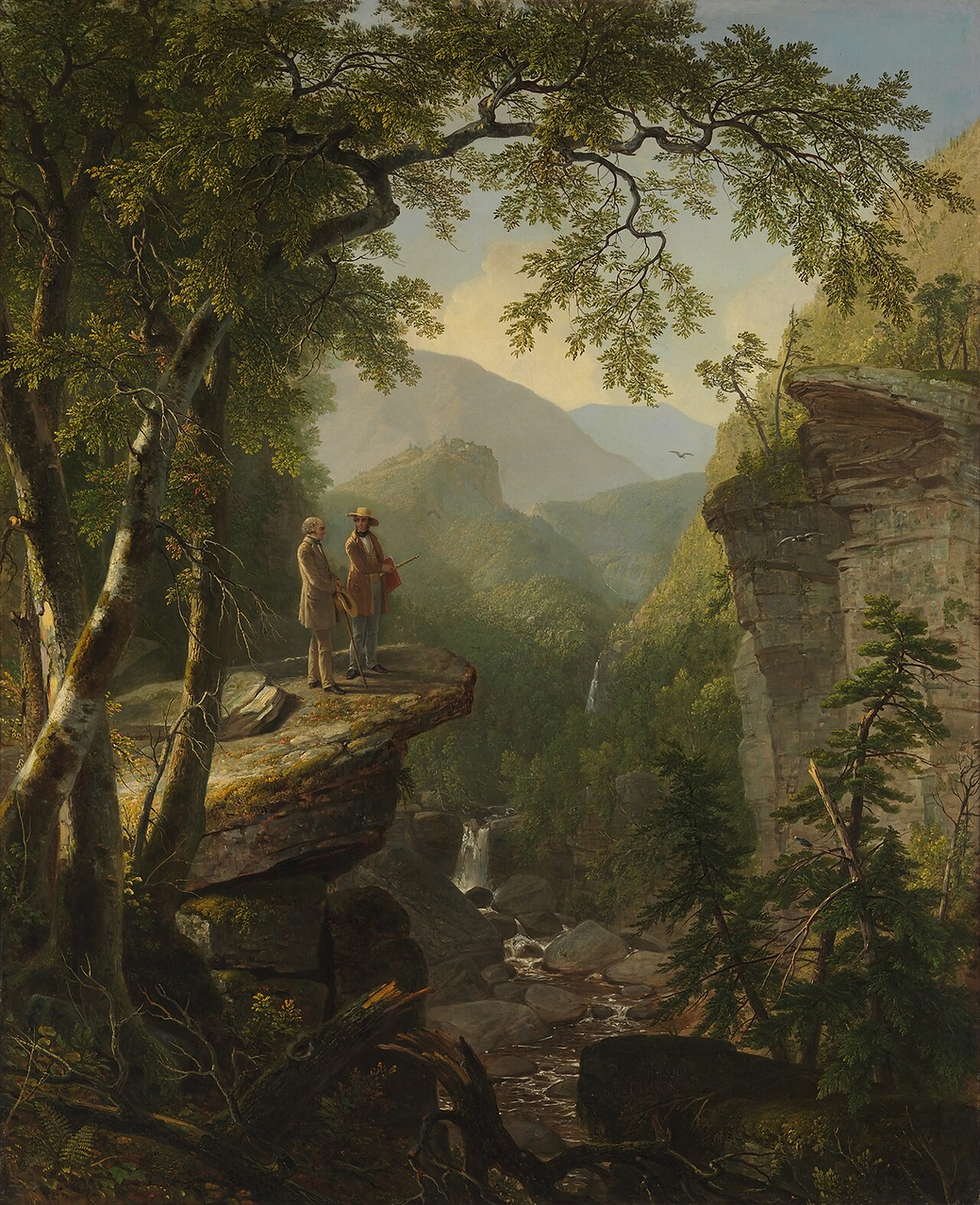
Landscape offers a familiar point of comparison, since it has helped shape national art histories in both countries. Asher B. Durand’s Kindred Spirits (1849), at Crystal Bridges in Arkansas, places the painter Thomas Cole and the poet William Cullen Bryant within an imagined Catskill landscape. Emily Carr’s Church in Yuquot Village (1929), at the Art Gallery of Ontario, depicts a white Catholic church amid dense forest in a Mowachaht/Muchalaht village on Vancouver Island. Both landscapes carry particular human histories: Durand honours two figures of American cultural life, while Carr records the presence of Christianity in an Indigenous community. Their places in public collections reflect further choices about how these national histories are preserved and presented. In 2005, a private foundation acquired Durand’s painting from the New York Public Library for Crystal Bridges; Carr’s entered the AGO through Charles S. Band’s 1970 bequest. Purchase and bequest provided different routes through which private resources and judgment helped shape public collections of national art.
The Durand acquisition formed part of a larger effort to broaden where American art could be encountered. Alice Walton founded Crystal Bridges as a charitable organisation in 2005 and contributed her collection to its holdings. When the museum opened in Bentonville, Arkansas, in 2011, it established a substantial collection of American art outside the country’s traditional art centres, with free general admission. Walton extended this commitment in 2017 through the Art Bridges Foundation, which supports the circulation of American art among institutions across the country, including those in smaller communities. This is a distinctly national collecting project sustained by private wealth, with an ambition that extends from acquiring significant works to widening their audience. It demonstrates how American collectors can invest deeply in their own cultural history while directing art and resources beyond the major cities most often associated with cultural authority.

These national collecting ambitions develop within the world’s largest art market. The 2026 Art Basel and UBS report estimates global sales of art and antiques in 2025 at US$59.6 billion, a 4% increase over the previous year. The United States accounted for 44% of that value, approximately US$26 billion, followed by the United Kingdom at 18%, China at 14% and France at 8%. Together, these four markets represented approximately 84% of global sales. These shares describe the geographical distribution of market activity; the nationalities of artists and buyers are separate considerations. A Canadian collector purchasing a European painting in New York contributes to the American market. Such concentration helps explain why a small number of commercial centres exert considerable influence over prices, visibility and the development of international reputations.
American dominance becomes more pronounced at the highest auction prices. In 2025, the US accounted for 78% of the worldwide value of fine-art auction sales above US$10 million, and all ten of the year’s highest-priced auction lots sold in New York. Globally, auction sales above US$10 million increased 30% in value, while sales below US$50,000 declined 2%. A growing total therefore does not describe an equally improving market for every artist or buyer. Nor does it measure artistic achievement. It does show how a small number of expensive transactions can direct attention towards particular artists, periods and collections.
The trade is broader than those auction headlines suggest. Dealers generated US$34.8 billion in 2025, while auction houses accounted for US$24.8 billion through public and private sales, approximately 58% and 42% of the total respectively. Public auction sales alone reached US$20.7 billion. Auction records primarily document resales, while galleries also support artists producing new work. The report’s combined Postwar and Contemporary category represented 45% of tracked fine-art auction value, yet its sales declined 2% to US$4.5 billion. Contemporary art can remain central to collecting while its resale market contracts. Museum recognition, studio activity and auction performance follow different measures and timetables.
Private wealth helps explain purchasing capacity without establishing a collector’s purpose. The 2025 Art Basel and UBS collecting survey found an average allocation of 20% of wealth to art among 3,100 surveyed collectors with high net worth across ten markets. However, Canada was outside that sample, so the finding cannot help us establish a Canadian-American difference in attitudes. Art also remains illiquid: a valuation does not guarantee a buyer at that price. Purchase, storage, insurance and eventual sale entail different costs. Wealth and auction results alone cannot establish a collection’s intellectual breadth or public contribution.
Ken Thomson’s collecting brings this relationship between private wealth and public contribution into a Canadian setting. In 2002, he paid £49.5 million (C$93.3 million) in London for Rubens’s The Massacre of the Innocents (c. 1610), which became part of the Thomson Collection at the Art Gallery of Ontario. The purchase belonged to a much wider collecting commitment: his gift added approximately 2,000 works to the museum, including more than 900 European objects and some 300 works by the Group of Seven and Tom Thomson. A sustained interest in Canadian painting developed alongside his engagement with medieval objects and European art. The breadth of that collection, and its availability for public study, give the expenditure a significance that the auction price alone cannot convey. Thomson’s purchase contributed to the British market; his gift enlarged the historical and geographical scope of a Canadian museum. International purchasing power became a means of building a public collection in Canada, where national commitments could be pursued alongside a wider account of art history.

Sam and Ayala Zacks pursued a similarly broad engagement with Canadian and international art. Their 1970 gift of Rita Letendre’s Méduse (1960) to the AGO places Canadian abstraction within this collecting history, extending the account of national art beyond recognisable landscapes. Following their marriage in 1947, the Zacks collected School of Paris, Canadian and Israeli art, as well as antiquities. Their gifts helped establish the AGO’s modern European collection, while their holdings were sought for museum loans internationally. As with Thomson, support for Canadian artists developed alongside wider collecting interests, their contributions brought these commitments into a public institution, allowing Canadian abstraction to be studied within a broader history of modern art.

The public life of such gifts also depends on the resources needed to preserve, research and exhibit them. The federal government’s 2025 heritage survey, reporting 2023 figures, records C$619.1 million in revenue for not-for-profit art galleries. Calculated from its tables, government funding supplied 45.4%; donations, including those from other charities, supplied 24.8%; earned revenue supplied 27.4%; and interest or investment income supplied 2.4%. These are institutional revenues, not Canadian commercial art sales or acquisition budgets. They support buildings, staff, research and programmes as well as collections. Although they cannot be directly compared with the American share of global sales, they establish the substantial roles of public funding and philanthropy in sustaining Canadian galleries.
Public policy further shapes the relationship between private giving and public collections. Canada’s cultural property certification encourages eligible transfers to designated public institutions through tax incentives, with certified fair market values informing their tax treatment. The US likewise recognises deductions for eligible charitable gifts of art, subject to valuation requirements. Gifts can substantially enlarge collections, as a recent donation to the National Gallery of Canada demonstrates. In March 2026, the Gallery announced 24 works from the Rennie family, bringing their donations since 2012 to 284. The new gift included American artists Kerry James Marshall and Christopher Williams alongside Canadians Brian Jungen and Jin-me Yoon. Through this donation, the international interests of a Canadian private collection became part of the national museum’s contemporary holdings.
The international reach of Canadian contemporary collecting is also evident in Kenneth Montague’s Wedge Collection in Toronto, which holds Sandra Brewster’s Untitled (Plain Black I) (2011–2012). Montague, a dentist, established the collection in 1997; its original gallery occupied the narrow hallways of his home. It now holds more than 400 works by artists from Canada, the United States and across the African diaspora, and lends to international exhibitions. Like the Rennie collection in Vancouver, Wedge combines a Canadian base with international interests. Montague’s sustained engagement with Black life and African diasporic culture gives these holdings a shared focus, connecting art made in Canada with artistic communities and histories elsewhere.

Njideka Akunyili Crosby’s Nkem (2012), acquired by the Rubells that year, provides an American counterpart to Montague’s engagement with diasporic experience. The Nigerian-born artist was a 2011–2012 artist in residence at the Studio Museum in Harlem, so the purchase coincided with a period of early institutional recognition. Her practice combines painting with transferred photographs, bringing Nigerian family life and popular culture into relation with her experiences in the United States. In a 2016 artist talk at the Whitney, she described how migration and generational differences had shaped these cultural relationships. An American collection thus accommodates histories that extend well beyond the country’s borders. The residency, museum presentations and private acquisitions represent distinct forms of support, each contributing to an artist’s development and recognition. Auction prices subsequently record resale-market outcomes, so they cannot account for the full history of that support.

The distribution of such support also affects whose work enters collections. Across the international dealer sample in 2025, women accounted for 45% of represented artists and 37% of sales by value. These figures describe gallery representation and commercial activity, rather than museum holdings, but the difference is significant: a broader presence among represented artists does not necessarily translate into an equivalent share of sales value. Collectors participate in this process through their purchases. They can reinforce established prices and reputations, or commit to work before its recognition is secure. Particularly when purchases are made through galleries working directly with artists, those decisions help sustain careers and influence the body of work from which future public collections will draw.
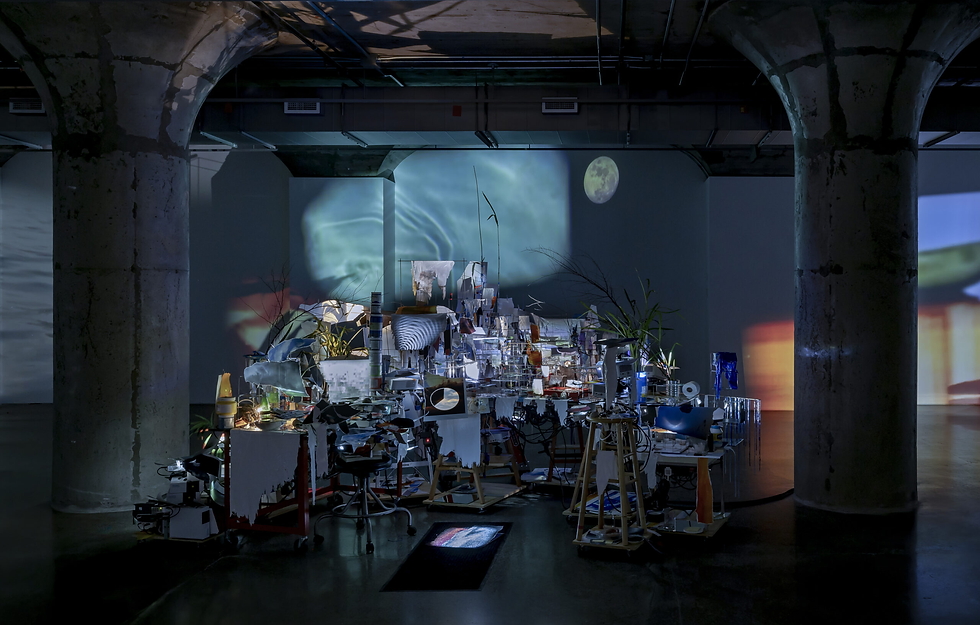
That commitment continues after acquisition, and its demands vary considerably with the work. Sarah Sze’s Images in Debris (2018), lent by Audrey and David Mirvish to MOCA Toronto in 2020, brings objects, projected images and the surrounding architecture into a complex installation requiring space and technical support. The loan made a work from a Canadian private collection available through a public exhibition of an American artist. Roni Horn’s Pink Tons (2008), at Glenstone in Maryland, presents different physical demands: the solid cast-glass cube measures more than a metre on every side. Established by Emily Wei Rales and Mitchell Rales and opened in 2006, Glenstone offers free admission. Both examples show how the public contribution of collecting depends on the arrangements made for installation, care and access, as well as on the acquisition itself.


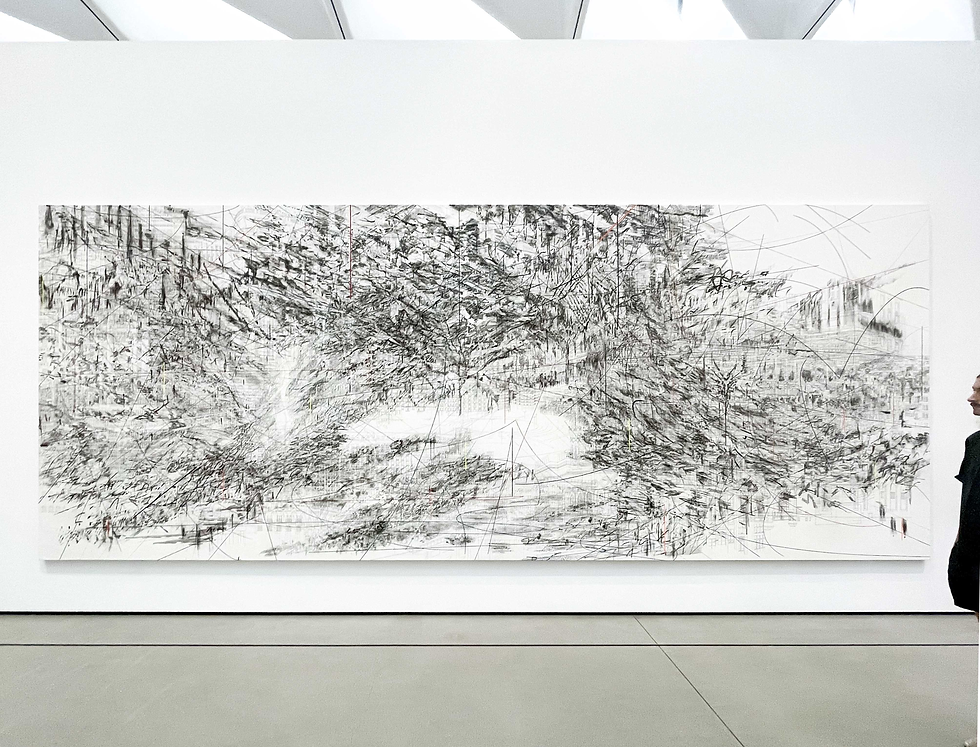
Julie Mehretu’s Cairo (2013), at The Broad in Los Angeles, likewise requires substantial exhibition space: its canvas stretches more than seven metres across. Architectural references to Tahrir Square connect the painting to the 2011 uprisings and to the accumulated political history of the city. An American collection gives public visibility to a work concerned with Egypt and collective political action. Founded by Eli and Edythe Broad, the museum houses more than 2,000 works and offers free general admission. The Broad Art Foundation, established in 1984, has also made more than 9,000 loans to institutions worldwide. The significance of private wealth lies partly in these commitments after purchase: maintaining exhibition space, supporting research and enabling circulation. Public presentation brings international art to local audiences, while lending allows a collection’s reach to extend beyond its permanent home.
The commercial circulation of art places continuing demands on galleries as well. In 2025, dealers’ operating expenses increased by an average of 5%, outpacing sales growth of 2%. Packing, shipping and logistics costs rose 10%, while art-fair costs rose 9%; fairs generated 35% of dealer turnover. These figures concern dealers’ businesses rather than museum lending programmes, but they reveal the expenditure required to bring work before audiences and buyers. Exhibitions, transport and participation in fairs must be financed even when sales improve only modestly. Purchases through galleries help sustain this activity alongside artists’ production. Headline auction prices tell us little about whether the businesses introducing artists, organising exhibitions and maintaining relationships have the resources to continue that work.
What this financial and institutional support makes possible is also a question of historical consequence. Rebecca Belmore’s blood on the snow (2002), in the Mendel Collection at Remai Modern, was purchased in 2004 with assistance from the Canada Council for the Arts and the Mendel Art Gallery Foundation. A white chair marked with red paint stands within a broad expanse of white fabric. In an account reproduced on Belmore’s website, critic Lee-Ann Martin connects the installation with the massacre at Wounded Knee and the 2002 discovery of missing women’s remains outside Vancouver. These references cross the Canadian-American border, bringing separate histories of violence against Indigenous people into relation. The acquisition gives those histories an enduring place in a Canadian public collection. Alongside the landscape tradition discussed earlier, it establishes another responsibility for national art history: to acknowledge the violence that familiar accounts of land and belonging have often obscured.

Amy Sherald’s Precious Jewels by the Sea (2019), purchased by Crystal Bridges in 2020, similarly broadens the American histories represented within that collection. Its contemporary Black beachgoers belong to the same holdings as Durand’s nineteenth-century landscape, extending the museum’s account of American life through different subjects and experiences. Kent Monkman’s History is Painted by the Victors (2013), given to the Denver Art Museum by Vicki and Kent Logan, brings a Canadian Cree artist’s critique of historical painting into an American institution.


Canadian institutions have their own history of selective recognition. Founded in 1880, the National Gallery of Canada purchased its first work by a First Nations artist for its contemporary art collection only in 1986: Carl Beam’s The North American Iceberg (1985). That chronology complicates any easy description of Canadian collections as naturally centred on Indigenous storytelling. The Gallery’s subsequent commitments developed within an institution that had long failed to recognise contemporary First Nations art through its acquisitions. National identity emerges through the subjects a collection promotes, but also through the omissions it has allowed to become customary. Acquisitions such as Beam’s therefore do more than enlarge the holdings. They alter the evidence available to viewers, teachers and historians, challenging the boundaries through which Canadian art has been understood.
Canada’s emphasis on national culture has historical reasons. Part of the rationale for establishing the Canada Council in 1957 was to strengthen Canadian cultural expression in the face of American and other foreign influences; developing cultural relations abroad also belonged to its founding purpose. National support and international exchange were therefore connected from the outset. Supporting Canadian artists can sustain the conditions in which they work. Expecting their work to affirm a recognisable national identity, however, can narrow the range of practices considered worthy of attention. Collecting becomes inward looking when familiar subjects or established national reputations become tests of relevance. International acquisitions offer no automatic guarantee of openness either. A collection of internationally approved names can be as predictable as one organised around inherited national preferences. Both local commitment and international curiosity depend on the willingness to judge individual works beyond these familiar assurances.
Recognition abroad can enlarge an artist’s opportunities while introducing expectations about national character. Jean-Paul Riopelle’s first Paris solo exhibition took place in 1949. André Breton’s description of his painting as the “art of a superior trapper” associated his abstraction with an imagined Canadian wilderness. By 1953, Pierre Matisse was showing Riopelle in New York, with regular exhibitions following from 1954. His growing recognition in Paris opened connections with American commercial networks, even as his Canadian origins supplied foreign critics with a framework for interpreting the work. International success could thus expand an artist’s audience while narrowing the terms of his reception. National identity travelled with the painting, sometimes becoming a category through which it was understood and promoted.
Jack Bush followed a different route. He remained based in Toronto while developing relationships that brought his work to American audiences. His connection with Clement Greenberg began in 1957; his international breakthrough included a 1962 exhibition at the Robert Elkon Gallery in New York and participation in Greenberg’s Post-Painterly Abstraction in 1964. His career distinguishes leaving Canada from building recognition abroad. Access to critics, galleries and exhibitions could extend an artist’s audience without requiring a permanent departure. For Canadian collectors, these histories raise a consequential question: does foreign recognition inform their judgment, or become a prerequisite for making it? International relationships can bring valuable scrutiny and opportunity. Sustained support at home, before an international consensus develops, gives artists greater room to work and helps Canadian institutions participate in establishing significance rather than waiting to inherit it.

The strength of the American collections discussed here rests on a concentration of private wealth, an international market that attracts art and buyers from across the world, and institutions able to sustain ambitious acquisitions through research, exhibitions and lending. Their collectors have helped establish the means through which personal choices become part of public art history. A work’s influence grows as successive audiences encounter it, scholars study it and other artists respond to it. Canadian collecting has demonstrated comparable intellectual ambition through commitments to national art, international modernism and contemporary practices that cross geographical and cultural boundaries. Its public contribution has likewise depended on relationships between private collectors and public institutions. The clearest American advantage is the scale of resources available to sustain these relationships. For Canada, the question is how to give the ambition already present in its collections greater continuity and reach. The quality of a collection depends on the judgment behind its acquisitions, and its wider influence depends on the opportunities those works receive to enter cultural life.
For Canadians, this is also a question of cultural confidence. Can we recognise the significance of work made here before a foreign museum, critic or auction house confirms it for us? Bush’s career demonstrates the value of international relationships, while the collections of Thomson, the Zacks and Montague show how commitment to Canada can develop alongside curiosity about the wider world. Neither requires Canadian identity to remain a fixed set of subjects or appearances. A national collection becomes more substantial when different accounts of the country can meet within it, including those that challenge familiar understandings of land, history and belonging. There must be room for artists whose work offers no recognisable landscape, whose histories cross borders, or whose practices resist expectations about what Canadian art should look like. Collectors help determine whether those artists receive sustained support or remain peripheral to the histories eventually taught. Using money well involves recognising what a purchase can make possible: the continuation of a practice, serious attention to an overlooked career, or a relationship between works that changes how both are understood. Such commitments require knowledge and conviction, particularly when an artist’s importance has yet to be discovered. They also require the willingness to discover that established judgments, including our own, may need revision.
That confidence must remain answerable to the authority collecting confers. When private taste enters a public museum, it helps shape what future audiences understand as significant, representative and worthy of preservation. Whose histories acquire permanence through those decisions, and whose remain absent? How much freedom do curators, artists and communities have to question the account a collector has assembled? These questions apply to existing holdings as fully as to new acquisitions. Public responsibility extends beyond making works available, it includes examining how they were obtained, what their presentation implies and which perspectives their interpretation admits. A collection earns trust through the knowledge it produces, the access it enables and the honesty with which it examines its own formation. Canadian collectors can build collections of consequence by accepting this broader responsibility for what their money preserves and promotes. The ambition should be to leave future audiences a richer account of art, together with the freedom to question and extend it. What kind of cultural inheritance are we creating, and who will have a meaningful part in determining its value?
UPCOMING
2026 Fall Group Exhibition
Opening Reception
Next Saturday, October 10th, 1:00 - 5:30 PM

We are pleased to present our latest group exhibition, featuring works by Bernadette Phan, our newest gallery artist, alongside new works by Ronald T. Crawford and Marion Landry. The exhibition also revisits Daniel Mullen’s work from our recent exhibition, Echoes, selections by other beloved gallery artists, and recent secondary market acquisitions. We look forward to welcoming you to the gallery to discover these new additions and revisit familiar favourites.
Above image: Bernadette Phan, Peace Song, 2021, Oil on canvas, 48 x 36 inches.
Photo by Kyle Juron © Paul Kyle Gallery. Work available, please inquire.

CONTACT US
4-258 East 1st Ave,
Vancouver, BC (Second Floor)
GALLERY HOURS
Tuesday - Saturday,
11:30 AM - 5:30 PM
or by appointment
我们提供中文服务,让我们带您走入艺术的界。


