Fall Group Show Opening

welcome to our
SATURDAY EVENING POST
October 10th, 2026
By Diamond Kyle
Written with time, thought, and a human pulse.
At today’s opening of our Fall Group Show opening, the pleasure of welcoming people into a newly arranged gallery was matched by the pleasure of seeing how carefully they looked, giving each work their attention and bringing thoughtful questions to the artists who joined us. Their enthusiasm found expression in the exchanges that developed around the paintings, where an observation about a colour or a surface could lead into a discussion of how a work began, how it changed, and the decisions that brought it to completion. There is something deeply rewarding about standing before a work while speaking with the person who has spent so much time bringing it into being, and discovering how much remains available to be seen.
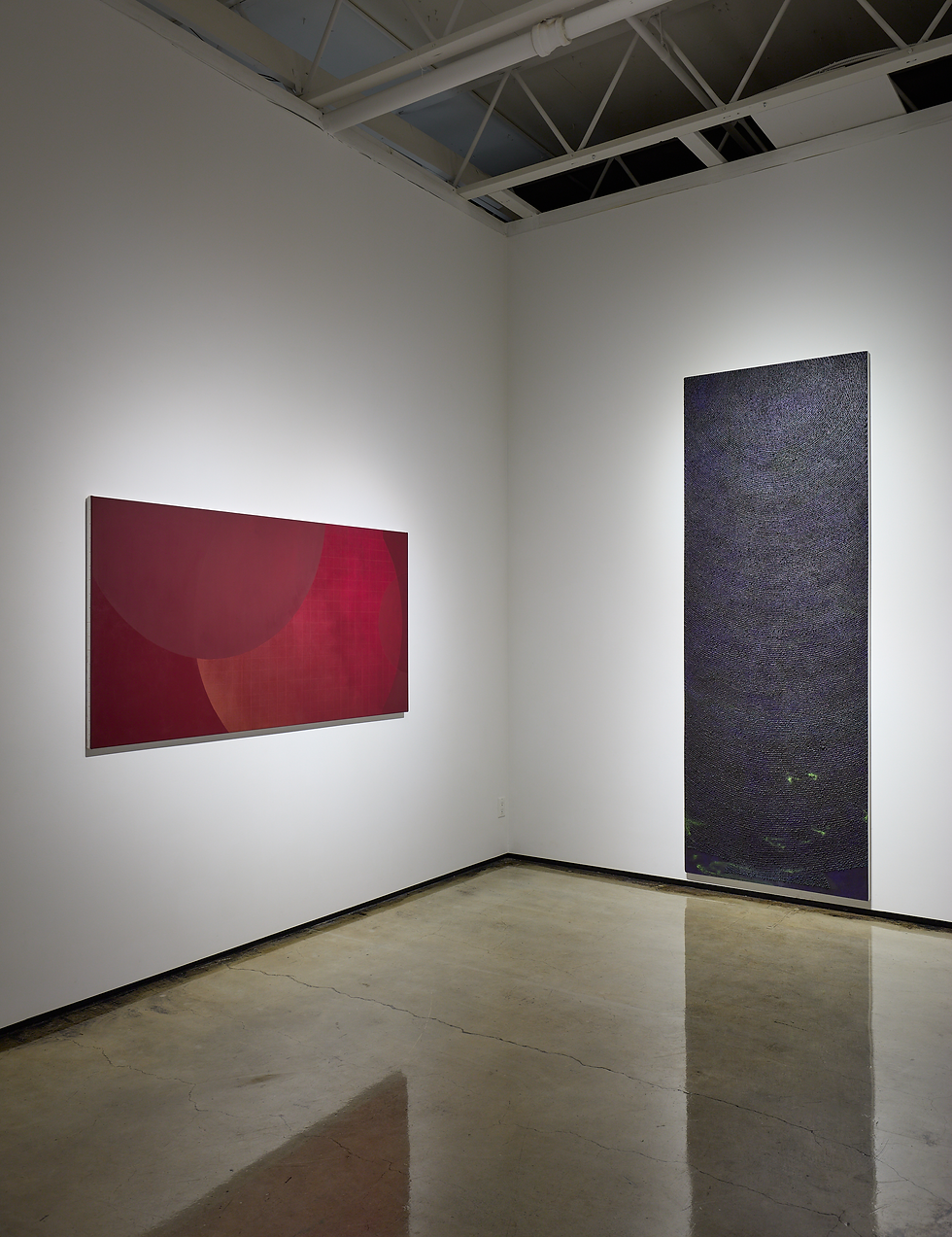
With each new installation, familiar works acquire different surroundings, and the gallery becomes a place in which we can reconsider what we thought we knew. Across this exhibition, affinities emerge between paintings made through remarkably different approaches. A densely marked surface can sharpen our sensitivity to the restraint of another composition and a geometric arrangement can make us more conscious of the irregularities of a handworked plane. Such comparisons draw attention to texture, proportion, spacing and the organisation of colour, allowing formal relationships to become evident across otherwise distinct practices. Giving each piece the space to establish its own presence makes these connections easier to perceive. The exhibition develops through both the individual encounter with a work and the broader relationships visitors discover as they move through the gallery.

Process gives the exhibition much of its coherence. These works explore light, mood and geometry through sustained encounters with materials, and their final forms retain evidence of the time and thought invested in them. Repetition, adjustment, accumulation and the responsiveness of a surface all have a part in determining what becomes visible. Looking closely, we begin to recognise how a seemingly simple arrangement might depend on a considerable history of choices, or how a richly textured field might grow from a remarkably economical gesture. The sustained attention required to make these works finds a counterpart in the attention they invite from viewers. Their material construction is integral to their visual effect, influencing how colour is perceived, how depth is established, and how the work changes with viewing distance and light.
Bernadette Phan’s paintings, presented in the gallery for the first time, bring an extraordinary density of touch to this conversation. Their thousands of individual marks invite us to move between the impression of the whole and the particularity of each small deposit of paint. At close range, the raised points catch light differently, revealing a surface whose apparent continuity contains innumerable variations. Our sense of the painting changes as we recognise how much depends on these modest differences, and how a repeated action can sustain such complexity. Each mark belongs to an overall structure while retaining the particular circumstances of its making, giving the surface both a consistent rhythm and an unmistakable record of individual decisions.


In Marion Landry’s paintings, geometry offers a means of examining the subtleties of light and atmosphere. Her freehand approach preserves the presence of the body within carefully measured relationships of colour and form, giving their order a human sensitivity. Her paintings make perception a bodily and spatial experience, drawing attention to how our position before a work contributes to what we see.


Revisiting paintings from Daniel Mullen’s Echoes exhibition extends this investigation of perception. The relationship between colour and the linen’s weave produces a luminosity that changes with distance, gradually revealing the structure within what initially appears to be a field of light. Returning to these works in different company gives their subtle shifts a fresh context. That responsiveness to light takes on another material character in Ronald T. Crawford’s new work. Working with plaster and acrylic, Crawford carves, sands and paints his surfaces, giving them a physical depth through which shadows become part of the image. Their worked textures suggest the effects of weathering, connecting the deliberate actions of the studio with processes of erosion and change. Seen alongside Mullen’s paintings, Crawford’s relief makes the relationship between actual depth and perceived depth particularly interesting. Both artists examine how a surface establishes spatial experience, approaching that question through distinct uses of material.


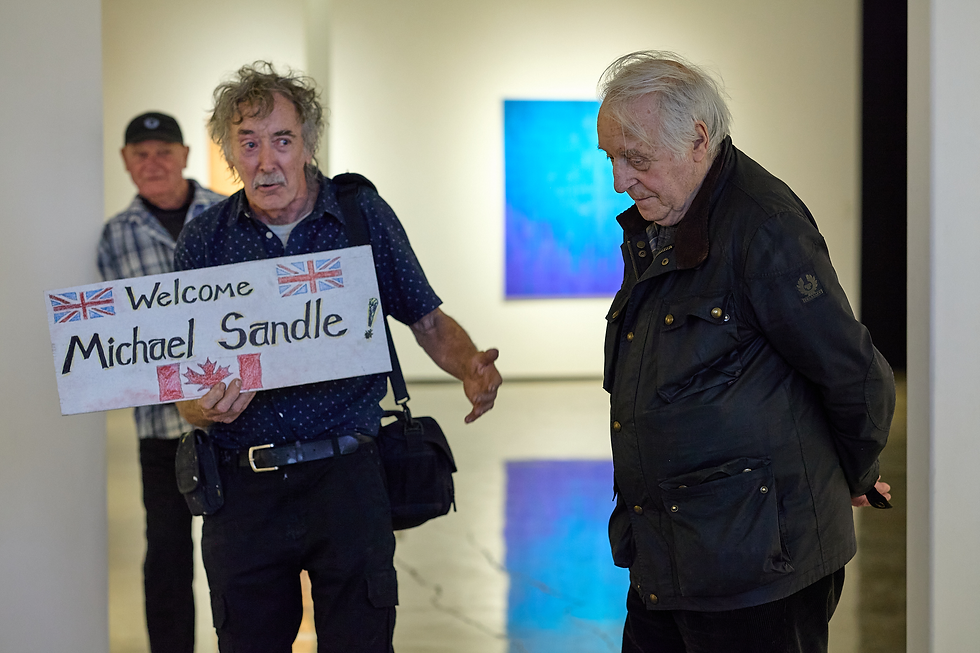
We were especially pleased to welcome George Rammell, whose sculpture Night Walker is included in the exhibition, and grateful to him for bringing British sculptor and artist Michael Sandle to the opening. Michael’s long experience as a sculptor and teacher brought another depth of perspective to the afternoon’s conversations. He spoke trenchantly about art, the experience of viewing it, and the encounters that have shaped his own engagement with it over the years. His candour was invigorating, and we appreciated the opportunity to hear someone speak with such conviction about questions central to the life of a gallery. His recollections reminded us that an understanding of art develops through accumulated experience, through works that remain significant to us, judgments we reconsider, and discussions that continue to inform how we work and look. Within an exhibition concerned with the sustained work of making, his reflections added a valuable consideration of how sustained engagement shapes our capacity to see and assess art. Our warm thanks to George for making the encounter possible, and to Michael for sharing his time, insight and experience so generously.


Works by Jack Bush and Robert Mangold in the show extend these conversations across generations. There is a particular pleasure in seeing the newer works meet these enduring paintings with such conviction, each sustaining its own presence while making the others available to renewed attention. Shared concerns with proportion, rhythm, surface and colour become clear, even as the artists arrive at distinctly different resolutions. The strength of these juxtapositions lies in the specificity of each contribution: the contemporary works pursue their own investigations while participating fully in questions that have occupied painters for generations. These relationships also keep the historical works open to reconsideration.
Thank you to everyone who joined us today, and to the artists whose presence made these exchanges so rewarding. We are grateful for the curiosity and care you brought to the works, and for making the gallery part of your Thanksgiving weekend.


Above photos by Kyle Juron ©Paul Kyle Gallery

CONTACT US
4-258 East 1st Ave,
Vancouver, BC (Second Floor)
GALLERY HOURS
Tuesday - Saturday,
11:30 AM - 5:30 PM
or by appointment
我们提供中文服务,让我们带您走入艺术的界。