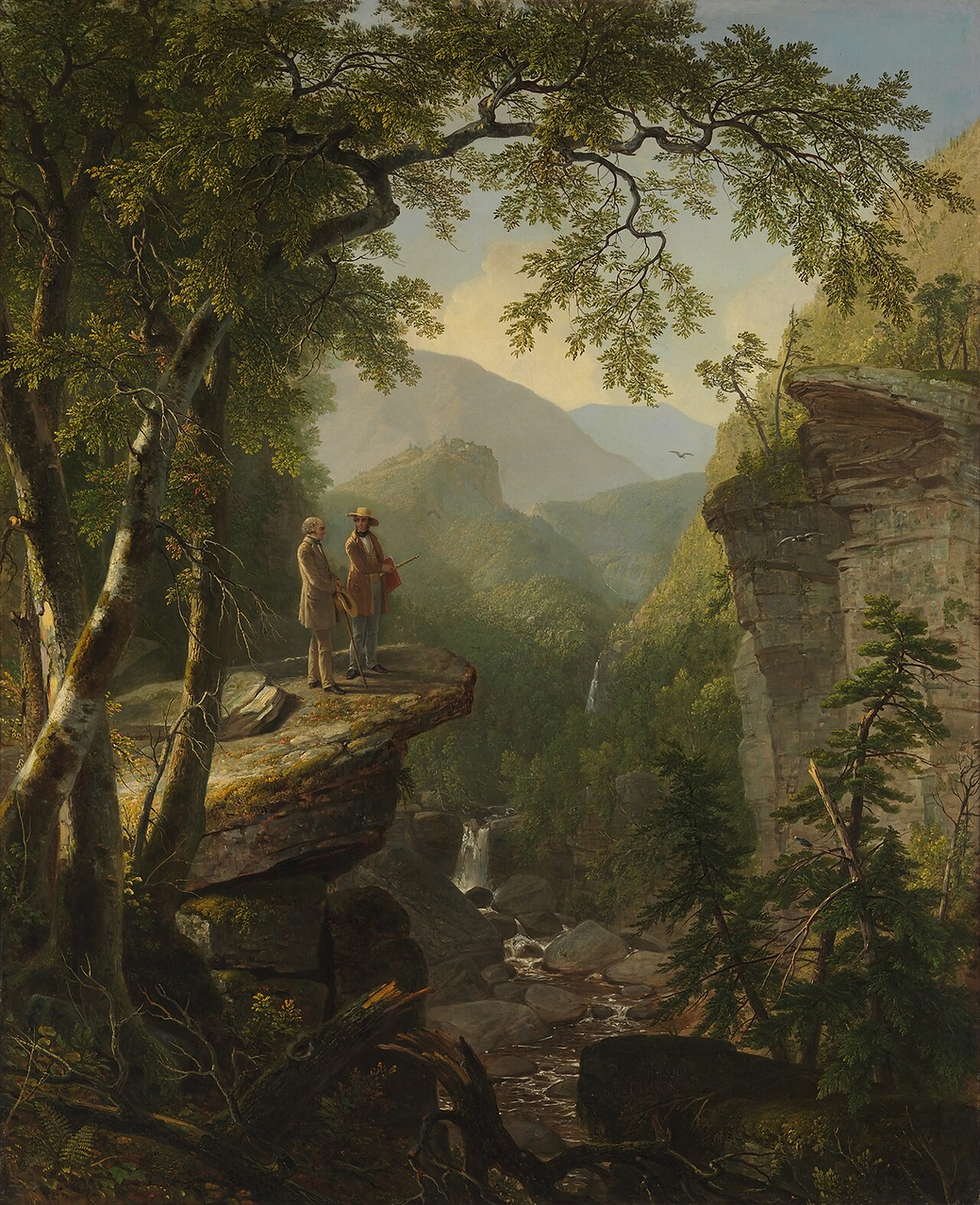
Intended Scale in Painting

welcome to our
SATURDAY EVENING POST
April 25th, 2026
By Diamond Zhou
There are paintings you look at, and there are paintings you step into. Some hold themselves within a parameter and ask for concentration, closeness, and a kind of intimate attention. Others do something far stranger, they rise to the scale of the body and gather your peripheral vision. They alter the room before you have even fully understood what they are doing. You do not simply stand in front of them and inspect them, you enter their terms.
That is why scale is of importance. However, large is not automatically better, and small is not automatically modest. Scale is not a constraint of dimensions, it is a decision about how a work wishes to meet us. Some paintings need to be encountered at arm’s length, where their force lies in compression, exactness, and privacy. Others need enough room to breathe, to spread, to become atmospheric and bodily, to make the viewer feel not like a detached observer but like a participant in a visual event. A painting finds its true scale not when it becomes as big as possible, but when it reaches the size at which it becomes fully itself.
Art history is full of works that think in more than one scale at once. There is the small work that is complete in itself, needing nothing larger to justify it. There is the sketch or study that carries the first spark of an idea later unfolded into something more public and commanding. And there is the large painting that does not merely occupy wall space, but changes the experience of space itself, becoming almost architectural in its effect. These are not simply different sizes of the same thing, they are different forms of address, different ways of placing art in relation to the body, to time, and to the way a work should be viewed.
This is more and more relevant, because so much looking happens on screens, where everything is reduced to the same glowing rectangle. Even we are guilty of that for presenting and reading these posts, perusing through the images that we encounter together on a screen. The mural and the oil sketch, the intimate drawing and the room-sized canvas, are flattened into a false equality. But artists have always known that scale is not incidental, it shapes how a work is felt, how it unfolds, and how long it can engage us.

It is easy to speak about scale as though art were always trying to become bigger, as though the small work were merely the larval form of something more public, more commanding, or more “complete”. But that is not how artists work, and it is not how serious looking works either. Smallness teaches a necessary humility, it is not failure, not hesitation, and not the embarrassed prehistory of monumentality. Some works need to be held close. their force depends on compression, restraint, and the fact that they do not try to conquer the room. They ask for nearness, intimacy, and close examination.

Landon Mackenzie’s works on paper have been described not as preparatory studies for the large canvases but as a parallel practice. That single distinction clears away a great deal of bad thinking. A work on paper is too often treated as rehearsal, as though the real performance must happen elsewhere and on a larger wall. But Mackenzie’s smaller works do not feel apologetic or incomplete. They think differently. They move differently. They hold notation, geography, memory, and feeling in a tighter field, and their intimacy is part of their intelligence. They are not waiting to become murals. They are already where they need to be.
Not every small work dreams of enlargement, sometimes it has already found its exact form. Sometimes its authority lies in staying near the hand and near the page. A large canvas may surround the body; a small work can gather the mind with extraordinary force, it can feel private without being minor, compressed without being slight.


The same idea extends to Marion Landry, who often moves through smaller sketches on paper in the development of larger works. But the small works are never merely studies. Each carries its own composition, temperament, and sense of completion, and at their best they stand as fully realized works in their own right.


Scale, then, is not a ladder of importance, it is a difference in address. Some works want to be encountered in a zone of intimacy, where the eye can settle. Vermeer remains one of the great reminders of this. A painting like Young Woman with a Water Pitcher would not become better by becoming bigger, it would become worse. Its stillness depends on containment; its power depends on measure. Blow it up to mural size and you do not intensify it, you destroy the very terms on which it lives.

If some small works are complete in themselves, others do lean forward. They prepare a different kind of arrival. They open onto the wall, onto distance, onto a more public and commanding form of presence. But even here the sketch should not be misunderstood, it is not a tiny version of the final work waiting obediently to be enlarged. It is often looser, riskier, quicker, more exposed. It is where an artist tests rhythm, mood, structure, and the first emotional intensity of an image before those elements are reorganized in a larger work.
Tom Thomson’s small oil sketches, made outdoors in Algonquin Park, were not minor works in the dismissive sense. They were acts of direct contact: fast, weather-struck, alert to unstable light and passing sensation. Later, in the studio, those same motifs became larger canvases. Something changed in the process: the sketch held immediacy, while the larger painting gathered, edited, and sometimes re-imagined. One carried the shock of seeing; the other carried the authority of form. Thomson did not simply enlarge his sketches, what he really had done was translated them from one condition of painting into another.


That is why the sketch should not be confused with the unfinished, because it is already alive as painting. Often it carries a candour and velocity the larger work cannot keep, even when the larger work gains strength and order. The studio painting is not the correction of the sketch, it is another answer to the same encounter. Artists often need both scales because they are solving two different problems at once: how to seize the moment, and how to give it durable form.
In Lawren Harris’ small studies, contour, pressure, and structure are being searched out. In the larger paintings, the image becomes less observed than declared. A mountain ceases to be simply a mountain and begins to assume the force of an emblem. Harris does not just make the motif bigger, he changes its temperature. The intimate act of looking hardens into a more public stillness, something formal, severe, nearly devotional.


For Pablo Picasso, the preparatory studies for Guernica are restless, searching, unstable, figures appear, shift, disappear. In the final mural, those trials lock into a public image vast enough to bear catastrophe. The studies do not simply precede the painting, they hold open the field from which the painting is drawn. They preserve doubt, speed, and experiment. The mural answers with scale, finality, and historical force.


Plenty of works are big. However, far fewer are spacious in the deeper sense, large enough not only to occupy a space, but to change the terms of looking. At that scale, a painting stops behaving like an image you take in all at once and begins to behave like an environment. The eye must travel, and the peripheral vision comes into play. The body must stand there, adjust itself, and remain looking, searching, and sometimes simply idle. What you are experiencing is no longer only composition, it becomes duration, proportion, atmosphere, and a bodily experience.
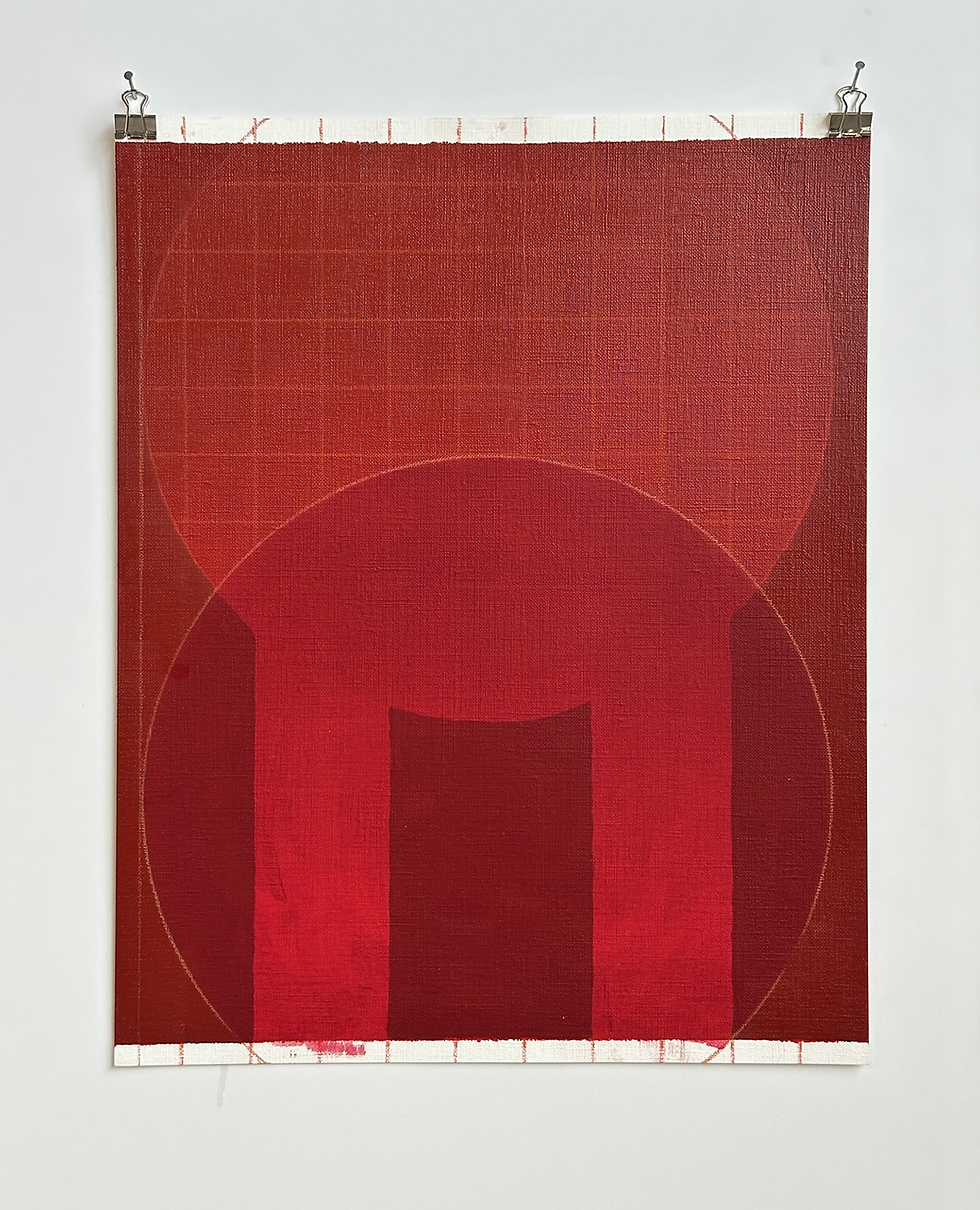
Daniel Mullen’s recent large paintings do not use scale to deliver daunting grandeur; the large scale is used to slow the eye down. In front of them, you cannot simply collect the forms into one neat instant of understanding and move on. The painting makes you stay with it. Geometry loosens, and structure becomes pulses and vibration. You begin by reading shape and relation, but after a while the work stops feeling like a set of formal decisions and starts feeling like a field, something you have entered rather than decoded. That is where scale does its real work. It gives the painting enough room to stop being an object and start becoming a condition, a condition you become part of, and start to experience something we call “sublime”.


These Mullen paintings remind us of Mark Rothko’s, in the way that these large canvases generate a chamber. For Rothko’s work, the colour does not stay put, it advances, recedes, hovers, darkens, and brightens the air. A painting like that cannot be reduced to a thumbnail. Reproduction can tell you where the forms are, but it cannot tell you what it is to stand there long enough for the painting to alter your heartrate, lower your breathing, and gather your thoughts into its sombre atmosphere. Rothko’s scale is not theatrical, it is devotional.


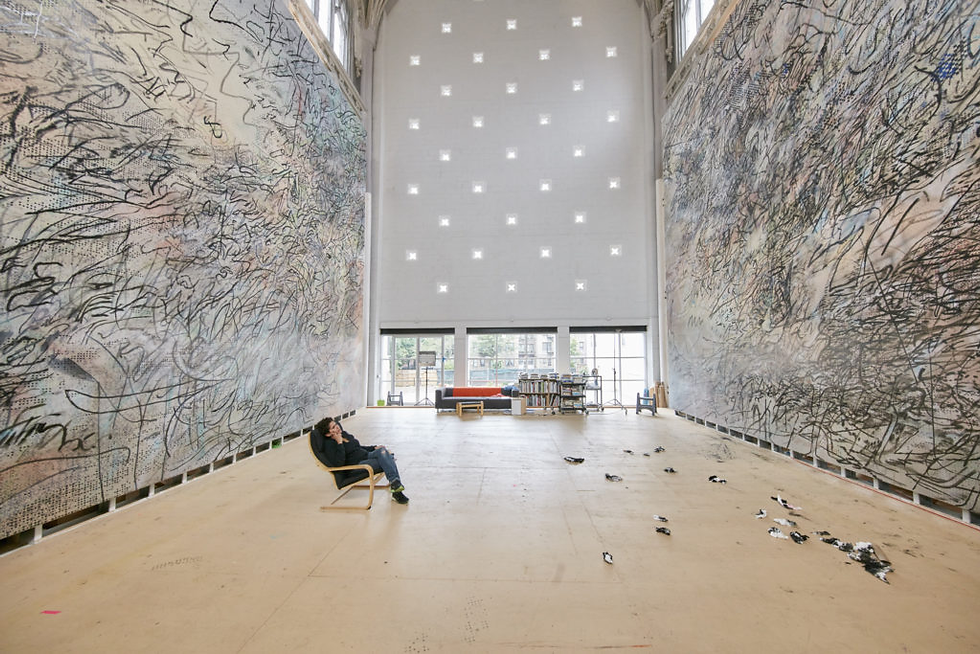
Julie Mehretu belongs in this company too. Her large paintings do not envelop the viewer through stillness but through turbulence. Layer upon layer of marks, architectural fragments, vectors, smudges, and eruptions gather into surfaces so expansive that they can no longer be read in a single glance. In her large paintings, scale becomes the condition that allows complexity to remain alive. The eye moves restlessly across the canvas, trying to gather order out of motion, only to be set loose again. Mehretu makes largeness feel less like monumentality than like exposure to the speed and instability of the contemporary world.

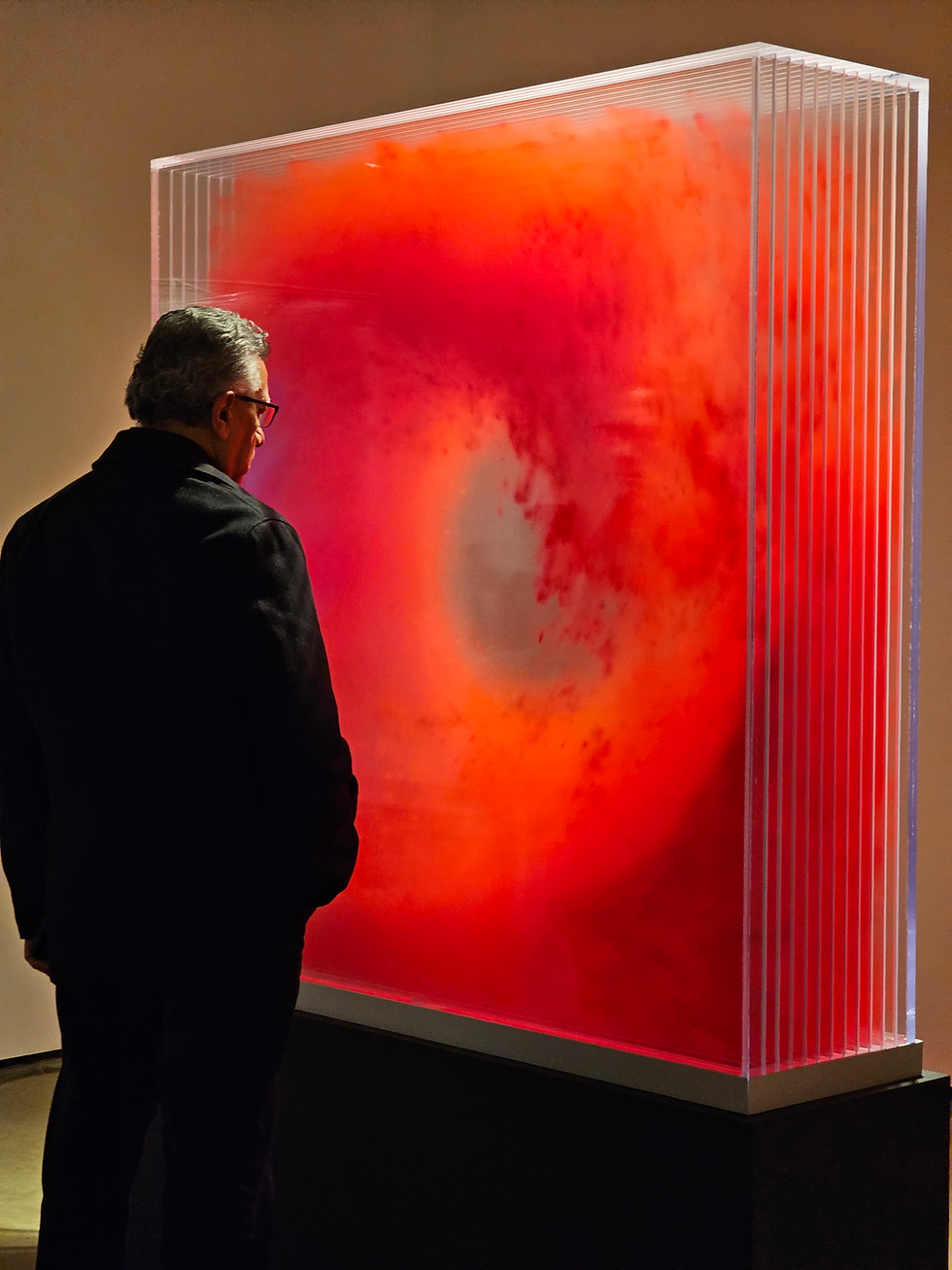
David Spriggs offers another way of thinking about scale. His large layered works, built from transparent painted planes, seem to hover somewhere between image and object, painting and sculpture, apparition and structure. Because the forms are distributed across space rather than fixed on a single surface, the viewer has to move in order to see them fully. They shift with angle, distance, and position. Spriggs makes scale feel less like monumentality than like suspension: not a mass placed before the body, but an image released into space and made bodily through movement. His work reminds us that scale is not only a matter of size, it is also a matter of where, and how, a work comes into being for the viewer.


In the end, the question is not only how art occupies space, but how it teaches us to occupy our own. To stand before a work that has found its right scale is to be reminded that form is never neutral, and that attention itself has an ethics, a discipline, even a kind of grace. We live in a culture that encourages haste, reduction, and the easy substitution of access for experience; yet the best works resist all of that. They restore a sense of balance, not only to the eye, but to thought. They ask us to become equal to what is before us through patience, receptivity, and the willingness to be changed by encounter. Perhaps that is one of art’s quietest but most enduring powers: not simply to give us something to admire, but to recalibrate our sense of presence, so that for a moment we are no longer moving too quickly, consuming too casually, or seeing too little. We are simply there, fully addressed, and returned to a fuller awareness of the world.
CURRENT EXHIBITION

UPCOMING EXHIBITION
BURTYNSKY: HUMAN/NATURE
Opening: Saturday, May 30th
Invitation Forthcoming


CONTACT US
4-258 East 1st Ave,
Vancouver, BC (Second Floor)
GALLERY HOURS
Tuesday - Saturday,
11:30 AM - 5:30 PM
or by appointment
我们提供中文服务,让我们带您走入艺术的世界。