The Soul

welcome to our
SATURDAY EVENING POST
May 2nd, 2026
By Diamond Zhou
When Harry Malcolmson was here recently, we had a conversation about a sentence by John Ruskin that I had used to open another post: “The greatest thing a human soul ever does in this world is to see something, and tell what it saw in a plain way.” I had chosen the line because I loved its clarity and its insistence that seeing is not a casual act. But Harry paused over the word: soul. What did Ruskin mean by it? Had I considered what the word would have meant in the nineteenth century, when Ruskin wrote it? Does it mean the same thing now? Does it mean an immortal essence, a religious principle, a psychological depth, a moral faculty, or simply that elusive quality we sometimes sense in a person or a work of art but struggle to define?
The question caught me off guard, partly because I use the word often and partly because I do believe in soul, though not always in a way that is easy to explain quickly. I mean something like an essence. I mean the inner coherence of a person: the force by which character, perception, memory, desire, discipline, wound, faith, and instinct all gather into a life. I mean something close to entelechy, the philosophical idea of an inner principle by which something becomes what it is meant to become. But Harry’s question stayed with me because it made me realize that “soul” is a word I use with conviction, but perhaps not always with enough definition. What is a soul? What qualifies as soul? Does an artist have one in a way that matters to the work? Can an artwork itself be said to have soul? And if the soul of a work exists, why do we so often feel it most clearly only when we are physically present with the object?
Ruskin was not using the word casually. In the nineteenth century, “soul” still carried religious, moral, and philosophical seriousness. It suggested not merely personality or feeling, but the immaterial depth of the human being, the seat of conscience, perception, judgment, spiritual life, and moral responsibility. When Ruskin writes that the greatest thing a human soul does is “to see something,” he is not describing eyesight as a mechanical function. He is claiming that true seeing requires the whole person. It is not enough to register the world optically, one must receive it truthfully, without vanity, distortion, laziness, or self-protection. To see plainly is already an ethical act.

The word “soul” has never had one simple meaning. In religion and philosophy, it has often referred to the immaterial aspect or essence of the human being, the part that confers individuality, personhood, and, in many traditions, survival beyond death. In Greek thought, psychē could mean breath, life, spirit, mind, or animating principle; it was not yet the tidy modern category of “belief in the afterlife.” Aristotle does not treat the soul as a little ghost lodged inside the body, in De Anima, the soul is the “form” or “first actuality” of a living body, the principle by which a living thing is alive and becomes what it is. This is close to the idea of entelechy: the inner movement by which potential becomes realized form.
That older meaning matters, because it allows us to speak of soul without reducing the discussion to the single question of whether one believes in an afterlife. For Aristotle, the soul is not only what may depart at death; it is what organizes life while one is living. It is the principle of animation, perception, appetite, thought, and becoming. A tree has a vegetative soul because it grows and nourishes itself. An animal has a perceptive soul because it senses, moves, and capable of love. The human soul includes reason, imagination, and moral perception. However distant this may seem from our secular habits of speech, it gives us a richer vocabulary for art. Soul is not simply a vague spiritual atmosphere, it is the form of aliveness.
In Christian theology, Thomas Aquinas, drawing on Aristotle, the soul is the form of the body, but the human soul also has a unique status as an incorporeal and subsistent principle. This is why, in the Christian inheritance that shaped Ruskin’s world, the soul is not merely consciousness or personality. It is the seat of conscience, judgment, perception, moral responsibility, and divine relation. Ruskin’s soul is therefore not casual, it does not mean “my personal taste” or “the feeling I had while looking at a sunset.” It means the full human being as morally awake.
Modernity changed the word. Descartes sharpened the division between mind and body, treating mind as thinking substance and body as extended substance; later scientific materialism, psychology, psychoanalysis, and neuroscience continued to unsettle older religious accounts of the soul. By the time we reach the twentieth and 21st centuries, “soul” becomes a contested word. For some, it remains literal and theological. For others, it becomes psychological: inwardness, selfhood, conscience, memory, desire. For still others, it is poetic shorthand for qualities that resist measurement. Harry’s scepticism belongs to this modern dilemma. If there is no afterlife, no separable immaterial substance, then what exactly are we talking about when we say “soul”?
I think the answer is that we are talking about an irreducible quality of inward life. Not proof of immortality, not a measurable organ, not sentiment. Soul is the word we reach for when a person, a work, or an experience seems animated from within rather than drawn and assembled from the outside. It is the difference between polish and necessity, between style and conviction, between an attractive surface and a living presence. In a person, soul is the continuity between character, perception, suffering, discipline, intuition, memory, and action. In an artist, soul is the pressure of inward necessity passing through a life into form.

Kandinsky understood something close to this when he wrote about the “spiritual in art.” His term “inner necessity” is perhaps one of the strongest modern phrases for what we mean by artistic soul. Kandinsky believed that authentic form did not arise merely from external appearance or academic convention, but from an inward compulsion that demanded expression through colour, line, rhythm, and composition. His abstraction was not decorative, it was an attempt to give form to inner life, to reach beyond visible appearances and allow colour and form to carry spiritual and emotional necessity.

Hilma af Klint makes this question even more complicated, and more interesting. Her Paintings for the Temple, produced between 1906 and 1915, were generated in part through her spiritualist practice as a medium, and she understood them as images of hidden structures, forces, and correspondences beyond ordinary sight. Whether one believes in the spirits she believed she was receiving or not, the works cannot be understood if we strip them of their metaphysical ambition. They are not simply abstract paintings, they are attempts to picture invisible order. Their soul, if we can use that word, lies not only in their colour, geometry, and scale, but in the seriousness with which af Klint treated painting as a vehicle for realities that exceeded the visible.

This does not mean that art with soul must be explicitly spiritual. Rembrandt’s late self-portraits do not need symbolism to feel inwardly charged. Cézanne’s apples are not religious icons, but they carry the pressure of a man trying to rebuild perception from the ground up. Agnes Martin’s grids do not illustrate doctrine, yet she repeatedly linked art to beauty, innocence, happiness, and spiritual inspiration; her restraint becomes a kind of discipline, a way of approaching stillness without emptiness. What these examples share is not subject matter. It is intensity of relation. The artist does not merely depict something; the artist submits to a way of seeing until the work becomes the trace of that submission.

This brings us to the soul of an artwork. A painting does not have a soul in the way a person might. It does not possess consciousness, conscience, or destiny. But an artwork can have presence. It can hold within itself the accumulated force of decisions, revisions, touch, scale, material, history, and intention. It can become more than an image. This is where the word “soul” may still be legitimate, provided we use it carefully. The soul of an artwork is not a vaporous essence hidden behind the object. It is the felt integrity of the object itself. It is what happens when material form becomes inwardly charged.

Walter Benjamin gives us the modern theoretical language for this through his idea of aura. In “The Work of Art in the Age of Mechanical Reproduction,” Benjamin argues that even the most perfect reproduction lacks the original artwork’s unique presence in time and space. He was not making a simple conservative argument that copies are bad and originals are good. His essay is more complex than that, since he also understood the political and democratic possibilities opened by photography, film, and mass reproduction. But his concept of aura remains essential because it names something that still troubles us: the difference between seeing an image of an artwork and standing before the thing itself.

This difference is not snobbery, it is phenomenological. Maurice Merleau-Ponty spent much of his philosophical career arguing that perception is embodied, that we do not encounter the world as detached minds inspecting neutral data, but as living bodies situated in space. This matters profoundly for art, the eye does not see alone, the body sees. We register scale through our height, distance through movement, colour through changing light, surface through imagined touch, weight through gravity, silence through the atmosphere of a room. To stand in front of a painting is not merely to receive visual information, it is to enter into a physical relation with the work.
“Soul” becomes most significant if we refuse to detach it from matter. The soul of an artwork is not hidden behind the object like a secret message waiting to be decoded. It is not separate from the canvas, pigment, paper, wood, steel, light, scale, surface, and space through which the work exists, it emerges through them. A painting’s soul is in the stroke of the brush, the decisions held in the surface, the way colour changes as one moves across the room, the way scale alters the viewer’s own sense of bodily proportion. A sculpture’s soul is in its weight, its resistance, its occupation of space, its refusal to be flattened. Matter is not the opposite of soul; matter is the condition through which soul becomes perceptible.

This is also where the distinction between concept and experience becomes important, a subject I have written about elsewhere. Concept is not the enemy of soul. Some of the most powerful works of the twentieth and twenty-first centuries are deeply conceptual. The problem begins only when concept becomes a substitute for encounter, when an artwork can be paraphrased so completely that the object itself becomes almost unnecessary. A strong idea may produce an intelligent work, but intelligence alone does not guarantee presence. At some point the work must do more than announce its premise. It must hold the viewer.
This is why the digital experience, for all its usefulness, remains incomplete. Digital reproduction gives us access, but access is not the same as encounter. It gives us an image, but not scale; colour, but not atmosphere; surface, but not touch; information, but not duration; context, but not bodily relation. The screen is brilliant at delivering information quickly, but it is poor at teaching reverence slowly. It makes art available, but availability can become its own danger when it persuades us that we have experienced what we have only viewed.

The distinction is important for collectors as much as for writers, artists, and viewers. A serious collector does not acquire only an image or a name. A serious collector acquires a relationship to an object that will live in real space, under changing light, across years of looking. This is why in-person viewing is not an antiquated ritual. It is the discipline by which judgment becomes more than preference. One begins to see how a surface holds up, how colour changes, how a work behaves from across the room, how it survives repeated attention, how it either deepens or collapses once the first impression has passed. Many works are charming in reproduction and weak in person. Others appear quiet in reproduction and astonishing in the room.


This is also where “soul” becomes a useful critical term, though only if we resist using it lazily. A soulful work is not necessarily emotional, expressive, spiritual, handmade, figurative, or sincere. A sentimental painting may have no soul at all. A severe geometric abstraction may have a great deal. Soul is not a style, not softness, not decorative warmth. It is the evidence of inner necessity made material.
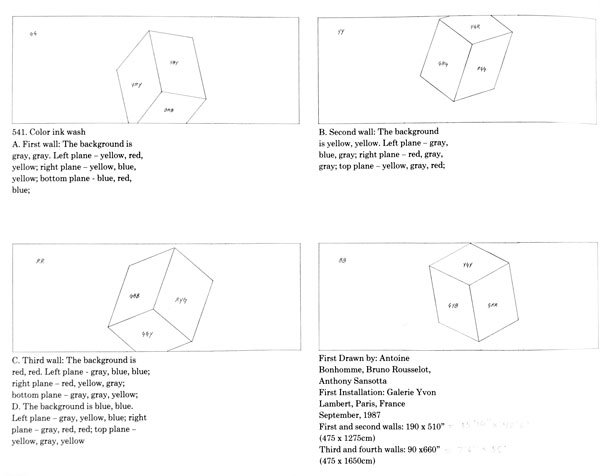
The opposite of soul in art is not intellect, the opposite of soul is vacancy. A vacant work may be intelligent, expensive, fashionable, well installed, and perfectly explained. It may have all the correct references and still feel dead. This is one of the uncomfortable truths of contemporary art. Concept can protect weak work from immediate collapse because it gives the viewer something to read while the object fails to act. But the best concept-driven art does not abandon presence, it transforms it. Sol LeWitt’s wall drawings, for instance, begin only as instructions, but they become real through execution, scale, architectural condition, and the viewer’s movement through space. The idea matters, but so does its incarnation.
In this sense, the soul of an artwork is closer to incarnation than illustration. It is the moment when an idea, feeling, perception, or necessity takes on a body. The artist’s soul is not poured into the work like liquid into a vessel, rather, the work becomes the site where a life’s presence is transformed into form. The result may reveal something about the artist, but it also exceeds the artist. A painting can outlive the mood that made it, it can outlive the explanation that accompanied it, it can even outlive the artist’s own understanding of what they made.

So what qualifies as a soul? In theological terms, one answer may still be: the immaterial essence of a human being, capable of relation to The Divine and perhaps of survival after death. In Aristotelian terms, it is the animating form of a living body. In modern psychological terms, it may be inwardness, consciousness, memory, moral identity, or selfhood. In art, I would define soul differently but not unrelatedly: soul is the felt presence of inward necessity in outward form. It does not prove the afterlife. It does not ask the sceptic to accept doctrine. But it also refuses the thinness of a purely material explanation, as if a human being were only biology and an artwork only pigment, support, and market history. "It would be possible to describe everything scientifically, but it would make no sense; it would be without meaning, as if you described a Beethoven symphony as a variation of wave pressure", as Einstein wrote, so the fact that something can be chemically analysed does not mean it has been fully understood. A painting is made of materials, yes, but it is not exhausted by its materials. A person is made of a body, yes, but no one who has loved, grieved, prayed, feared, created, or stood silently before a work of art believes that the inventory of matter is the whole account.
In Ruskin’s sense, to see something and tell what one saw plainly is not easy. It requires humility before the world; it requires a person to stop performing intelligence long enough to receive reality. It requires what I sometimes imagine an empty mind and the discipline of attention, which may be one of the last forms of reverence available to a distracted age. The soul, in this context, is not an escape from seeing, it is what makes seeing possible.
And this is why we still need to stand in front of art. Not because digital images are useless, and not because reproduction is inferior. Reproduction, digital or print is extraordinary. It educates, preserves, circulates, democratizes, and invites. But the artwork in person remains different in kind. It has a body, it occupies time and space, it asks something of our body in return. In the room, the work is no longer content, it is an event.
Perhaps the most honest thing we can say is this: the soul of art is not something we can prove before we look, it is something we test by looking. We stand before the work, and either it remains an object, or it begins to act upon us. It slows us down, it makes thought more physical and feeling more exact. It does not merely show us something; it changes the condition under which seeing takes place. That is the soul of seeing. It is the demand that we think more fully about what happens when a living person meets a living work in real space. And sometimes, in that encounter, something in the work recognizes something in us before we have found the words for it. That recognition may not prove the soul exists. But it gives the word a reason to remain.
CURRENT EXHIBITION

UPCOMING EXHIBITION
BURTYNSKY: HUMAN/NATURE
Opening: Saturday, May 30th
Invitation Forthcoming


CONTACT US
4-258 East 1st Ave,
Vancouver, BC (Second Floor)
GALLERY HOURS
Tuesday - Saturday,
11:30 AM - 5:30 PM
or by appointment
我们提供中文服务,让我们带您走入艺术的世界。