Dream
- Diamond Kyle

- Jul 11
- 15 min read
welcome to our
SATURDAY EVENING POST
Juy 11th, 2026
By Diamond Zhou
Written with time, thought, and a human pulse.
We spend years of our lives dreaming yet retain almost none of it. I return again and again to my bedroom, except the world beyond the window is ending and I know I must climb out to escape. The dead speak without explaining their return. Faces appear that feel deeply familiar, though I have no idea who they are or where I could possibly have known them. Within the dream, none of this seems strange. For a few moments after waking, the dream may remain astonishingly near, but its architecture soon collapses. What had felt complete becomes a handful of disconnected images, and before long even those have disappeared.
Art has always been drawn towards this unstable territory. In the past, dreams appeared as messages delivered to sleeping saints, prophets, rulers, and heroes; later, they became expressions of desire, fear, memory, and the unconscious. By the twentieth century, artists were no longer satisfied with depicting a person who dreamed, they wanted the artwork itself to dream, to compress time, animate objects, disturb scale, dissolve identities, and make visible to thoughts that we have learned to suppress. The dream offered art more than unusual subject matter, it offered another structure for reality.
There is, after all, a difference between an image of a dream and an image that seems to dream. In the first, the viewer remains outside the event. We see the sleeper and perhaps the angel, apparition, ladder, or monster that has entered the sleeper’s mind. The composition distinguishes between the dreaming body and the vision it receives, allowing us to understand the dream as a contained episode. In the second, no such separation is available, we enter a world in which the phantasmagorical has become ordinary, objects possess intentions, buildings develop inner lives, and time ceases to move in a single direction. Nothing is impossible because, within the dream, impossibility has temporarily lost its meaning.

Long before dreams were interpreted in the West as divine messages or disguised psychological confessions, Chinese philosophy had already used them to question the stability of identity itself. In the Zhuangzi, Zhuang Zhou dreams that he is a butterfly, entirely unaware of being Zhuang Zhou. Upon waking, he wonders whether he was a man dreaming he was a butterfly or a butterfly now dreaming he is a man. The story does not resolve the distinction, but places both identities within what the text calls the “transformation of things.”
Its power lies not simply in asking whether waking life is real, but in challenging the assumption that the waking self must be more authentic than the dreaming one. While Zhuang Zhou is a butterfly, he does not feel like a man imagining another form, because he is completely a butterfly. Only upon waking does one identity claim authority over the other. The dream therefore becomes less a message sent to a stable self than a disturbance of our confidence that the self is singular, continuous, or sovereign.
This philosophical history is also personal to me. My Chinese name is a phrase drawn from Zhuang Zhou’s dream of the butterfly, chosen for me by my grandfather, an educated man that gave his granddaughter a lifelong identity crisis before she could even speak. I grew up carrying this question of dreaming and transformation in my name long before I understood its philosophical weight. Perhaps that is why dreams have never felt to me like a distant subject to be studied, but something strangely intimate: a way of asking where oneself ends and another begins, and whether the person who wakes possesses the final right to decide what was real.

For much of Western history, dreams belonged less to the individual than to the cosmos. They might carry divine instructions, prophecies, temptations, or warnings. In Georges de La Tour’s The Dream of Saint Joseph, revelation enters quietly: a youthful angel gestures beside the sleeping man, while the candle hidden behind the angel’s arm becomes both the physical source of illumination and a metaphor for knowledge disclosed in darkness. Sleep does not close Joseph off from the world, it instead makes him receptive to a reality inaccessible to ordinary sight.
The dream in such works comes from elsewhere. It crosses into the sleeper from a realm beyond human perception, and the individual receives rather than invents it. The dream therefore belongs to an older conception of the self as porous, vulnerable to divine instruction, demonic interference, prophetic knowledge, and the presence of the dead. To dream was not merely to look inward. It was to become available to forces outside the limits of waking consciousness.

In Henry Fuseli’s The Nightmare a woman lies sprawled across a bed, her head and arms falling heavily towards the floor, while a grotesque incubus sits upon her body and the pale, sightless head of a horse pushes through the curtains behind them. The room is theatrical, erotic, claustrophobic, and morally obscure. Nothing in it resembles the orderly transmission of divine meaning. Fear and desire occupy the same bed, while the body becomes both the site of the dream and the surface upon which it exerts its presence.
Fuseli painted The Nightmare in 1781, more than a century before psychoanalysis formalized its theories of repression and unconscious desire. Yet the painting already treats the dream as something emerging from within the obscure depths of the human subject. Its creatures may appear supernatural, but they are not necessarily visitors from another world; they might equally be forms assumed by sensations that cannot otherwise be acknowledged. The incubus sits upon the woman like a secret given weight, transforming psychic disturbance into physical burden.
By the nineteenth century, the dream was increasingly relocated from heaven into the mind. As industrial modernity placed greater faith in observation, classification, scientific fact, and the visible evidence of the material world, Symbolist artists turned towards states that resisted measurement: memory, spiritual longing, fantasy, terror, hallucination, and interior vision. Symbolism was less a unified visual style than a rejection of the idea that art’s highest duty was to reproduce external reality objectively. An artwork might instead give form to a sensation, an emotion, or an idea, even when that form departed radically from natural appearances.
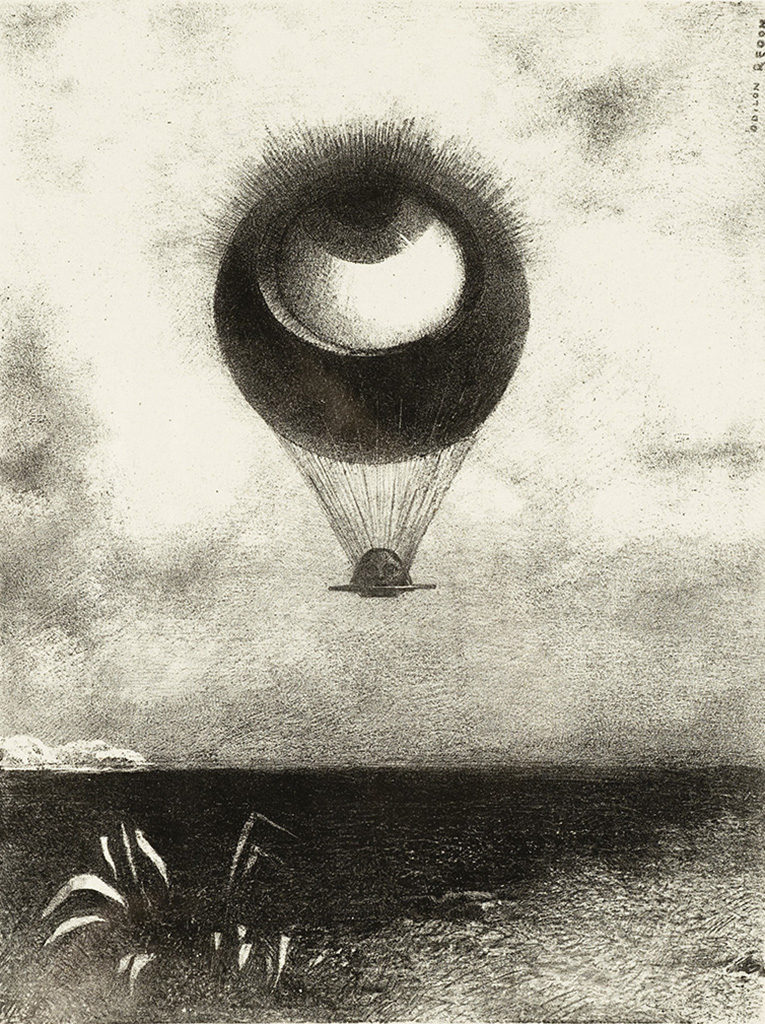
Odilon Redon belongs at the centre of this change. His early charcoal drawings and lithographs, which he called his noirs, are populated by floating eyes, severed heads, human-faced spiders, disembodied flowers, and uncertain organic forms. The darkness surrounding these beings does not establish a conventional setting. It feels closer to the darkness behind closed eyes, an interior space without reliable distance or scale.

In Closed Eyes, a pale face rises from an indistinct field, its lowered eyelids sealing the figure within an interior world unavailable to the viewer. The image is likely based on Redon’s wife, Camille, yet it resists the ordinary claims of portraiture. We are given the features of a particular person while being denied access to the experience that has withdrawn her from us. She may be sleeping, dreaming, remembering, or inhabiting a state for which waking language has no precise name.
The image captures one of the central paradoxes of dreaming: the body remains visible while consciousness has gone elsewhere. Nothing overtly impossible occurs, yet the closed eyes make the figure more remote than any fantastic creature. Redon does not attempt to show us the dream itself. Instead, he presents the threshold beyond which the dream cannot be followed, preserving the secrecy of an inner life that art may approach but never fully disclose.
This privacy complicates the relationship between dreams and art. Art transforms an interior experience into something shareable, but in doing so it must replace the dream rather than reproduce it. The artwork is never the dream itself. It is the trace left by the dream after language, technique, memory, and conscious intention have begun to reorganize it. The artist does not simply retrieve an intact image from the unconscious, the artist builds a new form from what survives.
Sigmund Freud’s influence upon twentieth-century art did not lie merely in providing artists with a dictionary of symbols. His more consequential proposition was that mental life exceeded conscious intention. A dream might disguise what waking thought could not comfortably admit, condensing several meanings into one figure or shifting emotional intensity from one object onto another. The mind was not transparent to itself, it could speak through displacement, contradiction, repetition, and distortion, revealing the individual as something less unified than modern reason had hoped.
The Surrealists seized upon this instability and treated the unconscious as a source of poetic, artistic, and potentially social disruption. André Breton promoted automatism, dream accounts, free association, collaborative games, and unexpected encounters among words and objects. Such methods were intended to loosen the authority of deliberate reason and permit forms of thought ordinarily suppressed by habit, etiquette, morality, and utility.
This was not an innocent flight from reality. European rationalism had presented itself as the engine of civilization while participating in mechanized war, colonial domination, social hierarchy, and systems of bureaucratic control. Reason could no longer claim moral superiority merely because it appeared orderly. For the Surrealists, dream, chance, desire, and irrational association offered ways of disobeying the structures that governed respectable waking life.
The dream therefore became more than a private psychological refuge. It offered a critique of the social world. If waking reality declared itself natural, coherent, and inevitable, dream logic revealed how quickly its arrangements might be altered. Objects could refuse their functions, identities could become unstable, and the ordinary hierarchies among human, animal, mechanical, and inanimate life could be suspended. The dream did not necessarily provide a better reality, but it exposed the existing one as constructed rather than absolute.

Max Ernst’s Two Children Are Threatened by a Nightingale captures the peculiar seriousness of this logic. Beneath an enormous blue sky, one girl brandishes a knife while another lies collapsed. A man carries a child across the roof of a small structure, while a tiny nightingale hovers above the scene as though it posed an immeasurable danger. Ernst connected the composition to a fever vision experienced during childhood and refused to contain the dream within the painted surface, attaching a wooden gate, elements of a toy house, and a knob to the work. The dream consequently breaches the boundary between representation and object, entering the physical space occupied by the viewer.
The title is dramatically disproportionate to what we see. Why should children be threatened by a nightingale? Why should a creature associated with lyric beauty become an object of terror? Yet dreams habitually produce such distortions of emotional scale. A trivial object bears the weight of catastrophe because its power belongs not to its outward appearance but to the hidden network of memories and associations gathered around it. The thing feared may seem harmless to everyone except the dreamer.

Salvador Dalí became the most publicly recognizable painter of the dream because he rendered irrational scenes with almost clinical precision. Melting watches, attenuated bodies, barren plains, and drawers emerging from flesh are given sharp edges, careful modelling, and persuasive light. The effect is not confusion but dreadful clarity. Dalí understood that dreams are not always vague, as some arrive with a visual certainty more convincing than memory.
Yet Surrealism becomes considerably less interesting when reduced to Dalí’s repertoire of spectacular strangeness. The movement’s more enduring achievement was its recognition that reality is already unstable, and that the marvellous need not be imported from elsewhere. It can be released from the objects, rooms, gestures, anxieties, and desires of ordinary life.
The history of Surrealism has also too often repeated the movement’s own gendered mythology. Women appeared as muses, lovers, mysterious children, erotic bodies, mediums, and embodiments of an instinctive irrationality supposedly unavailable to men. They were imagined as portals into the unconscious before being fully acknowledged as makers of its worlds.

Dorothea Tanning’s Eine Kleine Nachtmusik is set in a corridor lined with anonymous doors. Two girls appear beside an enormous, damaged sunflower. One stands with her back to us, her hair lifted by an invisible force, while the other leans against a doorway with her clothing torn. The scene contains little that can be conclusively identified as supernatural. Its disturbance lies in the conviction that something has just occurred, although the painting withholds the event. Tanning herself described the painting as a confrontation and compared hallways, stairways, and private theatres to spaces in which human dramas of aggression, suffocation, and submission unfold.
The corridor is a place of possibilities rather than destinations. Each closed door suggests another room, another consciousness, another reality continuing beside the one we can see. The sunflower, ordinarily cheerful and decorative, has become excessive, fleshy, and wounded. Tanning turns childhood, domestic architecture, and botanical life into a psychological theatre without supplying the narrative that would make it manageable.
For Carrington, the dream was not merely a repository of private neurosis. It opened onto mythology, alchemy, occult thought, ecological consciousness, and a refusal of fixed identity. Human beings are rarely sovereign in her work. They coexist with horses, birds, plants, spirits, and unknown organisms whose intelligence may equal or exceed their own. Her worlds challenge not only rationalism but the assumption that reality must be organized around the human subject.

Remedios Varo similarly created paintings whose strangeness is sustained by extraordinary internal order. Her figures operate instruments, travel through enclosed architectures, gather celestial substances, weave landscapes, and conduct experiments in spaces resembling monasteries, laboratories, and dream chambers at once. In The Creation of the Birds, a birdlike artist sits before a drawing table. Light from a distant star passes through an optical device, while pigment drawn from a violin-like instrument brings the painted birds to life.
The image proposes creation as an activity located somewhere among art, science, music, magic, and biological generation. It is fantastic, but not arbitrary. Varo’s invented machinery has a purpose, her spaces follow rules, transformation requires knowledge, attention, and skill. The painting does not reject reason so much as reject the limits modernity placed around it. It asks why art, science, imagination, and spiritual speculation were divided into separate territories when creation might depend upon their reunion.
This is one of the most theoretically productive aspects of the dream in art. Dream logic does not necessarily abolish order, more often, it reveals another order operating beneath the one we consciously recognize. A dream may appear incoherent when translated into waking language, but while it unfolds, each transformation possesses a strange inevitability.
To call an unfamiliar worldview “dreamlike” may reveal more about the viewer’s limits than about the work itself. Dreams are sometimes treated as a universal language, yet dreaming is shaped by history. The figures who appear to us, the places we fear, the permissions we grant ourselves, and the meanings we attach to animals, houses, water, blood, flight, or death are never culturally neutral. The unconscious is not a wilderness untouched by the social world, that world has already entered it.
Contemporary art has gradually carried the dream beyond the framed image and into the viewer’s physical surroundings. Installation, film, sound, light, and digital media can alter not only what we see but our sense of scale, orientation, duration, and bodily separation. The viewer no longer stands before a dreamlike scene but enters its conditions.
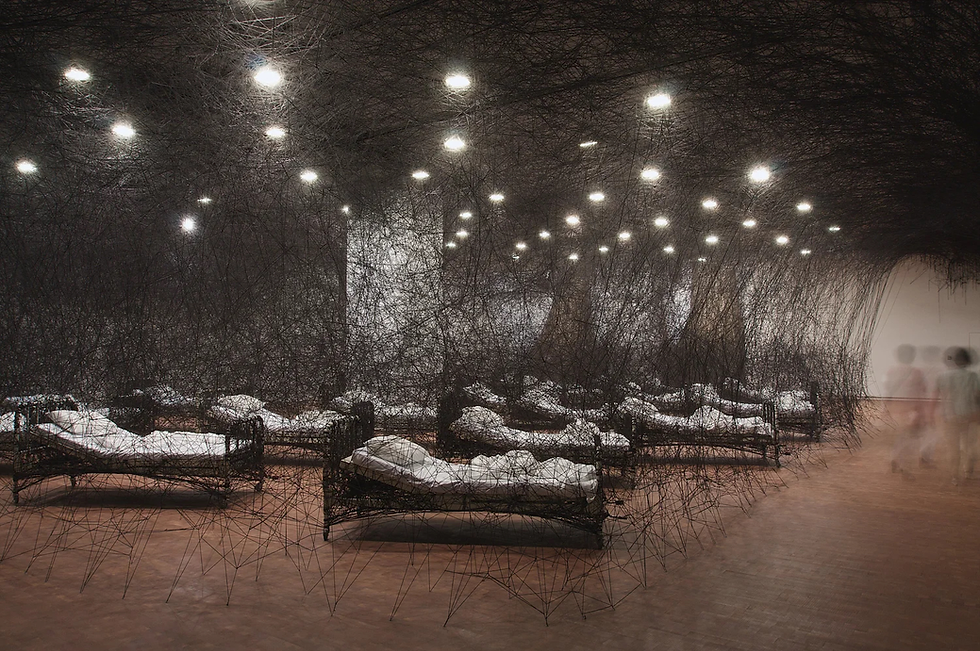
Chiharu Shiota’s During Sleep offers a particularly powerful example. In its 2002 presentation at Kunstmuseum Luzern, metal beds and bedding were enclosed within dense accumulations of black wool. The thread resembled drawing released into space, but it also suggested neural pathways, hair, roots, traps, and lines of memory. Around the beds, it formed an architecture that appeared both protective and imprisoning.
Sleep becomes communal yet inaccessible. Bodies may share a room and lie only a few feet apart, while each remains enclosed within a private world no other sleeper can enter. The bed, one of the most familiar objects in human life, becomes a threshold between consciousness and oblivion, intimacy and isolation, rest and vulnerability.
The empty bed carries another possibility. It may indicate a person temporarily absent in sleep, permanently absent in death, or retained only through the impression left upon the sheets. Dreams frequently restore those who are gone without acknowledging the impossibility of their return. We recognize them immediately and may even know, while dreaming, that they are dead, yet this knowledge does not prevent the encounter. Shiota’s thread makes such attachment spatial. Memory occupies the room after the body has disappeared.
Dreams have always blurred the distinction between what is present and what continues to act upon us despite its absence. Art does much the same. An image survives its moment of making, a room contains traces of people who have left it, an object becomes heavy with associations invisible to anyone who does not share them. Both art and dream recognize that the real is not limited to what can presently be touched.
That recognition becomes more complicated in the age of artificial intelligence. Digital systems can generate endless visions of liquefied buildings, hybrid animals, impossible anatomies, floating rooms, altered faces, and pseudo-Surrealist landscapes. The outward appearance of dreaming has become easy to manufacture. Strangeness, once cultivated through automatism, collage, technical experiment, or sustained attention to interior life, can be requested in a sentence and produced almost immediately.
Yet incongruity alone does not make an image dreamlike. A dream is not simply an arbitrary collection of unusual things. Its transformations possess an emotional necessity, even when that necessity remains concealed from the dreamer. The absurd object carries fear because it has absorbed the force of something else. The recurring room returns because memory has not finished with it, the dead person speaks because grief has abolished chronology, dreams may be irrational, but they are rarely indifferent.
Perhaps the dream is important because it is the one image-world we do not fully author. It arrives before logic, ignores reason, and often leaves behind a presence more durable than its content. We may forget the room, the face, or the impossible event, yet retain the certainty that something happened there which waking language cannot recover. The dream is not simply a message waiting to be decoded, it is evidence that the mind can produce experience without the permission of the self that later claims to own it.
Art enters that breach and keeps it open, it gives the dream a body after the dreamer has abandoned it, carrying into daylight what should have disappeared with the return of reason. The image remains before us like evidence from a reality we have agreed not to recognize, disturbing the borders between memory and invention, knowledge and intuition, self and stranger. The most powerful dreamlike art does not ask us to escape into another world, it allows that other world to intrude upon this one, until the familiar begins to look provisional and waking itself seems less like a return to truth than an act of forgetting.

Shirley Wiebe: The Hidden Door
Today’s post was partly inspired by The Hidden Door, an exhibition of works by Shirley Wiebe at Pendulum Gallery, curated by Chris Keatley. The title draws from Carl Jung’s description of the dream as “a small hidden door in the deepest and most intimate sanctum of the soul.” For Jung, the door marks a threshold between conscious life and the deeper, less governable regions of the psyche. In Wiebe’s work, it becomes both passage and barrier, an opening onto something half remembered and not fully understood. Houses, windows, stairways, and fragments of domestic space recur throughout the exhibition, carrying with them a sense of instability, as though home were not a fixed place but something repeatedly lost, rebuilt, or carried from one state of being into another.
A door is never a neutral image. It implies access, but also restriction: it may be opened willingly, left ajar, locked, concealed, or forced. It can offer privacy, protection, opportunity, escape, or entrapment. To stand before a door is to occupy a liminal position, neither fully inside nor outside, while crossing it requires some degree of knowledge, permission, ability, or force. Someone must know that the door exists, be able to reach it, and possess the means to open it. A hidden door intensifies this uncertainty. It suggests that an opening is present, but that access to it is unequal; someone knows where it is, while someone else remains outside. What lies beyond may provoke curiosity, desire, dread, or revulsion precisely because it has been withheld.
Before reading the titles or the accompanying statement, I encountered the works as compressed records of secrecy, anxiety, longing, regret, and unresolved experience. Some of the written passages felt close to poetry or haiku, brief but charged with urgency, as though certain thoughts had resisted visual form and could only remain as words. Those words reached me with a rawness that the objects did not always permit. Around them, fabric, mesh, wood, found materials, and sewn forms retained the outlines of ordinary things while appearing altered, incomplete, or deprived of use. Limbs were missing, forms were softened or severed, and familiar objects were placed beside things that resisted recognition. Reality remained present, but slightly displaced, as though viewed after waking while the dream had not yet fully released its hold.
On a second viewing, after reading the booklet and learning that the works emerged from Wiebe’s lifelong dream journal, the exhibition became more phantasmagorical and more anxious. The explanation did not make the works easier to understand, it however, made their strangeness feel more intimate. Her dreams entered the gallery not as illustrations, but as physical remnants of a private world, allowing the viewer to stand briefly among the materials of someone else’s subconscious. I found myself wondering about the dreams we do not remember, and whether their disappearance means they are truly gone, or whether they continue to shape us from somewhere beyond recall.
The Hidden Door is on view at Pendulum Gallery until August 28 and is worth seeing.

CURRENT EXHIBITION


CONTACT US
4-258 East 1st Ave,
Vancouver, BC (Second Floor)
GALLERY HOURS
Tuesday - Saturday,
11:30 AM - 5:30 PM
or by appointment
我们提供中文服务,让我们带您走入艺术的界。


