A Collector's Legacy - Part 1

Updated: 23 hours ago
welcome to our
SATURDAY EVENING POST
November 7th, 2026
By Diamond Kyle
Written with time, thought, and a human pulse.
Legacy
Part I: A Collector’s Legacy
We spend much of our lives acquiring things, surrounding ourselves with objects that reflect our interests, our affections, our achievements, and sometimes our ambitions. For those who collect art, these objects can become the companions of a lifetime. Paintings move from one home to another, sculptures find their places in familiar rooms, and works purchased decades earlier acquire meanings that have little to do with the circumstances of their creation. Over time, a collection becomes a kind of autobiography, although one written through the work of other people. But unlike an autobiography, a collection does not necessarily remain intact after its author is gone.
The paintings may be inherited by children who have different tastes, donated to institutions, sold at auction, or dispersed among collectors who know nothing of their previous owner. Works that once occupied the same rooms may eventually find themselves in different countries, separated from the relationships that gave the collection its particular character in the first place. The objects survive, but the world they existed in disappears.
What, then, constitutes the legacy of a collector? Is it the collection itself, the wealth it represents, the institutions it enriches, or the influence its owner exercised during a lifetime? And how much of that legacy belongs to the collector, rather than to the artists whose work made the collection possible?
We tend to think of legacy as something we leave behind, a final accounting of what has been accomplished. Yet in the world of art, legacy is rarely so easily contained. It begins long before death, through acts of patronage, judgement, friendship, and sometimes considerable financial risk. It continues through the decisions of heirs, trustees, museums, dealers, and future collectors, many of whom may interpret the original collection in ways its owner could never have anticipated.
Perhaps the question is not simply what a collector leaves behind, but what becomes possible because they collected at all. A serious collection is rarely assembled in a single moment of inspiration. It develops through years of looking, learning, making mistakes, revisiting artists, and occasionally pursuing works that others have overlooked. A collector may follow a particular artist's development across decades, recognising relationships between works that would be difficult to appreciate individually. Over time, those decisions begin to form a distinct intellectual and visual character, shaped not only by the objects acquired but by the works declined, the opportunities missed, and the unexpected discoveries along the way.
There is something deeply personal about this undertaking. The collector is not simply purchasing art according to an established hierarchy of importance; at their best, they are developing an independent understanding of what deserves attention. This may coincide with institutional opinion, but it need not. Indeed, some of the most remarkable collections have emerged precisely because their owners were willing to follow interests that were unfashionable, commercially uncertain, or insufficiently established to attract institutional support.
The freedom of private collecting is consequently one of its greatest strengths. An individual can act upon conviction without requiring the approval of an acquisitions committee or the justification of a collecting mandate. A collector may buy ten works by an artist when an institution might reasonably acquire only one. They may dedicate substantial resources to an obscure period of an artist's career, or spend years pursuing an object of little obvious commercial importance. Private wealth does not guarantee good judgement, of course, but it permits a degree of independence that institutions, with their financial obligations and public responsibilities, cannot exercise.
This distinction is especially significant in Canada, where many cultural institutions operate under considerable financial constraints. An important work may become available at a price well beyond a museum's acquisitions budget, while an individual collector, guided by personal conviction, and perhaps fortunately enough, sufficient resources, may be able to act immediately. The collector might preserve that work for decades, lend it to exhibitions, or eventually make it available to an institution that could never have afforded to acquire it independently. Private collecting, in this sense, can become an essential part of the cultural infrastructure upon which public museums eventually depend.
Yet we have developed a curious assumption that an important artwork reaches its highest purpose when it enters a museum. A work in private hands is often discussed as though its position remains provisional, while a museum acquisition is celebrated as a permanent achievement. We speak of works entering the public domain with an almost reassuring sense of completion, as though the uncertainties surrounding their future have finally been resolved. But public ownership does not necessarily guarantee public access, just as private ownership does not necessarily imply cultural exclusion.
The history of private collections becoming public institutions reveals several very different approaches to this question.
Isabella Stewart Gardner created one of the most personal museums in the world. When her Boston museum opened in 1903, the arrangements of paintings, sculptures, furniture, textiles, and architectural fragments reflected a sensibility that resisted the conventional organisation of encyclopaedic museums. Gardner was interested in the relationships between objects, in the atmosphere of rooms, and in the experience of encountering art within an environment she had carefully constructed. Her collection was never merely an inventory of exceptional possessions, it was, rather an imaginative world of her own making.
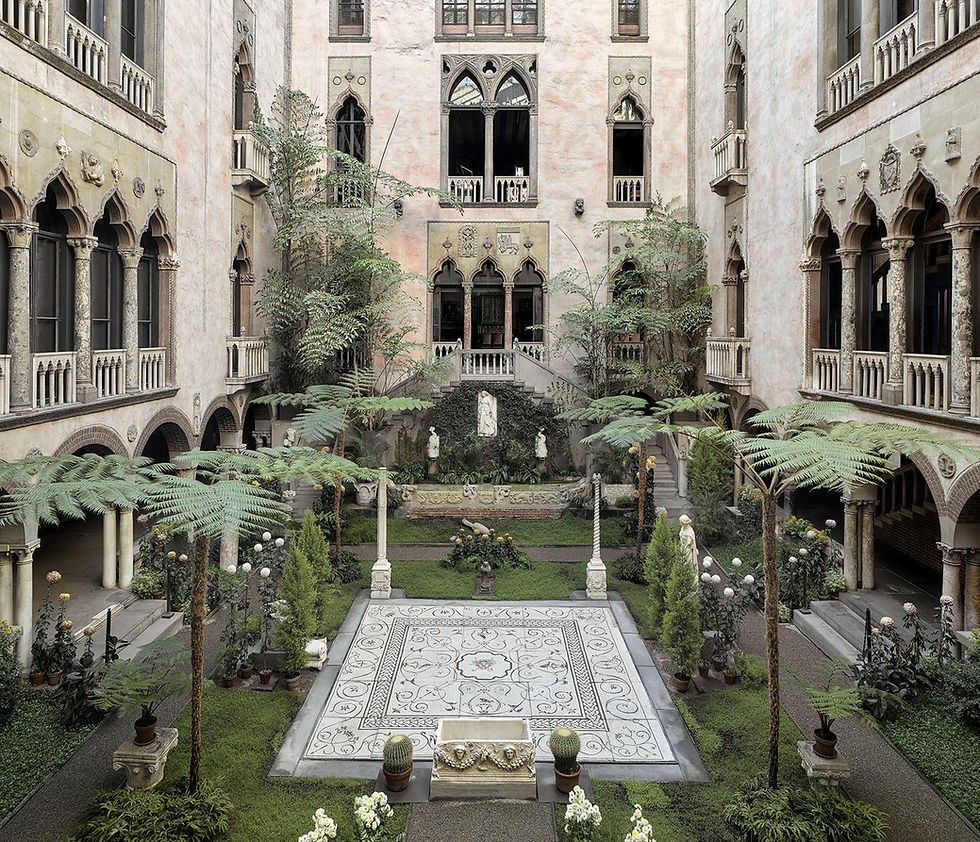


When Gardner died in 1924, her will instructed that the museum's displays should not be permanently altered. Her wishes have remained central to the institution's identity, preserving the unusual character that continues to distinguish it from other museums. Yet this extraordinary act of preservation also raises a philosophical question: to what extent should the intentions of a collector govern the interpretation of artworks by generations who never knew them? Gardner's vision has become part of the museum's historical significance, but most collections cannot, and perhaps should not, aspire to remain unchanged indefinitely.
Albert C. Barnes approached collecting with a similarly powerful sense of personal conviction, although his ambitions were explicitly educational. The Barnes Foundation, established in Pennsylvania in the early twentieth century, brought European modern paintings into conversation with African sculpture, decorative metalwork, furniture, and objects from other traditions. Barnes arranged these works according to visual relationships rather than conventional historical categories, creating ensembles that reflected his understanding of artistic form. His collection was an intellectual proposition as much as an aesthetic achievement.


The Foundation's relocation from Merion to central Philadelphia in 2012 became the subject of considerable controversy, involving questions about the founder's intentions, the responsibilities of trustees, and the institution's financial and educational future. Although the original arrangements were recreated in the new building, the circumstances surrounding the move demonstrated how difficult it can be to reconcile a collector's wishes with the changing demands of a public institution. Preservation, even when pursued conscientiously, is never entirely free from reinterpretation.
A different model emerged in Los Angeles with Eli and Edythe Broad. Their collection of postwar and contemporary art developed through decades of close engagement with artists and the art world, eventually encompassing substantial holdings of works by figures including Jean-Michel Basquiat, Cindy Sherman, Barbara Kruger, and many others. In 1984, the couple established the Broad Art Foundation, creating an extensive lending programme through which works could circulate among museums and exhibitions internationally. When The Broad opened in 2015, the collection acquired a permanent public home while maintaining a commitment to lending and continued acquisition.


The building itself offers a rather wonderful metaphor for the relationship between preservation and visibility. Designed by Diller Scofidio + Renfro in collaboration with Gensler, its architectural concept of the veil and the vault places collection storage at the centre of the museum's structure. Visitors can glimpse portions of the holdings that are not on display, acknowledging that the visible exhibition represents only part of a much larger collection. Storage is not concealed as an unfortunate necessity but recognised as an integral aspect of stewardship.
At Glenstone, established by Mitchell and Emily Wei Rales in Maryland, another private vision has become publicly accessible without sacrificing its distinctive character. The museum brings together art, architecture, and landscape in a deliberately considered environment, offering an experience shaped by the collectors' sustained interests rather than the conventional expectations of an encyclopaedic institution. Its expansion in 2018 demonstrated what substantial private resources could accomplish when directed towards a particular understanding of how contemporary art might be experienced.


These examples remind us that making a collection public need not mean surrendering its individuality. Private collectors can create institutions that retain the independence and specificity of the original vision, although the considerable resources required to establish and sustain such museums place this possibility beyond most collectors.
Canada has its own remarkable examples. Robert and Signe McMichael began collecting works by Tom Thomson, the Group of Seven, and their contemporaries while living in Kleinburg, Ontario. Their home gradually became a destination for visitors who shared their enthusiasm for Canadian art, and in 1965 they donated their property, buildings, and a collection of 194 paintings to the Province of Ontario. The McMichael Canadian Art Collection opened to the public the following year, transforming a deeply personal commitment into an institution of lasting national significance.

The generosity of Kenneth Thomson offers another extraordinary example. His gift of approximately 2,000 works to the Art Gallery of Ontario included significant holdings of Canadian paintings, European art, decorative objects, and historical material. Among them were extensive collections of works by Tom Thomson, David Milne, and Cornelius Krieghoff, as well as Peter Paul Rubens's The Massacre of the Innocents. The donation transformed the AGO's holdings and made an enormous body of privately assembled art available for public scholarship and appreciation.

Such gifts are essential to the development of public collections, particularly when institutions cannot independently afford works of comparable significance. But they also introduce obligations that extend far beyond the initial celebration of a donation. Museums must provide conservation, documentation, storage, research, exhibitions, and access, often with resources that are already stretched across substantial permanent collections.
It is therefore worth asking what happens when the generosity of collectors exceeds the capacity of institutions to absorb their gifts meaningfully.
We should not underestimate the importance of museum storage. Many works are too fragile for continuous display, while others are preserved for research, loans, or exhibitions that may take place decades in the future. A museum has responsibilities that extend far beyond the immediate interests of its visitors. Nevertheless, there is a distinction between preserving an artwork for future generations and allowing it to disappear indefinitely from cultural conversation. Canada's own museum-policy consultations have acknowledged the growing pressures surrounding storage, infrastructure, and access, including the fact that only a fraction of some collections can be exhibited at any given time.
A collector might reasonably wonder whether a painting carefully selected and enjoyed for forty years will continue to receive comparable attention after entering a public institution. It may be accepted because of its historical importance, yet seldom exhibited because of changing curatorial priorities. Other works from the same collection may be declined altogether. The intellectual relationships that once gave the collection its coherence can gradually disappear as individual objects are absorbed into different departments, exhibitions, and institutional narratives.
None of this diminishes the importance of museums, but it challenges the assumption that public ownership is necessarily superior to private stewardship. A thoughtful collector may understand and care for a particular work with extraordinary dedication, while an underfunded institution may struggle to provide it with sustained attention. Conversely, a well-resourced museum can preserve, research, and interpret a work in ways an individual owner could never achieve. The quality of stewardship matters more than the identity of the owner.
The question becomes more difficult when institutions decide to remove works from their collections.
Deaccessioning is a recognised part of responsible museum management, governed by policies intended to protect the public trust. Works may be removed because they fall outside a collecting mandate, are duplicated, raise questions of ownership, or are more appropriately held elsewhere. Yet the historical importance of art is rarely fixed, and the judgement of one generation may be reconsidered by another. Professional standards place restrictions on the use of proceeds from sales, but the larger question remains: who determines that a work no longer deserves its place in a public collection?
In 2018, the National Gallery of Canada announced plans to sell Marc Chagall's La Tour Eiffel (1929), which it had acquired in 1956, as part of an effort to raise funds towards the acquisition of a painting by Jacques-Louis David. The decision prompted considerable criticism, raising questions about transparency, institutional priorities, and the responsibility of a national museum to preserve works already held in trust for the public. The proposed sale was ultimately cancelled, and the Chagall returned to display.

The controversy was revealing because it concerned more than the relative merits of two paintings. Museum officials believed that the David would serve the institution's collecting priorities more effectively, while critics questioned whether the sale of an established work was an appropriate means of achieving that objective. Both positions involved judgements about cultural significance, but neither could claim to represent an entirely timeless assessment of art history.
A private collector making a comparable decision would face a different kind of scrutiny. They might sell one work to acquire another, change direction, or abandon a collecting interest altogether. This freedom can produce mistakes, but it can also permit the continuing evolution of a collection. Museums, by contrast, bear a public responsibility that makes such decisions necessarily more difficult. Their authority over objects held in trust cannot be exercised as though they were simply private possessions.
There is another possibility that receives comparatively little attention when discussing the future of important artworks: their continued circulation through the private market.
A painting may pass from one collector to another over many decades, returning periodically to the same gallery or dealer. Each transaction can bring new research, conservation, photography, provenance documentation, and opportunities for exhibition. A dealer who handles a work repeatedly may develop an unusually detailed understanding of its history and significance, recognising changes in scholarship and market perception that emerge over time.
The secondary market is sometimes dismissed as an arena concerned primarily with financial appreciation, but its contribution to the continuing life of artworks should not be overlooked. Serious dealers may support artists' reputations long after their deaths, introduce their work to new generations through sales and exhibitions, and preserve knowledge that might otherwise remain scattered across private archives. Naturally, the market is not immune to speculation, poor judgement, or commercial self-interest, nor does private ownership guarantee scholarly accessibility. But the movement of art between private hands need not represent a loss to culture.
An artwork can acquire a new life with each successive owner. Someone who purchases a painting at auction may research the artist, lend the work to an exhibition, or eventually place it with a collector whose enthusiasm introduces it to another community of interested people. The dealer who facilitates these relationships participates in a form of cultural continuity, even when the transactions themselves are commercial.
The museum preserves, while the market circulates. Neither function is sufficient on its own, and neither should be mistaken for the entirety of an artwork's cultural life.
For Dorothy and Herbert Vogel, collecting began with modest financial means and an extraordinary commitment to the contemporary art of their time. A postal worker and a librarian, they assembled more than 4,000 works, often acquiring pieces directly from artists with whom they developed longstanding relationships. Their small Manhattan apartment became a remarkable repository of artistic experimentation, particularly in Minimal and Conceptual art. Rather than establishing a single museum around their names, the Vogels eventually worked with the National Gallery of Art to distribute 2,500 works among fifty museums across the United States.


Their legacy demonstrates that preserving a collection does not necessarily require keeping it together. Through dispersal, works that had occupied a single apartment acquired new institutional contexts and reached audiences across an entire country.
The fate of Peggy and David Rockefeller's collection presents an entirely different understanding of legacy. In 2018, Christie’s sold approximately 1,500 objects from their collection for more than US$835 million, with the estate's proceeds directed towards philanthropic causes supported by the couple during their lifetimes. The collection's material unity ended, but the wealth embodied in those works was redirected towards other forms of public benefit.


Is this a lesser legacy than establishing a museum? I am not convinced that it is. A collection can be preserved intact, distributed among institutions, sold to support philanthropy, or returned to the private market, and each outcome can carry cultural significance. The important question is whether the decisions have been made with an understanding of what the collection represents and what its future might make possible.
This becomes especially complicated when the responsibility passes to the next generation. Children may inherit the financial value of a collection without inheriting the experiences through which it acquired meaning. A painting that reminds a parent of a friendship, a difficult negotiation, or an unexpected discovery may be little more than a valuable object to someone who did not participate in those experiences. The sentimental significance of a work cannot be transferred through a will, and neither can the knowledge accumulated through decades of looking and collecting.
A collection may represent wealth, but it also represents an education. The ability to make meaningful additions or judicious deaccessions requires an understanding of the artists, the relationships between works, their condition, their provenance, and their place within the wider history of art. The most valuable painting is not necessarily the most significant to the collection, and a work that appears unremarkable in isolation may be essential to understanding a particular artistic development.
An heir may therefore be legally entitled to make decisions for which they are not yet intellectually prepared for. This is not a criticism of inheritance, but an acknowledgement that ownership and connoisseurship are different things. Knowledge can be developed, advisers can be consulted, and relationships with scholars, artists, curators, and dealers can be cultivated. But thoughtful stewardship requires a willingness to learn, particularly when the person who originally assembled the collection is no longer there to explain its complexities.
There is also an emotional inheritance, which may be more difficult to manage than the financial one. The collection might be a source of pride, affection, obligation, or even resentment. One child may wish to preserve everything as an expression of filial devotion, while another may have neither the space nor the means to maintain it. Neither should necessarily be expected to devote their life to a passion they did not choose.
And perhaps a collection that survives unchanged, but without genuine interest or attention, has preserved less of its original spirit than one that is thoughtfully dispersed.
There is, of course, a fundamental distinction between the legacy of an artist and that of a collector. The artist leaves behind the work of their own imagination, while the collector leaves behind a record of what they recognised, valued, and chose to preserve. Yet the two legacies are not entirely separate. The history of art is also a history of patronage, of individuals whose commitments allowed artists to continue working, whose collections preserved particular periods of artistic development, and whose judgement sometimes anticipated institutional recognition. The collector does not create the artwork but may contribute significantly to the conditions under which it survives and becomes understood.
An artist's reputation may endure because of the collector's foresight, while the collector's reputation may endure because of the continuing significance of the artist. Their legacies remain intertwined, even as the objects themselves move beyond the intentions of either.
Ultimately, I wonder whether our desire to preserve collections is also an attempt to resist the passage of time. We surround ourselves with things that have survived other lives, other owners, and sometimes entire centuries, perhaps finding reassurance in their material permanence. A collection can give shape to a lifetime of curiosity and become an expression of identity that feels more enduring than the circumstances in which it was assembled. There is something profoundly human in the desire to leave a trace of ourselves in the world, to believe that the things we have loved and the judgements we have made might retain some significance after we are no longer here to explain them.
But what is it that we are really hoping to preserve? The objects themselves, the relationships we have established between them, or something of our own sensibility that we imagine might survive through their continued existence? A collection is, after all, a highly personal interpretation of the world, shaped as much by the circumstances of a particular life as by the works themselves. Its character emerges from countless decisions, some carefully considered, others intuitive or entirely accidental. We might regard it as the record of a lifetime of looking, but it is also a record of everything the collector did not see, could not acquire, or failed to recognise. Like any interpretation of history, a collection is necessarily incomplete.
And perhaps this incompleteness is precisely what allows it to remain meaningful. Future generations will bring different knowledge, sensibilities, and questions to the same objects. A painting once considered peripheral may assume unexpected importance, while another, greatly admired in its own time, may no longer command the same attention. The relationships that seemed so compelling to one collector may be reconsidered by someone who sees the works through an entirely different cultural or historical understanding. We cannot reasonably expect posterity to share all our convictions, nor should we necessarily wish it to. The possibility of being reinterpreted, even contradicted, is part of what allows art to remain alive. No individual, however devoted to an artist or a collection, can claim exclusive authority over the meanings that future generations will find in the work.
We spend a lifetime collecting things that will eventually belong to someone else. What remains is not simply what we owned, but what our ownership made possible.
CURRENTLY ON VIEW
FALL GROUP EXHIBITION


CONTACT US
4-258 East 1st Ave,
Vancouver, BC (Second Floor)
GALLERY HOURS
Tuesday - Saturday,
11:30 AM - 5:30 PM
or by appointment
我们提供中文服务,让我们带您走入艺术的界。


