An Artist's Legacy - Part 2

welcome to our
SATURDAY EVENING POST
November 14th, 2026
By Diamond Kyle
Written with time, thought, and a human pulse.
Legacy
Part II: An Artist’s Legacy
In considering the Legacy of a Collector, we confronted the curious impermanence of ownership: the knowledge that a lifetime spent acquiring, studying, and living with works of art must eventually give way to other owners and other interpretations. A collection may remain intact, find its way into a museum, or disperse across the world, its original character gradually altered by the circumstances of inheritance and the passage of time. Yet the artworks themselves continue to exist, their meanings extending beyond the lives of those who once possessed them.
For the artist, the question of legacy is both more intimate and more complicated. What remains is not a body of objects selected from the work of others, but the material evidence of a lifetime spent making something that did not previously exist. Paintings, sculptures, drawings, ceramics, notebooks, and unfinished experiments survive their creator, carrying within them the decisions, uncertainties, discoveries, and sometimes the contradictions of an artistic life. Together they form a body of work that may be recognised, misunderstood, celebrated, neglected, or rediscovered in circumstances the artist could scarcely have imagined.
But the work itself is only part of what survives. There are letters, photographs, exhibition records, studios, personal recollections, friendships, and the knowledge held by those who encountered the artist during their lifetime. There are works already dispersed through public and private collections, others retained by family members, and still others whose locations may no longer be known. There are legal rights and financial interests, but also questions of scholarship, historical interpretation, and the continuing influence of the artist's ideas.
Who, then, is responsible for an artist's legacy? The family that inherits the estate, the institutions that preserve the work, the collectors who continue to acquire it, or the scholars and dealers who bring it before new audiences? And what happens when their understandings of the artist differ?
In an earlier Saturday Evening Post, The Executor's Burden, we considered the immense practical responsibilities that accompany the administration of an artistic estate, drawing upon the enlightening writing and experience of our friend Christopher Varley and the often difficult realities of cataloguing, conservation, storage, and succession. But the question of legacy extends well beyond the settlement of an estate. An executor may eventually complete their responsibilities, a foundation may establish a programme of preservation, and an archive may find a permanent institutional home. None of these achievements can determine, with certainty, how the artist will be understood fifty or a hundred years later.
Perhaps this is the essential distinction between an estate and a legacy. The former concerns what has been left behind, while the latter concerns what continues to unfold. An estate can be administered, but an artist's legacy remains open to the changing judgements of history.
Picasso’s Estate
Few artists illustrate the complications of posthumous legacy more dramatically than Pablo Picasso. When he died in France in April 1973, at the age of ninety-one, he left no will. His estate encompassed an extraordinary quantity of paintings, sculptures, ceramics, drawings, prints, personal possessions, and real estate, together with complex family relationships and intellectual property rights that would require years of negotiation and administration.
Picasso's marital and family history further complicated the succession. His widow, Jacqueline Roque, whom he married in 1961, survived him, as did children from different relationships and grandchildren whose inheritance rights were affected by the circumstances of their parentage. Questions of legal recognition, family entitlement, and the distribution of an immense artistic fortune became entangled with the continuing management of Picasso's name and work.
The French government played an unusually consequential role in determining the estate's cultural future. Legislation introduced in 1968 had made it possible for heirs to transfer important artworks to the state in satisfaction of inheritance taxes, an arrangement known as dation en paiement. Through this mechanism, Picasso's heirs transferred a substantial group of works to the French national collections in 1979, followed by another important transfer from Jacqueline Picasso's heirs in 1990. These acquisitions became the foundation of the Musée national Picasso-Paris, which opened in 1985.

It would be inaccurate to describe this as the government simply seizing Picasso's entire estate. The heirs retained significant holdings and interests, while the settlement provided a means of satisfying tax obligations through artworks of exceptional cultural importance. Nevertheless, the result is remarkable: one of the world's most significant museums devoted to a single artist emerged not from a carefully articulated testamentary vision, but through the convergence of inheritance law, family negotiations, taxation, and the French state's determination to preserve an important part of its artistic patrimony.
Picasso's personal archives were subsequently transferred to the French national collections, enriching the museum's ability to document the artist's creative process and private world. The museum now holds thousands of works and an archive comprising approximately 200,000 items, offering an unusually comprehensive record of an artist whose public reputation was already immense during his lifetime.


It is worth contemplating how differently this legacy might have developed under another legal system, or had the family been unable to reach the necessary agreements. Would the works have been dispersed among private collectors? Would a comparable museum have been possible? And what might have happened to the archive, whose historical significance cannot be measured simply by the financial value of individual documents?
The Burden
An artist's heirs inherit something fundamentally different from the descendants of a collector. The objects may carry financial value, but they also represent the material remains of a person's creative life. A painting may remind a daughter of the room in which her father worked. A group of drawings may contain abandoned experiments that the artist would never have considered exhibiting. A photograph or letter might be insignificant in commercial terms yet inseparable from the family's understanding of the person they knew.
There is a difference between encountering an artwork as an object and encountering it as a remaining part of someone one has loved. A dealer’s negotiation over value may be experienced by a family member as a judgement upon the artist's achievement, or even upon the person themselves.


Yet emotional proximity does not necessarily confer artistic, scholarly, or commercial expertise. The child of a painter may know the artist's character, habits, and personal circumstances intimately while possessing little knowledge of the secondary market, conservation, museum acquisitions, or the historical significance of particular periods of production. A specialist may understand the work exceptionally well without having known the artist at all. Neither form of knowledge invalidates the other.
The difficulty arises when inherited authority is confused with inherited expertise, or when professional judgement is exercised without sufficient regard for the personal relationships.
A thoughtful estate requires an ability to distinguish between these different kinds of responsibility. Families need not become art historians, archivists, conservators, or dealers, but they must recognise when such expertise is necessary. Equally, those who work professionally with estates should understand that the family's relationship with the artist cannot be reduced to a commercial arrangement.
And there is another question, one perhaps less frequently acknowledged: should children be expected to devote their lives to preserving a parent's artistic ambitions? The responsibility may arrive when they have careers, families, and commitments of their own, without the financial independence required to undertake years of research and administration.
It is difficult to imagine a more complicated inheritance than one that demands both personal devotion and professional competence, particularly when neither the time nor the resources to provide them.
Where should the work go?
When considering the future of an artist's remaining works, museums are often the first institutions that come to mind. To have an artist represented in an important public collection can provide historical recognition, opportunities for scholarship, conservation, and the possibility of meaningful public access. But the placement of an artwork in a museum should not be confused with the conclusion of its journey.
As we considered previously, public ownership is not inherently superior to private ownership. Museums must operate within collecting mandates, conservation requirements, storage limitations, and often considerable financial constraints. An institution may have a genuine interest in an artist's work but lack the resources to acquire, preserve, or display a substantial body of it. Another may accept a donation that subsequently remains in storage for years.


A private collector, meanwhile, may develop an extraordinary knowledge of an artist, live with the work, support publications, and lend important pieces to exhibitions. A dealer may continue to handle the artist's work over decades, preserving provenance, researching individual objects, introducing them to new audiences, and sustaining a market that provides opportunities for further study and appreciation. The question should therefore be less concerned with the prestige of a particular destination than with the quality of stewardship it can offer.
An important painting might be better served by a regional museum with a strong interest in the artist than by a major institution where it would remain peripheral to the collection. A group of related works might possess greater historical value when preserved together, revealing changes in technique and artistic intention that would be difficult to appreciate individually. Conversely, placing works in several institutions may extend an artist's visibility across geographical and cultural boundaries.
The same considerations apply to the private market. Releasing an estate's entire inventory at once may overwhelm demand and establish unfavourable precedents, while carefully planned placements with knowledgeable collectors can help sustain attention over time. Financial value is not the sole consideration, but it cannot be ignored. A viable market contributes to the continued circulation of artworks and can provide the resources needed to preserve those that remain.
There is no universal formula for the future of an artist's work. Some collections benefit from remaining concentrated, others from dispersal. Some require institutional protection, while others acquire new significance through successive generations of private ownership. What matters is that these decisions are made with an understanding of the artist's work rather than merely the immediate circumstances of the estate.
The archive and the construction of an artist’s history
If the artworks are the material achievements of an artistic life, the archive is often the evidence through which the life of an artist can be reconstructed. Letters, notebooks, photographs, exhibition records, inventories, preparatory drawings, and studio documents may appear unremarkable when considered individually. Yet together they establish relationships between works, clarify dates, illuminate working methods, and preserve conversations that would otherwise disappear from the historical record.
An artist's archive is not necessarily a collection of precious objects. It may consist of ordinary correspondence, handwritten calculations, receipts for materials, annotated photographs, or notebooks containing experiments that were never realised. Their significance often lies in the connections they establish rather than their individual aesthetic or financial value.
Consider the Jack Bush fonds at the Art Gallery of Ontario. Donated by the artist's family in 1987, it contains personal diaries, painting records, photographs, scrapbooks, and examples of Bush's commercial work. The twenty-four volumes of diaries, written between 1952 and 1976, are especially intimate documents, originally undertaken in connection with psychiatric treatment. The AGO's archival catalogue continues to identify these diaries as restricted, with access requiring permission from the Jack Bush Estate.
This presents a difficult but revealing problem. An archive can be preserved within a major public institution while remaining only partially available to researchers. Such restrictions may arise from legitimate concerns about privacy, the circumstances of the original donation, or information concerning other individuals whose lives intersected with the artist's.
But the consequences of restricted access also deserve consideration. Personal diaries can contain extraordinary evidence about an artist's creative decisions, professional relationships, anxieties, and intellectual development. When such material is available only to selected researchers, the construction of the artist's historical narrative may depend upon a relatively small circle of people.

The publication of Sarah Stanners's four-volume Jack Bush Paintings: A Catalogue Raisonné in 2024 demonstrates the value of sustained archival research. The project documents approximately 1,850 paintings, incorporating provenance, exhibitions, bibliography, and, where appropriate, excerpts from Bush's diaries and related commentary. Its importance extends beyond the establishment of an authoritative record of individual works; it provides a foundation upon which future scholarship can develop.
The Bush example is not an argument for opening every intimate document without restriction. An artist's privacy and the interests of other people mentioned in correspondence or diaries deserve serious consideration. But restrictions should be carefully reasoned, clearly administered, and periodically reconsidered. A temporary embargo, a research agreement, or controlled access to sensitive records can sometimes reconcile privacy with scholarship more effectively than indefinite exclusion.

We should remember that the archive is not a neutral record of the past. It is shaped by what the artist preserved, what family members retained, what executors discarded, what institutions agreed to accept, and what scholars were subsequently permitted to examine. Each decision influences the evidence available to the next generation. History is not simply the past reproduced for future audiences. It is an interpretation assembled from what survives.
The historian Michel-Rolph Trouillot examined this relationship between power, historical evidence, and the production of narratives in Silencing the Past: Power and the Production of History (1995). Although his subject extended far beyond art, the implications for artistic legacies are considerable. An artist may be absent from an established history not because the work lacked significance, but because the evidence, resources, or institutional interest necessary to establish that significance were unavailable.
What happens when nobody records the history of an artist's exhibitions, interviews those who knew them, or preserves the correspondence that might explain an important development in their work? What happens when the only account of an artist's career is one written decades earlier, perhaps from a perspective that subsequent scholarship would challenge? Silence has consequences.
An artist who is not discussed, exhibited, published, or studied may gradually recede from cultural memory, even when substantial works survive in private collections and storage. Their absence from history can become self-reinforcing: because little has been written, future scholars may assume there is little worth investigating. To preserve an archive, then, is not simply to keep the papers. It is to make possible the questions that have not yet been asked.

Brice Marden, Cold Mountain 6 (Bridge), 1989–91, oil on linen, 274.3 × 365.8 cm. San Francisco Museum of Modern Art. © Estate of Brice Marden / Artists Rights Society (ARS), New York.
When legacy becomes a business
There is an unavoidable commercial dimension to the administration of artistic legacies. Storage, conservation, insurance, photography, research, cataloguing, and staff require money. A serious catalogue raisonné may take many years to complete. The maintenance of an archive can become a permanent financial responsibility, particularly when the estate retains a substantial inventory.
For some families, licensing income and the sale of artworks provide the principal means through which these responsibilities can be met. It would be unreasonable to expect an estate to perform this work indefinitely without adequate financial support.
Copyright is an important part of this framework. It protects an artist's work against unauthorised reproduction and exploitation, and it can allow an estate to exercise appropriate control over commercial uses. Under Canadian law, however, the ownership of a physical artwork and the ownership of copyright are distinct. Possessing an original painting or object does not automatically entitle its owner to reproduce it in a publication, and photographing the object oneself does not necessarily resolve the underlying copyright questions. Exceptions, including fair dealing for criticism and review, may be relevant in particular circumstances, but their application depends upon the nature and purpose of the use.
No serious advocate for an artist's legacy would suggest that an estate should be indifferent to the unauthorised mass reproduction of an artist's work, misleading commercial merchandise, or uses that compromise its integrity.
Yet the existence of a legal right does not, by itself, determine how wisely that right should be exercised. A scholarly publication, a carefully organised exhibition, a museum's educational programme, and a commercially manufactured decorative reproduction may all involve copyright, but they do not necessarily contribute to an artist's legacy in equivalent ways.
An estate that approaches every request primarily as an opportunity for licensing revenue may succeed in protecting its immediate financial interests while inadvertently discouraging the activities that sustain the artist's long-term reputation. A publisher with limited resources may abandon a monograph because the cost of image permissions exceeds the project's budget. A curator may reconsider an exhibition when the process of obtaining necessary permissions becomes unduly complicated or unpredictable. A dealer investing in research, photography, and publicity may hesitate to undertake another project if the professional relationship becomes disproportionately difficult.
These possibilities should not be mistaken for evidence that estates are generally obstructive, nor that every request deserves free access. But they reveal an important distinction between the commercial management of an estate and the cultural stewardship of an artistic legacy.
The financial success of an estate does not necessarily measure the vitality of an artist's reputation. A family might generate considerable income through sales and licensing while comparatively little new scholarship appears. Another estate might earn modest revenue yet facilitate important exhibitions, publications, and research that gradually transform the understanding of an artist's achievement.
The question is not whether an estate should earn money, but whether its commercial activities contribute to the continuing life of the work. A discriminating approach might recognise that scholarly, educational, journalistic, and commercial projects require different considerations. Appropriate fees, clear permissions, acknowledgement of legitimate rights, and professional communication can coexist with a genuine willingness to encourage serious cultural engagement.
The same principle applies beyond copyright. An estate may hold important archives, works, photographs, or specialist knowledge that other participants in the art world need in order to advance understanding of the artist. But stewardship does not necessarily require the estate to originate or control every exhibition, publication, or interpretation.
A gallery may have spent decades acquiring and documenting an artist's work. Collectors may possess knowledge of pieces that have long since left the family. Scholars may identify historical relationships that were never recognised during the artist's lifetime. An independent exhibition may bring substantial attention to a body of work without having been organised by those who administer the estate.
These are contributions to the artist's continuing cultural life, even when they arise outside the estate's immediate interests. An artist's legal rights may pass to heirs or other beneficiaries, but the artist's cultural significance cannot be confined to the people who administer those rights. It develops through a much wider community of knowledge, attention, and interpretation.
Who tells the artist's story?
If the archive supplies the evidence of an artistic life, the writer determines how that evidence is brought into conversation with history.
This is perhaps one of the most consequential decisions an estate can make, and one that is too easily treated as a matter of publicity. Selecting the right writer, publisher, or research partner is not simply a means of obtaining favourable attention. It can determine how an artist's work is understood for decades.
An exhibition catalogue may become the principal reference for future scholars. An essay written from a limited knowledge of the artist's development can establish interpretations that are repeated long after their original circumstances have been forgotten. Conversely, a thoughtful writer may recognise the importance of an overlooked period, identify a previously unexamined influence, or place an artist within a wider historical discussion that substantially changes their reputation.

The ideal writer is therefore not necessarily the person most inclined to praise the artist. Serious scholarship requires both sympathy and independence. It must be capable of recognising artistic achievement without becoming an exercise in unqualified admiration, and it must be willing to acknowledge contradictions, uncertainty, and work that does not fit comfortably within an established narrative. An estate might understandably prefer a writer who shares its interpretation of the artist. But the most valuable contribution may come from someone who sees the work differently, provided that interpretation is grounded in evidence and informed judgement.
The publisher performs a different but equally important function. A beautifully produced book may offer excellent reproductions yet reach relatively few researchers. An academic publication may possess intellectual credibility but lack the visual quality needed to convey the work. A gallery catalogue may document an artist's achievement with extraordinary care, but its historical influence will depend partly upon its circulation among libraries, institutions, scholars, and future collectors. There is no single ideal publishing arrangement. The appropriate choice depends upon the material, the intended readership, and the larger purpose of the undertaking. But publication should be understood as more than the production of a handsome object. At its best, it is an invitation to continue a conversation.
This is particularly important for artists whose reputations have never been firmly established within the dominant narratives of art history. A carefully researched book can provide the first coherent account of an artistic career, linking works previously scattered among private collections and introducing primary materials that have remained inaccessible or unknown.
The selection of a writer, a publisher, and the institutions willing to engage with the resulting scholarship may consequently have as much influence upon the future of an artist's reputation as the placement of an important painting. To tell an artist's story is not merely to record what happened. It is to decide what deserves attention, what relationships matter, and how a body of work might enter the historical imagination. The responsibility is considerable, because no account can be entirely complete.

Ways of preserving an artistic life
The histories of Hilma af Klint, Donald Judd, and Joan Mitchell offer three very different understandings of artistic legacy, each revealing something about the relationship between preservation, intention, and historical recognition.
Hilma af Klint created an extraordinary body of abstract work beginning in the early twentieth century, but kept much of it outside public exhibition. Convinced that the world was not yet prepared to understand the paintings, she stipulated that they should not be shown for twenty years after her death in 1944. In practice, her work remained largely unseen until 1986, and its subsequent recognition developed through exhibitions and scholarship that challenged established accounts of the origins of abstraction.
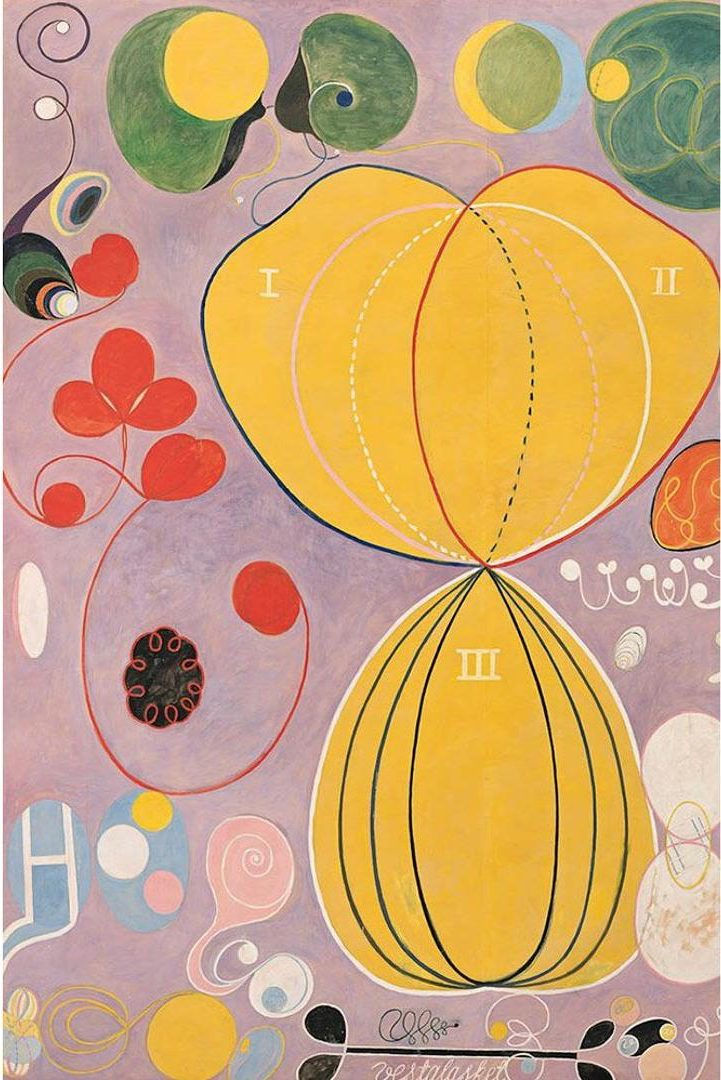

The Guggenheim Museum's Hilma af Klint: Paintings for the Future, presented in New York in 2018–19, introduced her work to an enormous international audience and encouraged a significant reconsideration of the relationship between abstraction, spirituality, and modernism.
Her example demonstrates that artistic importance and historical recognition do not necessarily emerge together. A body of work can exist for decades without acquiring the visibility or interpretative framework through which its significance becomes widely understood. Af Klint's paintings did not suddenly become important when the public discovered them, but what changed were the circumstances through which their importance could be recognised.

Donald Judd presents a different problem. His understanding of art extended beyond the individual object to its relationship with architecture, space, and the experience of viewing. At 101 Spring Street in New York, which he acquired in 1968, he developed an approach to permanent installation in which the placement of artworks and furnishings formed part of a carefully considered environment.
Following his death in 1994, the Judd Foundation undertook the substantial task of preserving the building and its installations. Reopened to the public in 2013 after an extensive restoration, 101 Spring Street remains an unusually direct encounter with Judd's intentions concerning the relationship between artworks and their surroundings.

Here, the legacy cannot be adequately preserved by conserving the individual objects alone. Their placement, architectural context, and spatial relationships contribute fundamentally to their meaning. The preservation of an artistic life consequently involves maintaining a particular experience, one that might be profoundly altered if the objects were simply dispersed among museums.


Joan Mitchell offers a third possibility, perhaps the most expansive in its understanding of legacy as a continuing enterprise. When Mitchell died in 1992, her will provided for the creation of a foundation to support working artists while also caring for her own artistic legacy. Established the following year, the Joan Mitchell Foundation has developed programmes of grants, residencies, research, archives, conservation, and scholarship. The foundation's work is not limited to ensuring that Mitchell's paintings remain visible; it also extends her commitment to the circumstances in which other artists can continue creating.
This is an especially interesting conception of posthumous influence. A legacy can become a source of support for work that has no direct relationship to the artist's own style or ideas. Mitchell's contribution is therefore expressed not only through the continuing recognition of her paintings, but through opportunities made possible for artists she never knew.
In 2026, the foundation published Creating Future Memory: Building the Field of Artist Legacy Stewardship, examining the responsibilities and challenges of preserving artistic legacies through the experiences of artists, families, archivists, curators, and other professionals. Its central premise is that the preservation of artistic history is a collective undertaking rather than a responsibility that any single person or institution can fulfil alone.
What can reasonably be preserved?
For every artist whose estate supports a foundation, a catalogue raisonné, or an institutional archive, there are many others whose remaining work is entrusted to family members with limited resources and little idea where to begin.
A studio may contain hundreds of paintings, thousands of drawings, notebooks, personal correspondence, photographs, and objects whose significance is not immediately apparent. Storage becomes expensive. The family may have no knowledge of conservation, no established relationship with a gallery, and no reliable understanding of which works have historical or commercial importance.
Who has the time to undertake such an enormous task? Who should determine what deserves preservation, what may be sold, and what can responsibly be discarded? These are not questions that can be answered entirely through sentiment. Nor can they be settled by assuming that every object produced by an artist possesses equal cultural value.
A considered inventory is the necessary beginning, but the next stages require different kinds of expertise. A knowledgeable scholar or dealer may help establish the development of the work and identify historically important examples. A conservator can assess condition. An archivist can determine the relationships among papers and records. Institutions may be approached for specific groups of works or documents, while other pieces may be placed gradually through the market.
Not every estate requires a foundation, and not every artist will receive a retrospective or comprehensive catalogue raisonné. But even a modest programme of documentation, informed placement, and accessible research records can make a substantial difference to what future generations are able to understand.
There is also a distinction between deciding that a work should not enter the market and deciding that its existence should disappear from the historical record. An unfinished painting may be unsuitable for exhibition yet important as evidence of an artist's experimentation. A minor drawing may illuminate the development of a major work. The preservation of documentation can sometimes be as important as the preservation of the object itself.
The purpose is not to keep everything indefinitely, nor to assign every surviving object a place in history. It is to ensure that decisions about what remains are made with sufficient knowledge to avoid destroying the evidence through which future judgements might be formed.
Ultimately, the future of an artist's work depends upon a network of individuals whose contributions may be quite different: family members, archivists, scholars, collectors, galleries, publishers, conservators, and museums. No single participant can reasonably possess all the expertise, resources, or authority required. Perhaps one of the most important qualities of a conscientious estate is therefore the ability to recognise when its responsibility is best fulfilled through the participation of others.

Perhaps one of the difficulties of preserving a legacy is our desire to give it a completeness that life itself rarely possesses. We want to identify the essential works, establish an authoritative interpretation, and secure a place for the artist within history. Yet in doing so, we risk overlooking the uncertainties and contradictions that made the creative undertaking possible in the first place. To preserve an artist faithfully should not require us to construct a flawless account of their achievement, nor to protect the work from the critical scrutiny through which its significance might be more fully understood.
There is a distinction, after all, between honouring an artist and insisting upon how that artist must be remembered. The former requires knowledge, care, and intellectual generosity; the latter can become an attempt to resolve questions that properly belong to history. Perhaps the most difficult responsibility of those who inherit an artistic legacy is not to provide the final account of a life, but to recognise that no such account can ever be entirely final.
An artist spends a lifetime making choices. After death, others begin making choices on their behalf. The character of a legacy may ultimately depend upon how carefully we resist the temptation to finish the artist's story for them.
UPCOMING - Friday, November 20th
A MUSICAL EVENING WITH VERDANT COLLECTIVE

We are thrilled to invite you to a special evening at our gallery on Friday, November 20, 2026. We will be hosting an intimate evening of classical music with Vancouver's newest music group, Verdant Collective. Featuring top local musicians, Verdant Collective aims to create unique, community-centred experiences that bring music into new, unexpected spaces and connect with diverse audiences. For this special event, we will be transforming our gallery space into a one-of-a-kind performance hall, complete with a grand piano.
This is a one-night-only event, taking place Friday, November 20. Doors and refreshments at 7:15pm, performance begins at 8pm.
CURRENTLY ON VIEW THROUGH NOVEMBER 28th
FALL GROUP EXHIBITION


CONTACT US
4-258 East 1st Ave,
Vancouver, BC (Second Floor)
GALLERY HOURS
Tuesday - Saturday,
11:30 AM - 5:30 PM
or by appointment
我们提供中文服务,让我们带您走入艺术的界。