Storm

welcome to our
SATURDAY EVENING POST
June 27th, 2026
By Diamond Zhou
Written with time, thought, and a human pulse.
A storm is being comfortably tucked into bed at night, listening to the shutters knock rhythmically against the window frame as a violent wind tries to find its way into the house. A storm is looking at a cloudy morning and bargaining with the sky, hoping it might clear, only to have the weather betray that small fantasy with rain. The wind lifts my carefully sprayed hair into a whirlwind of chaos and sends fresh water down the front of my blouse, leaving me with no shelter but a few inadequate trees along the walkway. A storm is being a teenager on a ferry, my classmates jeering and cheering as we rush onto the deck to watch lightning strike the water, all of us carried in that metal chassis, foolishly convinced of our own invincibility. A storm is watching the final twenty minutes of a movie you could not record, only for the room to flicker, sigh, and fall into darkness as the power goes out across the neighbourhood, and the whole world seems to have been silenced by wind. A storm is being stuck underground in a stalled subway train, only to learn that the tunnel one station ahead has flooded and emerging into the city with a crowd of strangers means being soaked with rain and uncertainty, only to find that the smoke shop on the corner has suddenly started selling umbrellas. It is terror, inconvenience, spectacle, memory, and opportunism all at once. It arrives from the sky, but it rearranges everything below it: our plans, our vanity, our courage, our sense of shelter, and our belief that the world will continue exactly as we left it.
Storms entered art long before they were part of a weather forecast, before clouds were classified, before barometers translated air pressure into prediction, before weather became data, storms belonged to the realm of signs. Thunder spoke, lightning warned, flood punished, wind carried gods, omens, judgement, and change. In the ancient and biblical imagination, the storm was never simply an atmospheric event, it was a rupture in the order of things. This older meaning clings to storm imagery across centuries. In art, storms are rarely only weather. They appear when the world can no longer be held in place by composition, reason, or human will. The sky breaks open, the sea rises, the horizon disappears, and figures shrink before forces larger than themselves. A storm makes landscape active, it turns scenery into event, it gives nature agency, mood, violence, and sometimes memory.

One of the most mysterious early storms in Western art appears in Giorgione’s The Tempest, painted in Venice around 1505 to 1508. The storm here is distant, a flash of lightning behind trees and buildings, yet the entire painting seems charged by its presence. A man stands to one side, a woman nurses a child at the other, and between them lies a stream, a city, ruins, vegetation, and unsettled air. The painting has invited allegorical, mythological, biblical, and poetic readings over the centuries, yet it continues to resist conclusion. Its lightning between the clouds is a disturbance to the scene, it electrifies the tension without resolving it. The storm here becomes a form of ambiguity.

Leonardo’s floods are visions of the world in violent transformation. Water, wind, rock, rain, and cloud all spiral into one another where there seems to have no definitive boundaries. The drawings carry the force of scientific observation and apocalyptic imagination all at once. Leonardo studied water as motion, erosion, and life; in these late images, that same water becomes excess, collapse, and unmaking. The storm is the mind of nature at its most terrifying.

By the seventeenth century, storms became one of the great theatres of spiritual crisis. Rembrandt’s Christ in the Storm on the Sea of Galilee from 1633 places faith inside physical danger. The boat tilts, the sail tears, waves crash over the side, and the disciples respond through panic, prayer, labour, nausea, and terror. Christ is the still centre, yet the painting’s drama belongs equally to the people around him. Each body reveals a different relationship to fear. The painting has its own stormy afterlife, as it is Rembrandt’s only known seascape, and in 1990 it was stolen from the Isabella Stewart Gardner Museum in Boston, where it remains missing. The absence has become part of the work’s modern legend. A painting about peril vanished into another kind of peril, passing from biblical storm into the darker weather of history, crime, and loss.
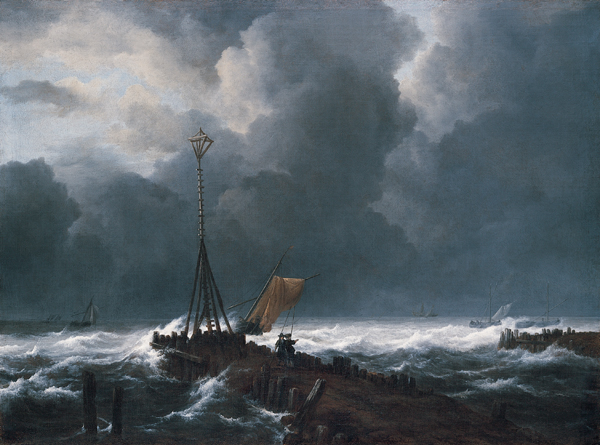
In Jacob van Ruisdael’s Rough Sea at a Jetty, the storm is one of geography, labour, commerce, and survival. Ships, shore, beacon, and jetty form a fragile human system at the edge of violent water. The scene carries no need for grand theatrical excess, and the storm gives meaning to the structures built against it.

By the eighteenth century, this relationship between danger and pleasure became central to the idea of the sublime. Edmund Burke associated the sublime with vastness, obscurity, power, pain, danger, and terror, especially when danger is experienced from a position of safety. A shipwreck can thrill the viewer because the viewer stands outside the wreck. The eye is permitted to approach what the body would flee. The sublime transforms fear into contemplation.
John Martin’s The Great Day of His Wrath moves the storm into apocalypse. Mountains collapse, cities fall, skies burn, and human figures become almost insignificant within the scale of destruction. Storm is a spectacle here, where it feels cinematic, enormous, theatrical, and a little “operatic”, in the best Victorian way. Yet its excess has purpose, the painting imagines the end of earthly stability, were nature becomes the instrument through which judgement takes form.

With Turner, the storm becomes more radical because it begins to consume the very structure of representation. In Snow Storm: Hannibal and his Army Crossing the Alps, exhibited in 1812, Hannibal and his army are present, yet they are dwarfed beneath a vast rotating mass of cloud, snow, darkness, and light. The heroic subject loses command of the image, while the terrible weather becomes the true protagonist. Human ambition, conquest, empire, and military glory are reduced before a storm that seems older, stronger, and more indifferent than history itself. For the creation of the work, Turner reportedly witnessed a Yorkshire thunderstorm while staying with Walter Fawkes at Farnley Hall and later transformed that local weather into Hannibal’s Alpine ordeal. Turner understood that a storm seen in one place could become the imaginative weather of another.

By the time Turner painted Snow Storm: Steam-Boat off a Harbour’s Mouth, exhibited in 1842, the storm had moved toward abstraction. Sea, snow, smoke, steam, and sky become one big vortex. The steamship appears as a small, struggling centre inside a rotating field of matter and force. Turner claimed to have experienced the storm from within, even saying that he had been tied to a mast in order to observe it. The tale has often been doubted, but it remains one of the great acts of Romantic self-fashioning. Turner presents himself as the artist who entered the storm and returned with vision. This painting is straddles two worlds at once, as it is still a sublime storm, full of danger and elemental violence, yet it also contains modern technology, where a steamship appears within the vortex. The storm is no longer only nature against humanity, it is nature, industry, machine, smoke, and speed all at once.

Constable offers the great countertradition. In Seascape Study with Rain Cloud, around 1827, the storm is immediate, observed, and intimate. The sea runs low across the picture while the sky dominates, heavy with a descending rain cloud. The painting conveys the the urgency of weather before it changes. Constable’s interest in atmosphere was serious and sustained, his sky studies are among the most attentive records of moving air in nineteenth-century painting. In this small work, the sublime is brought down from grand spectacle into empirical concentration.

The representation of storms changes again when we look to Japanese printmaking. Hokusai’s Under the Wave off Kanagawa, around 1830 to 1832, gives the sublime through line, rhythm, and form. The wave rises like a claw, Mount Fuji sits small and still in the distance, and the boats are held inside a moment of exquisite peril. The image is terrifying because it is so perfectly composed, and the sea becomes creature, architecture, and pattern.

Hiroshige’s Sudden Shower over Shin-Ōhashi Bridge and Atake makes heavy rain visible as rhythm, where the whole image seems organized by the angle of falling water. Rain falls as slanted lines across the surface, turning the scene into graphic structure. Figures cross the bridge under umbrellas and coverings, caught in the suddenness of exposure. The shower is social and temporal as it interrupts ordinary movement.

Albert Bierstadt’s A Storm in the Rocky Mountains, Mt. Rosalie from 1866 brings the storm into the American sublime. The painting is vast, panoramic, and theatrical, a “Great Picture” made fit for public display. The landscape opens under dramatic skies, with mountains, forest, water, mist, light, and cloud arranged as if the continent itself were being staged before the viewer. Bierstadt’s storm belongs to the nineteenth-century imagination of the American West: a landscape presented as immense, divine, spectacular, and newly available to vision. The painting’s beauty carries ideological weight, because the American sublime often turned land into destiny. Storm and mountain became signs of grandeur, but also of possession. The weather makes the landscape feel untouched and sacred, while the act of painting, exhibiting, and naming it brings it into cultural ownership. Bierstadt’s storm therefore stands at a complicated threshold, as it reveals wonder, and it participates in the making of national myth.

Laura Gilpin’s Storm from La Bajada Hill, New Mexico of 1946 brings storm imagery into photography with monumental restraint. The land lies low across the bottom of the image while the sky expands above it, dense with cloud, rain, and light. Gilpin gives the storm architectural presence. The weather rises in layers, as if built from shadow and illumination. Photography here becomes a way of witnessing atmosphere as structure, it makes the earth seem still only because the sky is so active.

By the twentieth century, the storm begins to change its meaning again. It remains sublime, but it can no longer be imagined only as nature’s power. The modern storm is also historical, technological, industrial, and political. This is where Walter Benjamin’s angel becomes essential. In his reading of Paul Klee’s Angelus Novus, Benjamin imagines the angel of history looking backward at the wreckage of the past while being blown helplessly into the future by a storm. That storm, he writes, is what we call progress. The reversal is devastating, progress, the word that promises improvement, motion, advancement, and mastery, becomes a storm piling debris behind it. The future arrives with such force that repair becomes almost impossible, the angel sees catastrophe where others see sequence. This image changes the lineage of storm in art, the storm is no longer only divine judgement, natural force, or Romantic terror, it becomes history itself.

Edward Burtynsky’s Xiaolangdi Dam #2, Yellow River, Henan Province, China, enters this lineage. At first glance, the photograph appears almost Turneresque: brown vapour, spray, sediment, water, force, and atmosphere all churning into a vast field of energy. It looks like a storm, yet the event is engineered. Water is being released through a dam. The tempest belongs to infrastructure, management, concrete, policy, and scale.
This is the contemporary sublime: beauty produced through systems that unsettle us. The force is real, the water is real, the grandeur is real. Yet the image carries the unease of human control. Burtynsky gives us a storm after progress, a Turner-like vision in which nature and technology have become inseparable. The river becomes spectacle through engineering. The sublime has passed through the dam.

David Spriggs takes storm imagery into spatial perception. In works such as Aeturnum, the storm is suspended as a phenomenon in space. His layered transparencies allow pigment, light, and image to gather into something that hover between drawing, sculpture, atmosphere, and apparition. A vortex appears through alignment and movement, where the viewer is required to complete the storm by moving around it. Spriggs gives contemporary form to a truth that has been present all along: a storm is a condition of seeing. It dissolves edges, disturbs orientation, and makes stability provisional. In these works, the storm becomes sculptural, optical, and almost metaphysical.
A storm can be so much to so many; it can be divine and comic, terrifying and beautiful, public and private, remembered from childhood or engineered by a dam. It belongs to the sky, but also to the body that runs for shelter, the animal startled in the leaves, the sailor gripping the deck, the painter chasing weather, the photographer waiting for the cloud to form, the viewer standing safely before danger and feeling the old tremor of scale.
Perhaps what storm images finally show us is not only destruction, but the instability of any world we have mistaken for permanent. They remind us that order is often a temporary arrangement. Art keeps returning to storms because they make visible the forces that polite daylight conceals. They show that beauty is not always gentle, that progress is not always innocent, and that nature has never just been a background against which human history unfolds.
CURRENT EXHIBITION


CONTACT US
4-258 East 1st Ave,
Vancouver, BC (Second Floor)
GALLERY HOURS
Tuesday - Saturday,
11:30 AM - 5:30 PM
or by appointment
我们提供中文服务,让我们带您走入艺术的界。