Matter, Light, and Becoming

welcome to our
SATURDAY EVENING POST
June 20th, 2026
By Diamond Zhou
Written with time, thought, and a human pulse.
Beacon
I was sitting on the ground looking upward at the English ivy climbing along the fence. The ivy was not simply green, it was layered, stratified, alive with different densities of matter and light. Where the noon sun struck the leaves, they became translucent, their surfaces altered from the familiar darkness of mature ivy into a young, bright, almost naïve green. The leaves seemed briefly illuminated from within, each one holding the sun in its thin body before releasing it again. The plant climbed with a quiet but determined intelligence, searching, reaching, extending upward and outward, its limbs outstretched languidly, its leaves opening themselves to warmth as though light was the sole nourishment it needed.
It was this experience of layered translucency, of matter becoming alive through light, that momentarily returned my thoughts to Susan Collett’s porcelain vessels. In the Beacon series, clay is no longer merely clay. It assumes the vividness of a living organism, something that appears to have grown rather than simply been made. The work rises from its base and opens outward in fluted, irregular folds, like leaves, ribbons, shells, lace, or the lifted edges of a garment. Its surface is not smooth or obedient, but built from thin, striated layers that catch, hold, and interrupt light. The porcelain seems to breathe between opacity and illumination. At times it is white as milk, at times warm as skin, at times shadowed like bone or linen. Like the ivy in sunlight, it reveals itself through degrees of exposure.

The title Beacon signifies that the work does not simply receive light passively. It appears to transform light into presence. A beacon is a signal, a lamp, a guiding point, a sign of orientation across distance or darkness. Yet Collett’s beacon is not declarative, it does not blaze outward with spectacle. Its illumination is quieter and more intimate, a kind of radiance produced through thinness, vulnerability, and permeability. When daylight moves through the vessel, the porcelain becomes less a solid wall than a membrane. The object seems to hold air, shadow, and warmth inside itself. Its layered body, its ribbons and ridges, its shrouding and caressing surfaces, all gather around an emptiness that feels strangely inhabited.
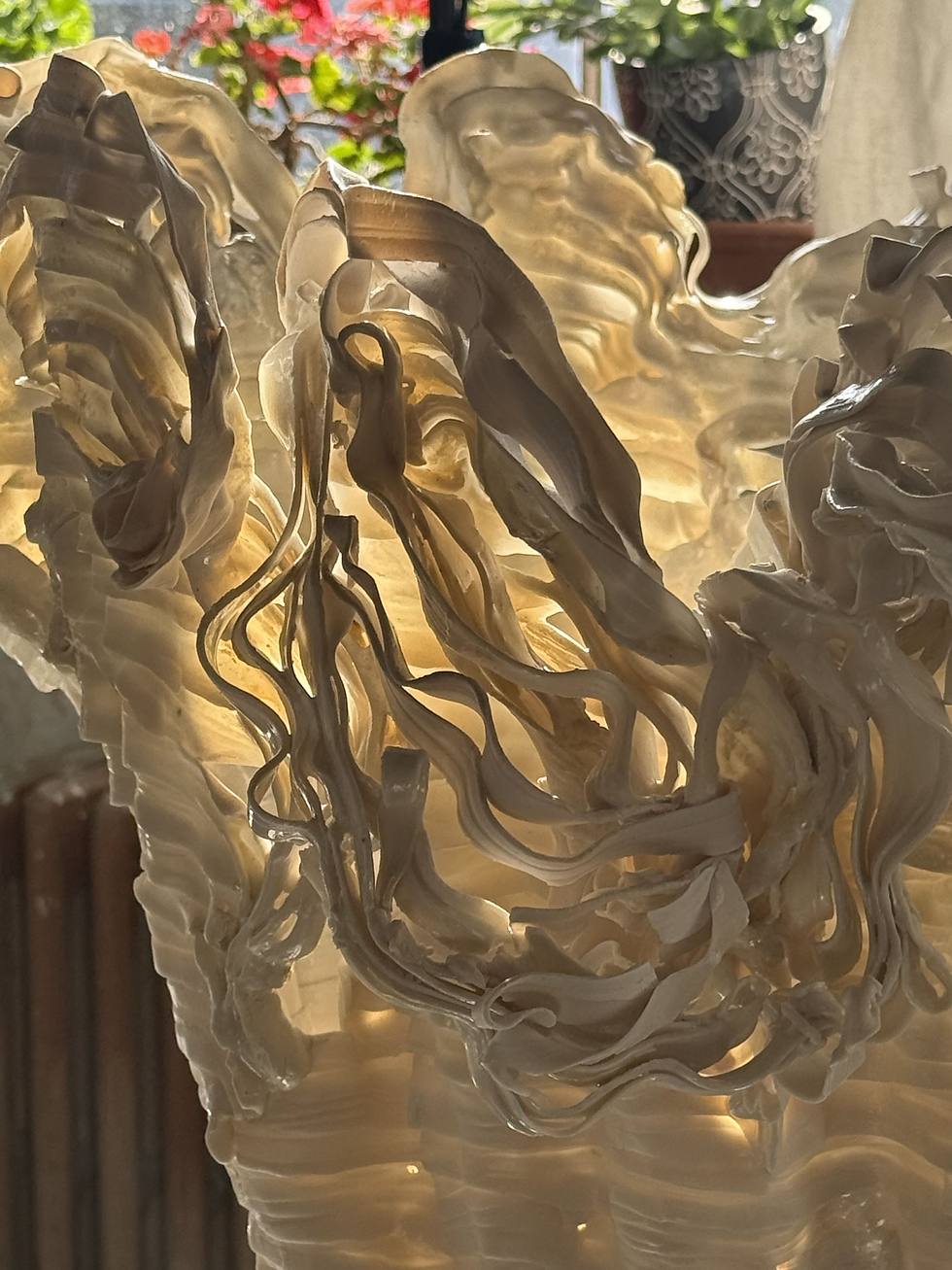

Ceramic carries a long tradition of containment: bowls, cups, urns, jars, chalices, funerary vessels, domestic vessels, ritual vessels. Even when ceramic sculpture moves far from function, the vessel remains as an inherited form, a kind of ancestral grammar. Collett does not reject that history but loosens it. In Beacon, the vessel no longer seems made to contain water, flowers, food, or ashes. It contains atmosphere, it holds light, breath, movement, and the memory of touch. Its interior is not a practical cavity but a charged space, a hollow that has become almost spiritual in its intensity.
The work is also profoundly sculptural. To call it a vessel is not to diminish it, but to recognize the vessel as one of the oldest and most enduring sculptural ideas: a body, a shelter, an offering, a form that gathers space within itself. Collett does not treat the vessel as a container. Her porcelain walls are thin enough to suggest fragility, yet strong enough to hold their expanding form, allowing light, air, and shadow to move through and around the work. The flared rim rises and falls with irregular grace, like a leaf edge, a wave, a collar, a flower, or a piece of fabric caught in a slow current. The sculpture seems to have captured motion, then entered stillness. Its striations deepen this sense of suspended movement. Each ridge records pressure, repetition, touch, and patient accumulation, so that beauty is not applied to the work but built into the process of its becoming. Collett’s background in printmaking can be felt in this rhythm of mark making, layer, and surface expression: the disciplined recurrence of gesture, the hand moving through material, the porcelain registering contact as both structure and memory.

Laden and Racine
Susan Collett’s Laden and Racine series accumulate, crust, twist, erupt, and root themselves and rise from below into being. Looking closely at these works one senses branches, coral, mineral deposits, forest debris, riverbed sediment, and the pale remnants of something once alive. They belong to no single category of nature: botanical, marine, geological, and bodily all at once, with “racine” carrying the sense of root as both origin and entanglement.

These are works heavy with process. Their forms appear to have been built through insistence, as though each filament, fold, wire, glaze, and encrusted surface had arrived by a logic of necessity. Unlike the Beacon series, both Laden and Racine’s fragility is embedded in accumulation. The works seem to be burdened but are not defeated, they are excessive in the fertile sense of the word, full beyond measure, overgrown with traces, dense with the residue of making.
The work feels archaeological, as though it has been retrieved from a site where ritual, nature, and decay have mingled beyond separation. It has the aura of an object that has survived burial, flood, fire, or some other passage through matter. Yet it is not ruinous in the usual sense. Ruin implies the remains of something once complete, yet these works feel like ruins that are still becoming, fragments that have not finished forming, remnants that are also beginnings.


I cannot help but think of the word entelechy in connection with Racine. In Aristotelian thought, matter is not merely inert substance, it carries potentiality, and form is the realization, or coming-into-actuality, of that potential. Collett’s sculptures feel like visible signs of such a process held in suspension. They do not represent branches, coral, roots, or buds so much as they disclose the principle by which such things come into form. Matter appears to be moving toward its own fulfilment, becoming itself through chance, accumulation, and transformation. The work is not static, even when still, it is an arrested event.
Collett’s technique of using multi-fired paper clay and wire enables her creation of these forms and allow the clay to behave as veins, tendrils, exposed nerves, stems, or small metallic shoots. In Racine, the tendrils rounded ends reveals themselves as droplets of sap, dew, seed, or molten silver. These forms interrupt the ceramic mass with tiny flashes of another order of material, one more tensile, industrial, and linear, and what first seems like a ruin begins to reveal a springtime intelligence. This gives the work its strange vitality. New growth appears to be stirring from within the encrusted body of the work. This is one of the most magical aspects of Racine: the sculptures seem not only made, but self-generating, as though their forms had begun to continue themselves after the artist’s hand withdrew. Collett does not make a coral, a branch, or a tree, she makes the condition of branching, clustering, sprouting, weathering, and regenerating visible.

The time element in these works is not merely thematic. It is material. Clay must be built, dried, fired, glazed, and fired again. It is a medium of waiting, risk, and transformation. Unlike bronze, which often carries the authority of certain permanence, ceramics remains haunted by vulnerability at every stage. It can crack, warp, slump, shatter, or fail. Collett does not hide this risk, she allows it to remain visible in the fissures, protrusions, crusts, and irregular edges of the work. The sculptures seem to have survived their own becoming, and that survival is part of their meaning.
There is something in Collett’s sculptures that recalls the smallest revelations of the natural world, those moments when matter appears suddenly alive with meaning. The underside of a leaf lit by sun. The faint mineral shine of a stone just pulled from water. The pale green persistence of spring returning through a crack in the ground. In such moments, the world reveals, briefly and without explanation, that nothing is ever truly still, that even what appears silent is carrying some hidden movement within it. What Susan Collett gives us is not simply the beauty of form, but the wonder of matter on the verge of revelation, a world caught at the instant before it fully becomes itself.

Susan Collett maintains a full-time studio art practice in downtown Toronto for over 30 years. She holds a BFA in Printmaking with a Minor in Ceramics from the Cleveland Institute of Art, USA. Her focus is public and private gallery exhibitions and commission work.
Strength against fragility is a core theme of her large-scale clay sculpture and printmaking.
Collections include The Montreal Museum of Fine Arts, Canada House, Trafalgar Square, UK. The Canadian Clay & Glass Gallery , The Gardiner Museum of Ceramic Art, Toronto, The Kasturbhai Lalbhai Museum, India, Sevres porcelain Museum, Paris, Arizona State University Museums, USA., The Gyeonggi Museum, Korea, The Burlington Art Gallery among others.
Exhibitions include The Korean Biennale 2024, ICAF, International Ceramic Art Fair, Gardiner Museum 2023, ESSENCE, The Canadian Clay & Glass Gallery, 2023, PAPER CLAY ILLUMINATED, USA touring, 2020-21, curated by Peter Held, The Keramion Museum 2019, solo Sandra Ainsley Gallery 2017, The Toronto International Art Fair 2013-2016, Korean Biennale 2012,2015, Taiwan Biennale 2012, with group exhibitions at SOFA Chicago, New York, Palm Beach and the Toronto International Art Fair.
The Canadiana Collection of the Official Residencies of Ottawa, Rideau Hall, holds the sculpture FILIGREE and it was placed in the private office of the Governor General of Canada. In 2015, AXIS was included in the permanent collection at the opening of Canada House, Trafalgar Square, Uk where she met Queen Elizabeth & Prince Phillip.
Susan received her letters from the IAC, International Academy of Ceramics in 2007 and her RCA, Royal Canadian Academy of Art in 2008.
CURRENT EXHIBITION


CONTACT US
4-258 East 1st Ave,
Vancouver, BC (Second Floor)
GALLERY HOURS
Tuesday - Saturday,
11:30 AM - 5:30 PM
or by appointment
我们提供中文服务,让我们带您走入艺术的界。