A Week with Edward Burtynsky
- Diamond Kyle

- May 30
- 5 min read
welcome to our
SATURDAY EVENING POST
May 30th, 2026
By Diamond Zhou
Written with time, thought, and a human pulse.
There was a particular kind of significance to this past week, not only because we had the privilege of welcoming Edward Burtynsky to Vancouver, together with his wife and business partner Julia Johnston, and his team, Caren and Karen, but because the exhibition itself seemed to create the conditions for serious looking, listening, and conversation. For the gallery, this is an important exhibition in several ways.v, with photographs that move across geographies, industries, and decades of sustained effort. These works are available to collectors, but they are not merely objects of acquisition. They are works of value in the deepest sense, because they hold within them the evidence of time, distance, labour, risk, beauty, and consequence.


Earlier this week, artist Neil Campbell said something I have been thinking about ever since. He observed that very few artists now make work that carries a true sense of awe. It was a simple remark, but it gave language to something that is difficult to name. Standing before Burtynsky’s photographs, one feels awe not because the works are large, or beautiful, or technically astonishing, though they are all of those things, but because their beauty is inseparable from scale, disturbance, and implication. They do not offer beauty as relief. They offer beauty as a way of seeing that draws us in before we fully understand what we are being asked to see.
Ed spoke this week about the sublime in the Kantian sense, not as a pleasant feeling of grandeur, but as an encounter with something that exceeds us, something whose scale or force unsettles our ordinary capacity to measure and contain the world. Traditionally, the sublime belonged to mountains, storms, oceans, darkness, vastness, and the overwhelming forces of nature. What is so powerful in Burtynsky’s work is that the sublime has shifted. We are no longer only humbled by what nature has made, as Ed has suggested, we are now confronted by the magnitude of what we have made ourselves. Mines, quarries, railcuts, tailings ponds, oil fields, salt pans, stepwells, shipbreaking yards, dams, and industrial systems become, through his photographs, both images of human ingenuity and evidence of human consequence.


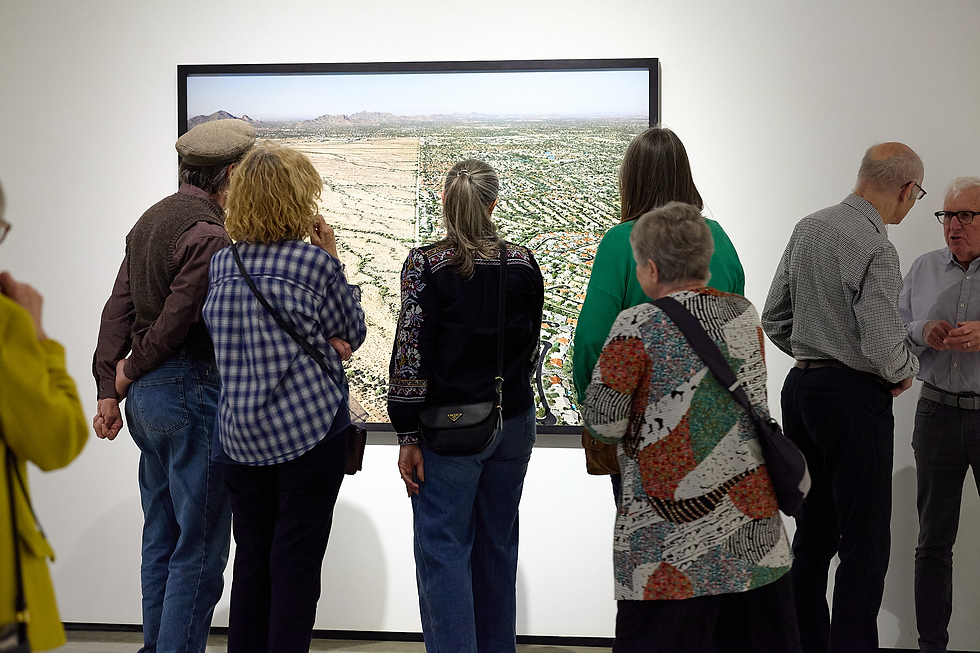
That is the difficult intelligence of these works. Burtynsky does not reduce the world to an environmental lesson, nor does he give us the comfort of simple moral distance, as though the landscapes before us were made by someone else, somewhere else, for reasons unrelated to our own lives. His photographs implicate without accusing. They show us systems of extraction, production, transportation, and transformation that are vast enough to seem abstract, yet intimately connected to the materials, comforts, technologies, and assumptions of modern life. Their beauty is therefore never innocent, but neither is it false. The world remains visually astonishing even where it has been wounded, and Burtynsky allows that contradiction to remain unresolved.
To see this survey in Vancouver is to see the evolution of a way of looking across more than four decades. These photographs are not simply images of places Ed has visited; they are the record of a life spent entering landscapes most of us will never see and returning with images that make visible the hidden scale of our own civilization. His work asks what progress looks like when seen from a distance, what industry looks like when stripped of its ordinary invisibility, and what value means when beauty and damage occupy the same surface.

This is also why the experience of seeing these works in a commercial gallery is important. A museum exhibition asks us to contemplate cultural significance, but a commercial exhibition asks an additional and more personal question. What does it mean to live with a work that carries this much visual power and historical weight? What does it mean for a collector to bring into a home, an office, or a private collection an image that is not merely decorative, but intellectually demanding and morally alive? Burtynsky’s photographs are collectible not because they are easy to possess, but because they continue to work on the viewer long after the first encounter. They are works one returns to because they do not exhaust themselves.


We are deeply grateful for the private events and gatherings that surrounded the exhibition this week, and for the many people and organizations who helped make them possible. Thank you to Scotiabank, RBC, Capture Photography Festival, the Audain Art Museum, Taittinger for the champagne, and Cocktails and Canapés for their thoughtful and highly professional service. We are especially grateful to Carol Lee and the Lee family, whose generosity, humility, and commitment to community building are felt in everything they do. Their work with the Chinatown Storytelling Centre, including the newly opened Learning Lab, is a powerful reminder that culture is not preserved by institutions alone, but carried forward by people who understand the importance of memory, hospitality, history, and shared presence.
We also want to thank the individuals who took time while Ed was in Vancouver to meet with us, to welcome us into their homes, to share their collections, and to offer us the gift of their attention. We know how valuable time is, especially for people whose days are filled with responsibility, and we felt deeply fortunate to be received with such openness and warmth. There is something profoundly meaningful about being invited not only into someone’s home, but into the private world of their looking, their collecting, their commitments, and their care. Those moments stay with us, because they remind us that art is never only about objects, it is also about the relationships, conversations, and forms of trust that gather around them.


Thursday evening’s conversation between Ed and John O’Brian was filled with such enthusiasm that we were genuinely sorry we could not accommodate everyone who tried to sign up. The gallery was full, with people standing in order to listen, and what was most striking was not simply the size of the audience, but the quality of attention in the gallery. People came because they wanted to think through the work, to hear Ed speak about process, history, landscape, industry, and the long arc of his practice.


We feel immensely grateful for this week, for Ed’s presence, for Julia, Caren, and Karen, for everyone who supported the exhibition, and for the many people who came with such generosity of mind and spirit. Above all, we are grateful for the chance to share these extraordinary works in Vancouver. Burtynsky’s photographs leave us with awe but not awe as escape. They leave us with awe as recognition, as responsibility, and as the difficult privilege of seeing more than we may have been prepared to see.
Above photos by Kyle Juron ©Paul Kyle Gallery.

CURRENT EXHIBITION
This exhibition at Paul Kyle Gallery offers a powerful survey of Edward Burtynsky work, revealing the complex and often uneasy relationship between human industry and the natural world through images of striking beauty and consequence. It will be the first major show of his work in Vancouver in over a decade.
CONTACT US
4-258 East 1st Ave,
Vancouver, BC (Second Floor)
GALLERY HOURS
Tuesday - Saturday,
11:30 AM - 5:30 PM
or by appointment
我们提供中文服务,让我们带您走入艺术的界。


