Geometry in Art

welcome to our
SATURDAY EVENING POST
March 7th, 2026
By Diamond Zhou

Geometry in art is often too narrowly understood through the lens of modern abstraction, as a language of squares, grids, circles, hard edges, and restraint associated chiefly with the twentieth century. Yet geometry as an artistic impulse is far older and far less narrow than that description suggests. Long before modernism adopted it as a self-conscious formal vocabulary, geometry had already served across cultures as a means of giving visible order to thought, architecture, ritual, cosmology, ornament, and collective belief, so that line, interval, repetition, and proportion carried not only decorative force but symbolic, spiritual, and intellectual consequence. Modern artists did not invent this ambitious undertaking, they reduced it, clarified it, and asked whether structure itself, rather than representation, could bear the full weight of meaning.


That ambition gave geometry an unusually wide emotional and philosophical range. It could suggest equilibrium, transcendence, discipline, radiance, system, containment, purity, tension, or silence. It could operate as an architecture of thought or as a means of slowing perception. Even within modern art, its uses diverge so sharply that no single emotional tone can contain them. Geometry now belongs to a continuing discussion about order and experience. It also belongs to the way a room is shaped, the way attention is slowed, and the way a work of art establishes its authority over space.
In the early twentieth century, geometric abstraction emerged as one of the clearest ways to detach form from description and to make relation itself the subject of art. Suprematism, Constructivism, De Stijl, and Concrete art proposed, each in its own manner, that painting might abandon the representation of things in order to articulate structures more fundamental than appearance, whether those structures were spiritual, social, perceptual, or universalising in ambition. Piet Mondrian’s equilibrium was not simply compositional neatness but a search for dynamic balance through opposition and restraint. Kazimir Malevich’s reductions did not aim merely at simplification but at a new order of experience in which painting might approach pure feeling through the suspension of objecthood. Geometry in these movements was never just a matter of shape. It was a proposition about the world and about the capacity of abstraction to remake vision itself.


Josef Albers clarified another possibility altogether, one in which geometry became less a doctrine than a disciplined method of inquiry. The nested format of the Homage to the Square paintings appears, at first, almost prohibitively simple, yet that very constancy allowed Albers to demonstrate that colour is never stable in isolation and that perception is always relational, contingent, and subtly vulnerable to context. The square, repeated with near liturgical consistency, becomes a site of continuous visual transformation. What looks fixed proves unstable, and what appears objective reveals itself as contingent. Geometry here intensifies sensation by stripping away distraction and exposing the astonishing mobility of seeing.

Agnes Martin brought geometric order into an altogether quieter space. Her grids and bands do not declare authority in a hard voice, nor do they seek optical spectacle; they create a condition in which we are asked to become more delicate, more patient, more willing to register minute changes of composition, line, and tone. Her paintings show that discipline and subtlety are not opposing values, and that restraint can deepen rather than flatten feeling. Geometry in Martin is not a mechanism for control but a way of sustaining concentration. The work asks the viewer to submit to structure slowly.

Carmen Herrera’s angular divisions, reduced palette, and unwavering economy refuse every surplus gesture, yet the paintings never resolve into inert design because the meeting of wedge and field, symmetry and disruption, edge and interval produces real visual pressure. The paintings hold their force through exact decision, through a clarity that is not neutral but charged. In Herrera’s hands, geometry becomes a language of compression, and the severity of means only heightens the intensity of relation. Her work remains among the strongest rebuttals to the lazy idea that abstraction becomes less human as it becomes more exact.

Ellsworth Kelly pursued a different kind of clarity, one less compressed than Herrera’s and more open in its relation to shape, scale, and colour, yet no less rigorous in its commitment to reduction. In his work, geometry is rarely a matter of system for its own sake. It becomes a way of isolating visual experience, allowing contour, interval, and chromatic presence to act with unusual directness. His paintings and shaped canvases do not explain themselves through complexity. They assert themselves through singleness, through the conviction that a form, precisely placed and fully resolved, may carry an intensity out of all proportion to its apparent simplicity.

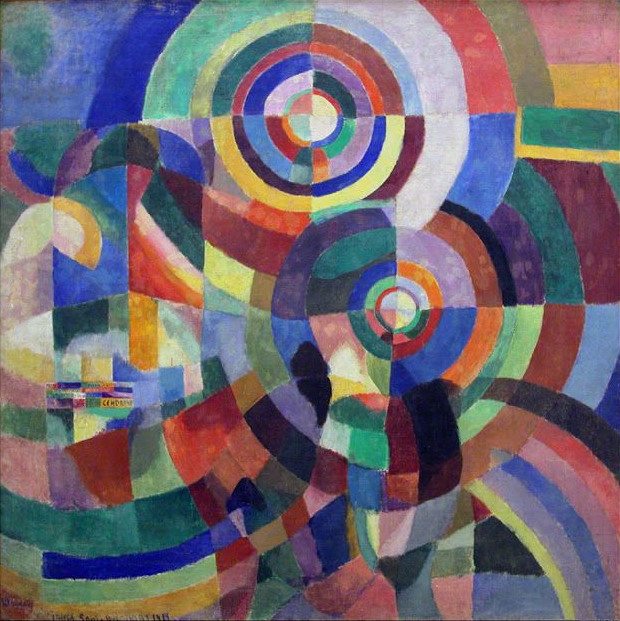
Sophie Taeuber-Arp carried geometry across painting, textile, design, architecture, and performance, revealing how seamlessly ordered form could move between media without losing its formal intelligence, and Six Spaces with Four Small Crosses still feels fresh because its structure is lucid. Sonia Delaunay infused abstraction with movement, simultaneity, and chromatic rhythm, giving geometry a vital and urban pulse in works such as Prismes électriques. Verena Loewensberg brought a different kind of freshness to Concrete art, showing how geometric clarity could remain light, buoyant, and unexpectedly lyrical. Together they remind us that geometry has never belonged solely to manifestos, and that one of its deepest strengths lies in its capacity to cross media, speed, and sensibility without losing formal seriousness.


Victor Vasarely and Bridget Riley, whose work helped define Op art, demonstrated that exact structure does not necessarily yield calm or certainty, and that repeated forms, calibrated contrasts, and controlled patterning can unsettle the eye more effectively than any gestural excess. Their work remains crucial because it exposed geometry’s ability to generate vibration, disorientation, and perceptual suspense. The eye does not simply receive order in these works, it labours under it, misreads it, is pulled forward and held back by it. Yet the larger force of geometric art does not end there, because the same vocabulary that produces optical agitation can also produce stillness, devotional focus, architectural lucidity, or bodily tension.


Once geometric form enters real space, it ceases to be only a relation on a surface and becomes a condition of movement, scale, enclosure, balance, and physical awareness. Donald Judd’s serial structures insist upon interval, unit, and the literal fact of the object. Sol LeWitt treated geometric form as an open proposition, extending cubes and modular systems into serial thought. Dan Flavin transformed the straight line into radiant structure, making architecture itself the medium through which light becomes measurable. Richard Serra gave geometric form a heavy, bodily presence, so that the viewer encounters not only shape, but mass, balance, and spatial tension.


Anne Truitt occupies a particularly beautiful place within this expansion because her sculptures hold the directness of pared down form without sacrificing inwardness. Their painted surfaces, hand worked and carefully calibrated, remind us that simplification need not produce impersonality, and that a vertical structure can carry memory, mood, and emotional gravity without abandoning formal precision. The same may be said, differently, of Lygia Clark and Gego, both of whom opened geometry away from fixity. Clark’s articulated metal forms make measured structure provisional and transformable. Gego loosened line into transparency, network, and volume, allowing geometry to breathe, fray, and open itself to the space around it.


The California artists associated with Light and Space and related finish-fetish practices opened another path, one in which geometric form retained its exactness while acquiring sensual, atmospheric, and perceptual delicacy. De Wain Valentine’s polished resin discs and columns are explicit in structure yet elusive in experience, because light seems not merely to strike their surfaces but to enter and inhabit them, with light seeming not merely to strike their surfaces but to enter and inhabit them. Larry Bell’s glass cubes hold reflection, transparency, and opacity in a state of permanent negotiation. John McCracken’s monochrome planks position the painted plane between wall and floor, preserving the authority of the image while insisting on objecthood and physical presence. Geometry here becomes luminous, suspended, and uncannily atmospheric.


In Canada, geometric art developed with its own particular intensity. Guido Molinari made serial colour into doctrine, as a sustained insistence that interval and repetition could serve as the primary structure of pictorial experience. Claude Tousignant, especially in the targets and hoops, pressed colour toward bodily sensation, so that circular form becomes less a motif than a force field. Yves Gaucher, by contrast, found in repetition and separation a grave and musical restraint, allowing the measured interval to carry silence, tension, and a strange authority of pause. Rita Letendre brought another current into the discussion altogether, because her directional abstractions retain a muscular, driving energy that keeps geometry from becoming too sedate. Together they show that geometric structure in Canada could be serial, bodily, meditative, and forceful all at once.
Writing on Gaucher, the Canadian art historian and curator Roald Nasgaard captures the paradox beautifully: “Gaucher’s well-practised intuition determines the exquisitely tuned details of line lengths, tonalities, and relative placements. Despite their limited means, the emotional range of the paintings is astonishing.”


Joseph Kyle’s paintings make one of geometry’s most ambitious claims, namely that structured form may do more than organise a surface and may instead become a vehicle for coherence, inwardness, and totality. His concept of Syn-optics is defined as “seeing as a whole,” a mode in which shape and colour operate on equal footing and the painting is apprehended as an integrated totality rather than as an assembly of isolated effects, a formulation that clarifies the larger ambition of the work, since these paintings do not pursue formal control for its own sake but seek synthesis, asking the viewer to experience relation in a fully integrated way so that colour, structure, interval, and balance become inseparable from a larger condition of awareness.

Music, spiritual inquiry, and the teachings of Sri Aurobindo and Integral Yoga shaped that ambition in ways that distinguish Kyle from harder, colder accounts of geometric abstraction. The point is not simply that he had intellectual or spiritual influences, but that the paintings register those commitments structurally. Their order does not feel doctrinal, it feels concentrated. Geometric abstraction is often assumed to be primarily cerebral, while feeling is more easily located in gesture, atmosphere, or figuration, yet Kyle’s paintings undo that opposition. Their precision is not opposed to inwardness, but becomes the means by which inwardness is stabilised, clarified, and offered to the viewer in visual terms. Measure becomes attunement, and order becomes a way of holding consciousness in balance rather than a way of subduing it. Structure, colour, movement, and form are experienced as an intentional totality, and the painting is apprehended less as a set of separate formal decisions than as something closer to a symphonic whole, which is precisely what allows his work to sit so meaningfully within a broader history of geometry rather than at its margins.

In light of Joseph Kyle’s birthday, this meditation on geometry is also a small act of recognition, a way of honouring both the achievement of his work and the particular beauty of the sensibility it represents. Kyle’s paintings have helped shape our understanding of what geometric abstraction can hold when it is pursued with seriousness, inwardness, and formal conviction, and they have also sharpened our appreciation for artists who trust measured relations, who understand that structure need not harden into sterility, and who recognise that precision, when it is fully alive, can carry emotional, intellectual, and even spiritual force. Geometry, in that sense, is never only a matter of style. It is a way of thinking, a discipline of attention, and often a declaration of faith in the expressive capacity of relation itself.

That sensibility continues to inform the artists we are drawn to and the artists who find a place within the gallery, because what it preserves is not simply a formal preference but a way of understanding art itself: as a field in which relation matters, precision need not exclude feeling, and structure may still open onto spaciousness, intensity, and reflection. It is this conviction, carried forward in different ways across many practices, that gives geometry in art its continuing force.
Geometry in art persists because it addresses a question that never disappears: whether form can hold thought without stiffening into system, and whether order can remain alive rather than merely correct. The finest works in this tradition do not answer by reducing experience, they answer by concentrating it. They show that structure need not be the opposite of feeling, that clarity need not exclude complexity, and that exact form, in the hands of the right artist, can become one of the most powerful means by which art makes perception more rigorous, more self-aware, and more whole.


Its deepest appeal may finally lie in the fact that geometry reaches beyond art history into a larger human problem. Human beings do not merely want sensation, they want orientation, they want order, they want some relation between the scattered nature of experience and the possibility of coherence. Geometry offers no simple salvation, but it does give visible form to that longing. A repeated interval can steady the eye, a held proportion can calm the mind, a circle can gather a room, a grid can make silence legible, a sharply resolved painting or sculpture can bring the viewer, if only briefly, into contact with an order that feels neither imposed nor decorative, but discovered.
That is why geometric art so often approaches the threshold of the spiritual without requiring iconography, and why it can feel emotional without becoming confessional. Barnett Newman understood this with particular force, recognising that geometry could do far more than organise a surface. In such work, geometry ceases to be merely structural. It becomes a way of testing whether the simplest relations may still open onto awe, stillness, or something very close to faith. It works in a zone where form becomes more than arrangement and less than doctrine, where structure carries a kind of belief without needing to name its theology.

In that sense, geometry in art is not finally about shape at all. It is about the possibility that relation itself, once clarified, may become sustaining. It is about the conviction that order need not imprison experience, and may instead gather it, refine it, and carry it toward a condition in which seeing becomes more lucid, more patient, more interior, and perhaps, for a moment, more equal to the life one is trying to live. That is also why geometric art has remained so enduringly attractive to collectors, curators, architects, and artists alike. At its highest level, it offers not just visual pleasure but a discipline of presence. It reminds us that art need not always persuade through narrative or seduce through excess, sometimes it works by bringing disparate things into such precise relation that we feel, for a moment, the possibility of inward alignment. And in a culture organised around speed, saturation, and distraction, that may be one of the most generous things art can still do.
CURRENT
The Collaborators
Nettie Wild and Friends, Films, and Installations

Special event screenings of each film and installation will be followed by conversations with Nettie Wild and her collaborators, unpacking the creative and practical challenges behind each work.
UPCOMING THIS WEEK
 | SUNDAY, MARCH 8th KONELĪNE: our land beautiful, experimental feature documentary, 92 mins (2016) Doors open at 1:00PM, screening begins at 2:00PM Joining director Nettie Wild for the post screening discussion will be fellow collaborators producer Betsy Carson, editor Michael Brockington, composer Hildegard Westerkamp, and sound designer Mark Lazeski. |
WEDNESDAY, MARCH 11th A PLACE CALLED CHIAPAS, feature documentary, 92 mins (1998) Doors open at 6:30PM, screening begins at 7:30PM Screening and discussion with Nettie Wild and fellow collaborators Betsy Carson, Kirk Tougas, and Velcrow Ripper |  |

CONTACT US
4-258 East 1st Ave,
Vancouver, BC (Second Floor)
GALLERY HOURS
Tuesday - Saturday,
11:30 AM - 5:30 PM
or by appointment
我们提供中文服务,让我们带您走入艺术的世界。