How to Write About Art

Updated: Apr 25
welcome to our
SATURDAY EVENING POST
March 7th, 2026
By Diamond Zhou
“For many years, I have been moved by the blue at the far edge of what can be seen, that color of horizons, of remote mountain ranges, of anything far away. The color of that distance is the color of an emotion, the color of solitude and of desire, the color of there seen from here, the color of where you are not. And the color of where you can never go.”
– Rebecca Solnit

Rebecca Solnit’s reflection on distance, longing, and the unreachable edge of vision has stayed with artist Alexander Jowett, offering a resonant point of departure for a body of work shaped by the horizon as both image and idea.
Sometimes art making is simply a way of channelling feeling into form.
To write about art, especially from the artist’s perspective, is not to supply a running defence of one’s own existence, nor to pretend that every work arrives in the world already accompanied by a fully articulated theory of itself, but to discover, after the work has begun to assume its shape, what kind of language can stand beside it with enough clarity to be useful and enough restraint not to overtake it. A great many young artists are already influenced by that culture, are taught to experience writing as a kind of compulsory justification, as though every ceramic work, photograph, installation, or painting must first survive scrutiny before it is allowed to count as serious. Yet the actual life of making tends to proceed otherwise, through material curiosity, failure, adjustment, memory, rhythm, visual appetite, and the slower recognition, often reached only afterward, of what one has really been doing. An artist statement, then, should be a supplementary form, one that ought to clarify the terms on which the work wants to be encountered, and perhaps clarify them for the artist as well.
That is why the first discipline in writing about art is still the most practical one, and also the one most frequently neglected: begin not with the grand theme, not with the abstract framework you hope the work will sustain, and not with the vocabulary that signals seriousness, but with the work itself, with what is there. What is the medium, the scale. What do the surface, weight, texture, colour, contour, repetition, cut, or reflection ask of the eye and the body. How does the work behave. Does it hold the viewer back, draw the viewer inward, slow perception down, sharpen it, scatter it, or make it pass through sequence, symmetry, compression, and delay. Description, in serious art writing, is not a humble preliminary to interpretation, as though one first names the obvious and only later begins to think; it is the foundation of thought, because without a sufficiently exact account of the work’s appearance and operation, interpretation too easily begins to float free of the object and turns into a general statement about a topic rather than a real statement about this work. Younger artists, and sometimes young art educators need to hear that plainly. Not every decision has to be justified in advance, but if one is writing after the fact, one must remain answerable to what the work can actually be seen to do.

Artists attempt to solve this problem through their various forms of writing, and when they write well, they rarely begin by inflating the work’s ambition, instead, they begin by identifying the level at which visual form had to take over from speech. Georgia O’Keeffe found she could say things with colour and shapes that she had “no words for”, she says that not because it romanticizes ineffability, but because it locates the necessity of visual art precisely where language first proves insufficient.

Sol LeWitt wrote that “the idea becomes a machine that makes the art,” which remains one of the cleanest accounts we have of how works such as the Wall Drawing series can be understood from within its own logic, not as a final image waiting to be interpreted but as the result of a prior conceptual structure.

Louise Bourgeois, speaking of the spider that culminates in Maman, wrote, “The Spider is an ode to my mother. She was my best friend,” and in that compact statement she manages to name psychic origin, symbolic charge, and emotional allegiance. In each case, the artist identifies a genuine centre of necessity rather than attempting to narrate every meaning the work may later carry. Good artist writing does not account for everything; it tells us where the work had to begin.

One can watch the same principle take a more extended and observational form in artists such as Alma Thomas and Joan Mitchell, both of whom show that even abstraction can be written from the pressure of lived looking rather than from imported theory. Thomas, speaking of the holly tree outside her window, said, “Why, the tree! The holly tree! I looked at the tree in the window, and that became my inspiration,” and what follows in the same account, her sense that the wind kept giving her “new colors through the windowpanes,” tells us something essential about how perception becomes form, and how messages are delivered in her work: “Through color, I have sought to concentrate on beauty and happiness, rather than on man’s inhumanity to man.”

Joan Mitchell’s statement is, if anything, even more instructive for painters: “I paint from remembered landscapes that I carry with me—and remembered feelings of them, which of course become transformed.” That sentence refuses two equal errors, the false literalism that would reduce painting to transcription and the false mystification that would detach painting from experience altogether.


Glenn Ligon work begins so often in quotation but still insists on the limits of language. Speaking about Study for Black Like Me #2, he says, “not everything can be explained in language,” and then adds that he is interested in those moments when “language comes up short or fails.” Ligon names the threshold at which language remains necessary but cannot be sovereign. The statement becomes even more instructive when one considers the mechanics of the work itself, the repeated stencilling that moves from clarity toward illegibility, turning text into a visual field of accumulation, erasure, and pressure.
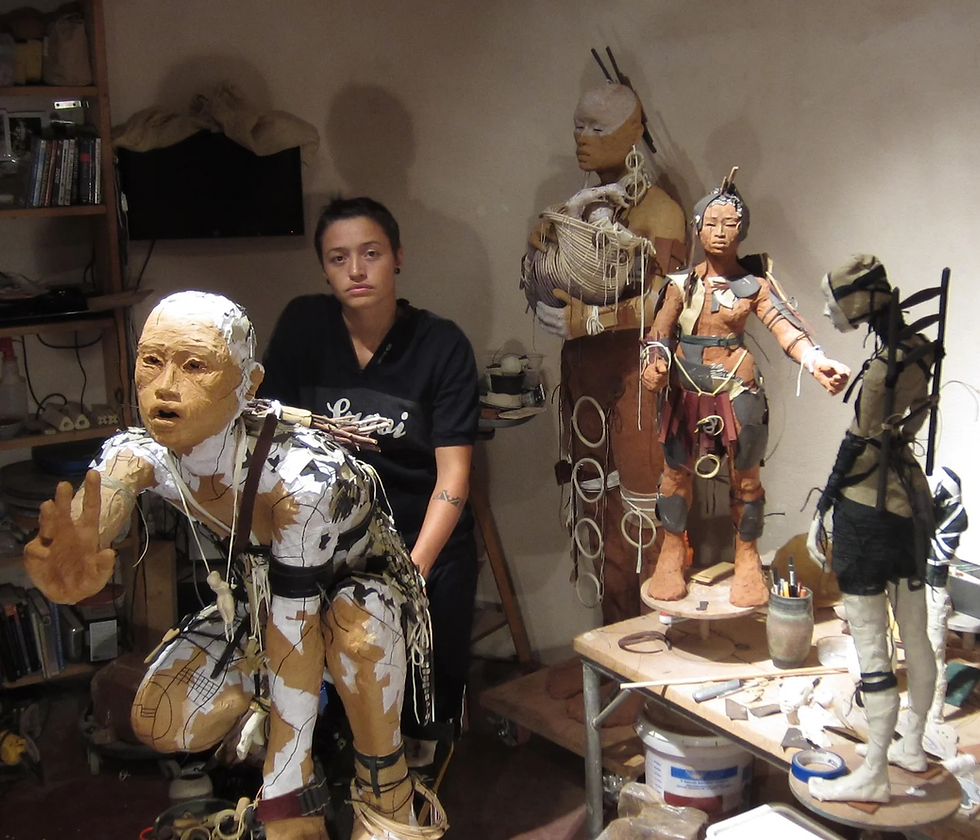
For students working in ceramics, sculpture, or any medium in which process remains visibly present, Rose B. Simpson may be one of the most valuable contemporary examples, because her language restores making to its full intellectual dignity. Of her practice she says, “I’m trying to reveal our deep truth and that deep truth is process,” and it is difficult to imagine a more direct correction to the classroom assumption that every formal decision must arrive pre-justified. Process, here, is not what happens before meaning, process is one of the places where meaning takes form. The trace of the hand, the inheritance of ceramic knowledge, the movement between past and present, and the artist’s own language of becoming all work together to remind us that a statement need not function as an audit of decisions. It may instead register the conditions under which a work had to be made. That is especially important for younger artists, who are often penalized for not yet possessing a polished critical vocabulary when what they may in fact possess is something more primary and more promising: a real relation to material, to touch, to rhythm, to inherited forms, to failure, to intuition, and to the emerging intelligence of the object itself. Writing should help that intelligence become legible but should not replace it.
It is also worth preserving the distinction between artist writing and curatorial or critical writing, because the two are not interchangeable and should not be treated as though they were. The artist is rarely best placed to produce a full historical positioning of the work, and the critic or curator is not entitled to use the artwork merely as a platform for rhetorical display. The strongest curatorial prose usually moves outward in an ordered way, beginning in scene, structure, and visual fact before widening into context and implication. Strong criticism, in other words, does not leap immediately to the most total claim available. It earns its reach by exactness. It gives the reader something to verify in the work before asking the reader to accept the larger argument built around it. Young writers often need permission to slow down in this way. The temptation, especially in institutional settings, is to sound finished too early. The better ambition is to sound accurate first.

“I don’t express myself in my painting. I express my not-self. The dictum ‘Know Thyself’ is only valuable if the ego is removed from the process in search for truth… The fact that people break down and cry when confronted with my pictures shows that I can communicate those basic human emotions… the people who weep before my pictures are having the same religious experience I had when painting them. And if you say you are moved only by their color relationships then you miss the point.”
- Mark Rothko
What makes writing about art useful, memorable, and worth passing on, then, is not simply lucidity. Though lucidity is indispensable and not simply elegance, though prose without shape rarely carries thought very far, but a proper relation between language and object, between what the work can be responsibly said to contain and what the sentence dares to propose. The best art writing leaves the work more available, not more closed. It asks the act of looking, of seeing. It names what is there, what is happening, what has been risked, what has been withheld, what kind of thought or feeling the work is organized to sustain. It also recognizes, without embarrassment, that not every serious work begins with a statement, and that some of the most consequential artistic decisions are discovered in the act of making rather than announced in advance. That is why the culture of art writing matters beyond the statement itself. If younger artists are taught that writing is merely justificatory, they will either become defensive or formulaic. If they are taught that writing is a mode of attention, one that can accompany the work without subduing it, then they may develop a language equal to practice rather than fearful of it.
CURRENT
The Collaborators
Nettie Wild and Friends, Films, and Installations

Special event screenings of each film and installation will be followed by conversations with Nettie Wild and her collaborators, unpacking the creative and practical challenges behind each work.
UPCOMING THIS WEEK
 | SUNDAY, MARCH 15th BLOCKADE feature documentary, 92 mins (1993) Doors open at 1:00PM, screening begins at 2:00PM Joining director Nettie Wild for the post screening discussion will be fellow collaborators producers Betsy Carson and Gary Marcuse and composer Roy Forbes. |
WEDNESDAY, MARCH 18th Doors open at 6:30PM, screening begins at 7:30PM CLICK HERE TO RSVP FOR MARCH 18th SATURDAY, MARCH Screening at 3:00PM during gallery hour KLAVIERKLANG experimental performance video, 17 minutes 33 seconds (2024) Beneath The Forest Floor two channel audio soundscape, 17 minutes 23 seconds (1992) Created by composer HIldegard Westerkamp Round Up experimental documentary video, 3 mins |  |

CONTACT US
4-258 East 1st Ave,
Vancouver, BC (Second Floor)
GALLERY HOURS
Tuesday - Saturday,
11:30 AM - 5:30 PM
or by appointment
我们提供中文服务,让我们带您走入艺术的世界。