Inspirational Artists' Quotes

welcome to our
SATURDAY EVENING POST
April 4th, 2026
By Diamond Zhou
“...until the age of 70, nothing I drew was worthy of notice. At 73 years I was somewhat able to fathom the growth of plants and trees, and the structure of birds, animals, insects and fish. Thus when I reach 80 years, I hope to have made increasing progress, and at 90 to see further into the underlying principles of things, so that at 100 years I will have achieved a divine state in my art, and at 110, every dot and every stroke will be as though alive. Those of you who live long enough, bear witness that these words of mine are not false.”
— Katsushika Hokusai
[translation by Henry D Smith II]
This quote is not a casual remark but a late-life manifesto, Hokusai's fervent belief was that the older he got the greater his art would become. In 1834, when he was 75, he famously written this in a postscript to volume one of his extraordinary illustrated book One Hundred Views of Mt Fuji (Fugaku hyakkei): What gives it force is Hokusai’s refusal to see mastery as completion; he imagines art as something that keeps ripening even into old age, which makes the line feels like a vow. He suggests that real seeing may require a lifetime of failure, repetition, humility, and stubbornness. For anyone who has ever worried about being too late, Hokusai answers with almost comic severity: too late? He was planning his best brushstroke for age one hundred ten.

“Je vous dois la vérité en peinture, et je vous la dirai.”
(“I owe you the truth in painting, and I will tell it to you.”)
— Paul Cézanne
Cézanne wrote this in a 1905 letter to Émile Bernard. It became one of the decisive statements of modern painting because it shifts the goal of art away from prettiness or finish and toward truth, the underlying structure of truth, what he describes as. “truth of being” and the “logic of colour”, which is of structure, sensation, and perception.

“What I dream of is an art of balance, of purity and serenity, devoid of troubling or depressing subject matter…”
— Henri Matisse
This comes from Notes of a Painter in 1908, one of the foundational texts of modernism. People often treat Matisse’s serenity as softness, but it was a serious ambition: to make art that could restore order to a frayed mind without surrendering intensity or intelligence.

“Color is the keyboard, the eyes are the hammers, the soul is the piano with many strings.”
— Vasily Kandinsky, The Effect of Color, 1911
Kandinsky explains why abstraction, for him, was never a retreat from meaning. He thought colour could act directly on inner life, almost musically, which is why his writing remains so important to the spiritual history of modern art.

“Art does not reproduce the visible; rather, it makes visible.”
— Paul Klee
This survives as the signature sentence of Klee’s 1920 Creative Confession. It is one of the cleanest defences of modern art ever written: art is not there to mirror the world obediently, but to reveal what ordinary seeing misses, buries, or cannot yet articulate.

“The pictures were painted directly through me, without any preliminary drawings and with great force.”
— Hilma af Klint
The Guggenheim notes that Hilma af Klint said this of one of the major series for her Paintings for the Temple, a body of work she developed beginning in 1906. When she died in 1944 she left behind more than 1,200 abstract works, and that they remained largely unseen until 1986. For years modern art told a story of abstraction led by a familiar male sequence, yet here was a woman in Sweden making monumental abstract paintings before many of the official heroes had stabilized their own languages. She presents the artist as vessel, receiver, medium, and it unsettles not only the history of abstraction, but the ego structure of authorship itself.

“I rarely draw what I see. I draw what I feel in my body.”
— Barbara Hepworth
This is one of the most beautiful sculptural statements of the twentieth century. Hepworth shifts form away from mere optical description and into embodiment, which helps explain why her sculpture feels so lived, so sensed from within rather than merely looked at from outside.

"Painting is not separate from life. It is one.”
— Lee Krasner
The Metropolitan Museum of Art preserves this in writing about Krasner, and it is especially moving because her career was so often read through someone else’s legend. The quote refuses that reduction: painting for Krasner was not a profession adjacent to life, but the very medium through which life, memory, struggle, and self-knowledge became visible.

“Creative art is for all time and is therefore independent of time.”
— Alma Thomas
This is one of the most triumphant statements in American art. The Anacostia Community Museum preserves the longer form of the quote and places it beside Thomas’s late, radiant abstractions. The same source notes that those paintings were inspired not only by natural phenomena but also by the Apollo lunar missions.
Thomas is speaking from the far side of exclusion, she was a Black woman artist and teacher who came to major recognition late, and instead of turning bitterly inward, she made paintings of extraordinary light, rhythm, and chromatic joy. There is something almost defiant in that joy. Her phrase “released me from the limitations of the past” is not abstract uplift, it is a statement earned against racism, sexism, ageism, and institutional delay. And then she goes further: she claims that art, at its highest level, exceeds these categories altogether, it is a universalist statement, but not a naïve one. It comes from someone who knew exactly what history had done.
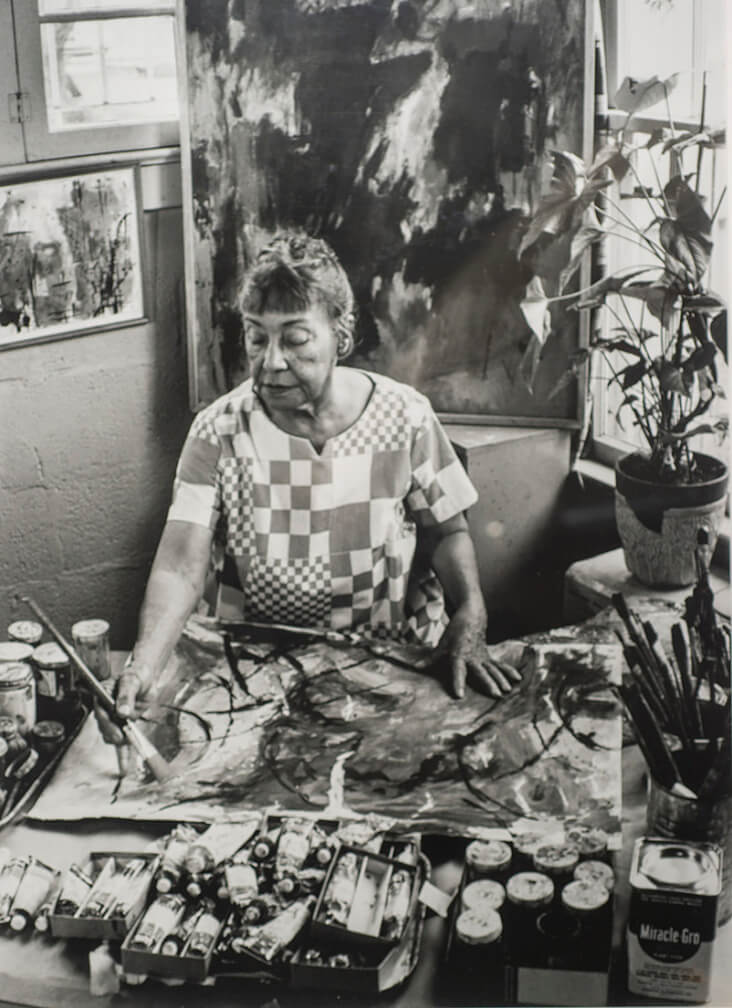
“It’s not about me. It’s about we.”
— Glenn Ligon
The quote is a theory of subjecthood. Ligon’s work threads autobiography into symbols that speak to collective experiences, while his broader practice examines cultural and social identity through literature, photographs, and other found sources. Ligon moved away from Abstract Expressionism and he transformed from telling “my own stories,” to became interested in “what other people have to say” and in bringing what was already in the world into the work.
Ligon is not a diarist in the ordinary sense. Even when the work is deeply personal, it is rarely merely confessional. He takes language already saturated with history, from Zora Neale Hurston, James Baldwin, Jean Genet, Richard Pryor, and others, and subjects it to repetition, smudging, erosion, and delay, so that reading becomes difficult and meaning becomes thick rather than transparent. His stencilled texts become abstract, hard to read, and layered in meaning; the Whitney Museum explains that in works using Hurston’s words, the text begins crisp and becomes smudged into darkness, making identity itself appear contingent, unstable, and historically pressured.
Ligon understands that the self is never simply private property. It is composed through language, race, desire, nation, and memory, through quotations that arrive before us and exceed us. His work explores race, language, desire, sexuality, and identity. His work foregrounds the construction of Black identity through words and images and often adds personal agency to preexisting texts. In other words, Ligon’s “we” is not a cheerful collective slogan. It is a dense, contested social field. The individual voice matters, but only because it is already haunted by other voices. Ligon’s art is original, yet it is built out of citation, appropriation, repetition, and communal language.

“Art is art-as-art and everything else is everything else. Art-as-art is nothing but art.”
— Ad Reinhardt
Reinhardt’s line is one of the great statements of artistic severity, almost comic in its absolutism and yet entirely serious. The Ad Reinhardt Foundation places this within his broader 1963 argument that each revolution in art moves it away from being “art-as-also-something-else” and toward “art-as-only-itself.” This was never merely a slogan of purity. It belonged to a total programme in which painting was to be stripped of narrative, symbolism, sentimentality, social utility, theatrical expression, and nearly every external demand placed upon it. As MoMA notes, Reinhardt called for a “purely optical kind of art” and pursued the “essence of art” through a “pure, abstract, non-objective, timeless, spaceless, changeless, relationless, disinterested painting.” The language is so extreme it approaches monastic discipline, which is precisely why it remains compelling.
That programme finds its fullest form in the late black paintings. At first glance they can appear as blank refusals, yet they are structured by barely perceptible cruciform divisions and subtle shifts of hue that require prolonged, concentrated looking. Reinhardt’s purism is therefore not empty but exacting: he removes anecdote so that seeing itself becomes the event. No story, no symbol, only the discipline of attention. This is why the quote remains so provocative. Where most viewers still want art to tell, improve, express, flatter, or console, Reinhardt refuses with elegance. One need not agree with him to feel the force of the question he leaves behind: can art justify itself without borrowing authority from politics, morality, biography, commerce, or therapy? What saves him from mere doctrine is that his severity proved historically fertile. MoMA notes that younger artists, particularly the Minimalists, found his rigor exemplary. In stripping art toward essence, Reinhardt gave later artists something they could inherit, resist, or overturn, and that is often how the most consequential severity enters history.

“No picture exists before it is done, no form before it is shaped.”
— Anni Albers
This is one of the deepest things any artist has said about the act of making. The Albers Foundation preserves it in her essay One Aspect of Art Work, where she continues by saying that conception gives a work only its “temper,” not its “consistency,” and that things take shape in material and in the process of working it.
This destroys the fantasy of total control. We like to imagine that great artists begin with a complete vision and then merely execute it. The work teaches you what it is while you are making it, material answers back, process thinks, and the hand discovers what the mind did not yet know. This is why her writing feels profound far beyond weaving, it is a philosophy of form, but also of thought, and even of life: one does not fully know the shape of anything important in advance.

“My painting is not an allegory or a story. It is more like a poem.”
— Joan Mitchell
The Joan Mitchell Foundation preserves this in a 1986 conversation, where she also says she is trying to “catch motion” or “catch a feeling,” eliminate clichés, and make the work exact. The quote rescues abstraction from a common misunderstanding. The misconception that if a painting is not illustrative, it must therefore be empty, formal, or detached from life. For Mitchell, her work is like poetry, it is dense with feeling, memory, rhythm, weather, sensation, and association, and not reducible to small plots and events. The quote is also a quiet rebuke to over-explanation, just as poem is not a puzzle with one solution, neither is a painting.

“I will always be in awe of the straight line.”
— Carmen Herrera
Herrera faced barriers as a woman and Cuban immigrant, worked for decades with extraordinary discipline, and only began receiving major public acclaim much later, continuing nearly to the end of her life at age 106. The straight line, in her hands, is not just geometry, but conviction, refusal, and patience without spectacle. Herrera devoted her life to paring painting down to edge, interval, and relation, and in doing so she made a bodily commitment to minimalism. What I love in the quote is the use of the word “awe”. Not admiration, not preference, but “awe”. She speaks of the straight line as if it were still capable of wonder after decades of repetition. That is the mark of a real artist: not addicted to novelty, but inexhaustible depth in a chosen problem.

“My monument will be in their work.”
— Augusta Savage
Savage emerged from the Harlem Renaissance, became known as a sculptor, teacher, and community art leader, and later directed the Harlem Community Art Center. The Smithsonian biography records her brutal early opposition at home: her father, a Methodist minister, violently objected to her making art, and she later recalled that he had almost whipped “all the art” out of her.
Savage is not speaking from comfort or abundance, she is speaking from struggle, and redefining success away from individual glory toward transmission. Savage says that the real monument may be another person’s flowering, the least vain and most civilizational things an artist can say. It is also a monumental quote because of how many Black artists she helped clear a path for at a time when institutions were systematically hostile.

“The inner life of a human being is a vast and varied realm and does not concern itself alone with stimulating arrangements of color, form, and design.”
— Edward Hopper
The line appears in the Whitney Museum’s Hopper teaching materials, where it is paired with his interest in turning observed New York scenes into subjective, inwardly charged images rather than mere records of urban life. Hopper kept in his wallet the quote by Johann Wolfgang von Goethe (1749-1832): “the reproduction of the world that surrounds me by means of the world that is in me.” Living in New York City provided Hopper with ample opportunities for experimenting in his art with exterior and interior spaces, real, imagined and metaphorical.
Hopper was never indifferent to composition; his paintings are among the most exactingly structured in twentieth-century American art. Yet he refused the idea that form alone could account for what painting is for. The real subject, as he understood it, was the pressure of inner life itself: solitude, hesitation, estrangement, desire, memory, and the charged suspension of moments that never fully resolve into story. His rooms, windows, facades, and figures are therefore never merely descriptive. They are arrangements through which inwardness becomes palpable, though never fully explained. In Hopper, painting does not illustrate psychology so much as create the conditions in which it can be felt.

UPCOMING EXHIBITION
DANIELL MULLEN
ECHOES
Opening: Saturday, April 18th


UPCOMING EXHIBITION
BURTYNSKY: HUMAN/NATURE
Opening: Saturday, May 30th


CONTACT US
4-258 East 1st Ave,
Vancouver, BC (Second Floor)
GALLERY HOURS
Tuesday - Saturday,
11:30 AM - 5:30 PM
or by appointment
我们提供中文服务,让我们带您走入艺术的世界。