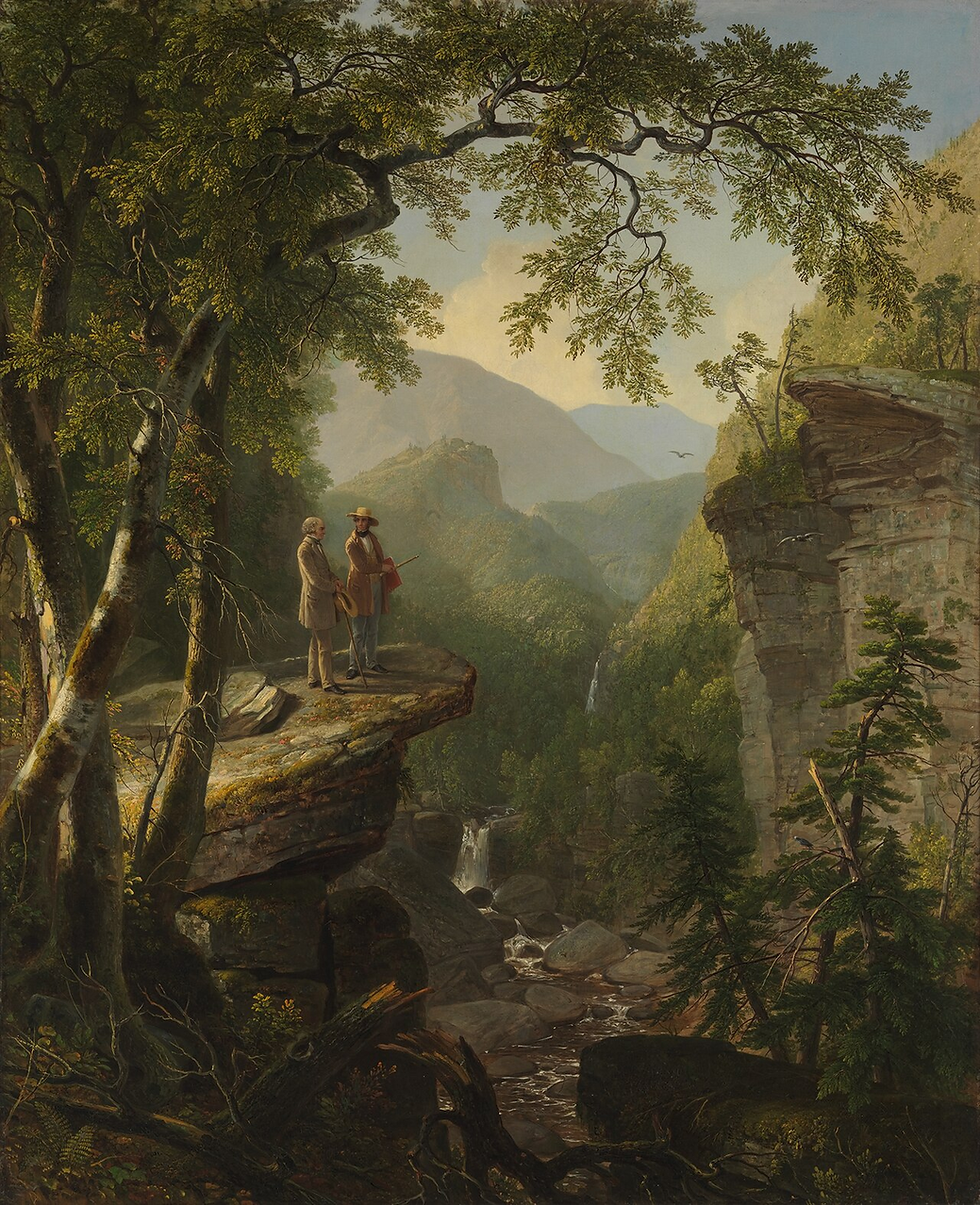
The Beauty and Philosophy of Chinese Xieyi Painting

welcome to our
SATURDAY EVENING POST
October 17th, 2026
By Diamond Kyle
Written with time, thought, and a human pulse.
Having grown up surrounded by Chinese painters working in a remarkable variety of styles, I have spent much of my life taking for granted a tradition whose complexities I had never felt compelled to examine closely. The subtleties of brushwork, the treatment of surface, the delicate balance of composition, and the intricate relationships between negative space, foreground, and background were all so familiar to me that they became almost instinctive. I grew accustomed to hearing my parents discuss Chinese painting with extraordinary fluency, moving effortlessly through a vocabulary of aesthetic principles, technical distinctions, and philosophical ideas particular to the tradition. This language became part of the atmosphere in which I grew up, something I understood through familiarity rather than deliberate study. It was therefore to my considerable astonishment that, during a recent conversation with my mother about Chinese painting, I discovered how ill-equipped I was to discuss it with the same intellectual precision. I had acquired an intimacy with its visual language without developing the critical vocabulary to articulate what I had long taken for granted.
A painter who wishes to paint bamboo might begin by studying the intervals or negative spaces between its leaves, the weight and inclination of its stems, and the peculiar way it bends without surrendering its uprightness (which oddly, makes me think of the sword fighting scene in Ang Lee’s 2000 film Crouching Tiger, Hidden Dragon). Such observations are encouraged and very necessary, yet they do not fully explain how to paint bamboo well. A botanical illustration of a stalk of bamboo may describe its structure with precision, while another painter, using only a handful of ink strokes, produces something that seems no less alive. The difference is familiar enough, but it presents a difficult question: if the second painting tells us less about the bamboo's appearance, in what sense, and just how might it tell us more about the bamboo itself?
Chinese painters and scholars have considered variations of this question for centuries. Their answers have involved the cultivation of character, the discipline of calligraphy, the observation of nature, and the relationship between what the eye perceives and what the hand makes visible. They have also questioned whether resemblance, however skilfully achieved, can account for everything a painting communicates. Within this history, 写意 (xiěyì), commonly translated as “freehand” or “expressive” painting, offers a particularly rich way to reconsider what we ask of an image and what we believe it can reveal.

The two characters that make up the word 写意 (xiěyì) deserve attention. 写 (xiě) means to write, although it can also refer to rendering or depicting; 意 (yì) encompasses intention, thought, meaning, and the inward disposition from which an action proceeds, neither the English word idea nor expression captures its full range. In painting, 写意 (xiěyì) suggests an approach in which the subject's visible form remains important without determining the limits of what the painter wishes to communicate. It is closely associated with the cultivated movement of the brush, with selection rather than exhaustive description, and with the possibility that a few marks may disclose qualities that detailed imitation leaves untouched.
Yet the apparent freedom of 写意 (xiěyì) must not be mistaken for carelessness. Its historical development cannot be separated from the disciplined practices of calligraphy and poetry, or from traditions of painting that valued meticulous observation. Indeed, the sixth-century critic 谢赫 (Xie He) included both 气韵生动 (qìyùn shēngdòng), commonly translated as spirit resonance or vital animation, and 应物象形 (yìngwù xiàngxíng), corresponding to things through the depiction of their forms, among his six principles of painting. Vitality and resemblance were not necessarily opposing ambitions. The question was how they might coexist, and whether outward accuracy alone could provide a sufficient measure of artistic achievement.

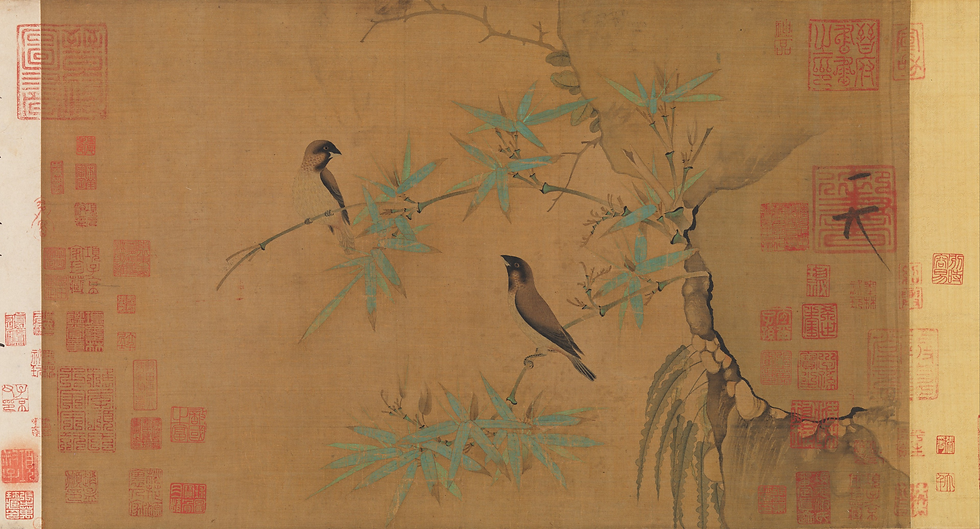
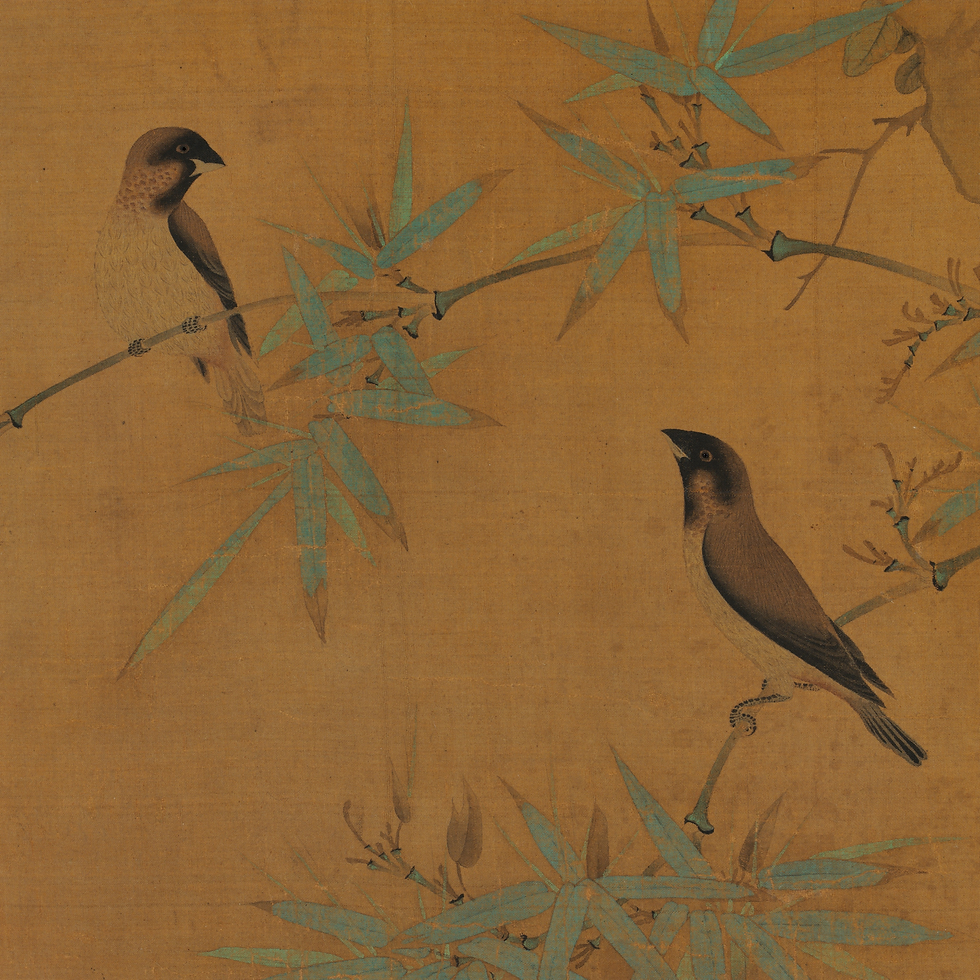
The extraordinary precision of the Northern Song emperor Huizong's Finches and Bamboo offers an important caution against treating expressive painting as inherently more profound than faithful depiction. Its birds are meticulously observed, down to the small details that give their bodies weight and animation. The artist's attention to physical appearance is itself a means of apprehending life. A distinction between painting the appearance of a subject and painting its spirit should be noteworthy, but it cannot become an easy hierarchy in which one achievement is presumed superior to the other.
During the Northern Song dynasty, 苏轼 (Su Shi, 1037–1101) gave this problem a particularly memorable formulation through his friendship with the celebrated bamboo painter 文同 (Wen Tong, 1018–1079). In his essay An Account of Wen Yuke's Painting of Bent Bamboo in Yundang Valley (文与可画筼筜谷偃竹记), Su Shi criticizes the practice of assembling bamboo mechanically, joint by joint and leaf by leaf. Bamboo, he observes, possesses a coherent structure from the moment it begins to grow. The painter should therefore have 成竹在胸 (chéngzhú zài xiōng), the complete bamboo already formed within the mind, before taking up the brush. Yet Su Shi also recognizes that understanding a subject and being able to paint it are different accomplishments. The desired image may be clear in the mind but falter in its execution. What he calls 心手不相应 (xīn shǒu bù xiāng yìng), the failure of mind and hand to respond to one another, makes artistic knowledge inseparable from acquired skill. Intellectual comprehension alone is insufficient, because the hand must develop capacities that thought cannot simply command.
Su Shi's observation recalls the writings of 庄子 (Zhuangzi), a philosopher I particularly admire for his exploration of the relationship between knowledge, skill, and human experience. In the famous account of 庖丁解牛 (Páo Dīng jiě niú) Cook Ding carving an ox, a butcher works with such extraordinary understanding of the animal's structure that his knife moves through its natural openings with scarcely any resistance. His accomplishment is the result of years of practice, during which the internal organization of the animal has become intelligible through the trained movements of his body. Cook Ding's mastery is neither mechanical precision nor thoughtless spontaneity. It is a form of understanding so thoroughly assimilated that perception and action have become almost inseparable. Even so, he remains attentive to difficulty, knowing when to proceed with particular care.
What interests me here is the possibility that painting requires a similar intimacy with its subject. To paint bamboo is to understand more than its outward appearance. Its growth, flexibility, resistance, and response to the elements must become familiar enough that the painter can translate them into the movements of the brush. Shitao's monumental Bamboo in Wind and Rain becomes an excellent example of this idea. The artist invokes Wen Tong's practice of living among bamboo, observing its transformations throughout the day, the composition's leaves and stems register the disturbance of weather, although the wind itself remains unseen. We recognize its presence through the altered disposition of bamboo, through the inclination of a stem, the direction of a leaf, and the force of a brushstroke. What the painting reveals is not simply what bamboo looks like in the wind, but something of how it responds to the wind.
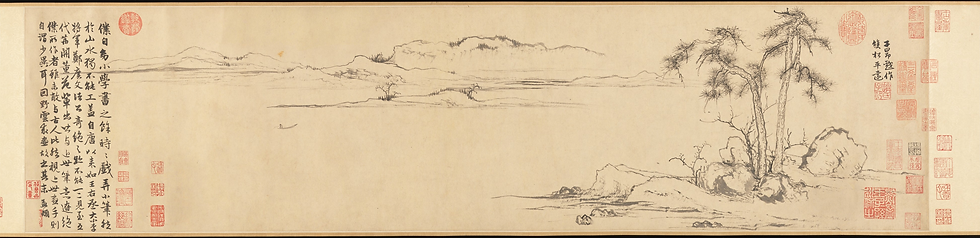

Yet a brushstroke cannot be understood exclusively through its relationship with nature. In Chinese literati painting, its meaning is also shaped by calligraphy and the historical inheritance of artistic conventions. 赵孟頫 (Zhao Mengfu)'s Twin Pines, Level Distance constructs trees and rocks through brush techniques associated with different forms of writing. The pines retain their identity, while the strokes simultaneously demonstrate the qualities of seal script and cursive brushwork. The line describes an object, establishes formal relationships within the painting, and invokes an intellectual tradition.
Here lies a difficulty for any account of 写意 (xiěyì) as immediate, unmediated expression. The seemingly spontaneous mark may be the product of years of disciplined imitation, repetition, and refinement. Its freedom is achieved through familiarity with conventions, and to recognize its significance often requires knowledge of those conventions. How, then, can we distinguish a brushstroke that reveals genuine insight from one that merely performs the accepted signs of vitality?
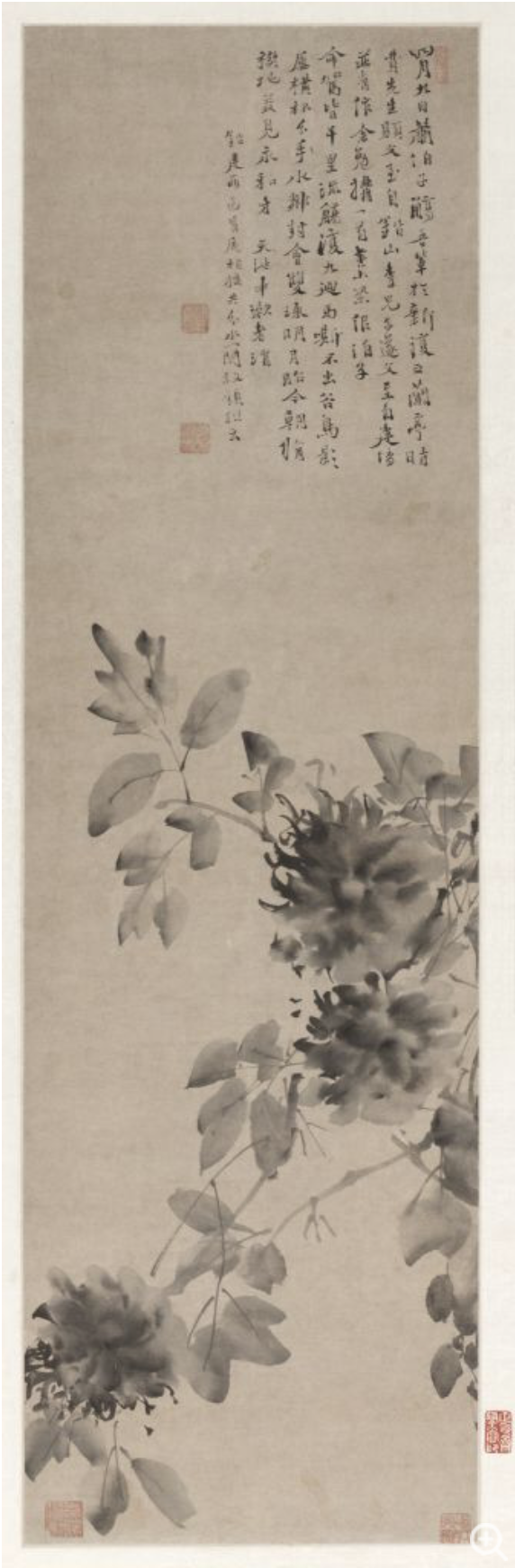
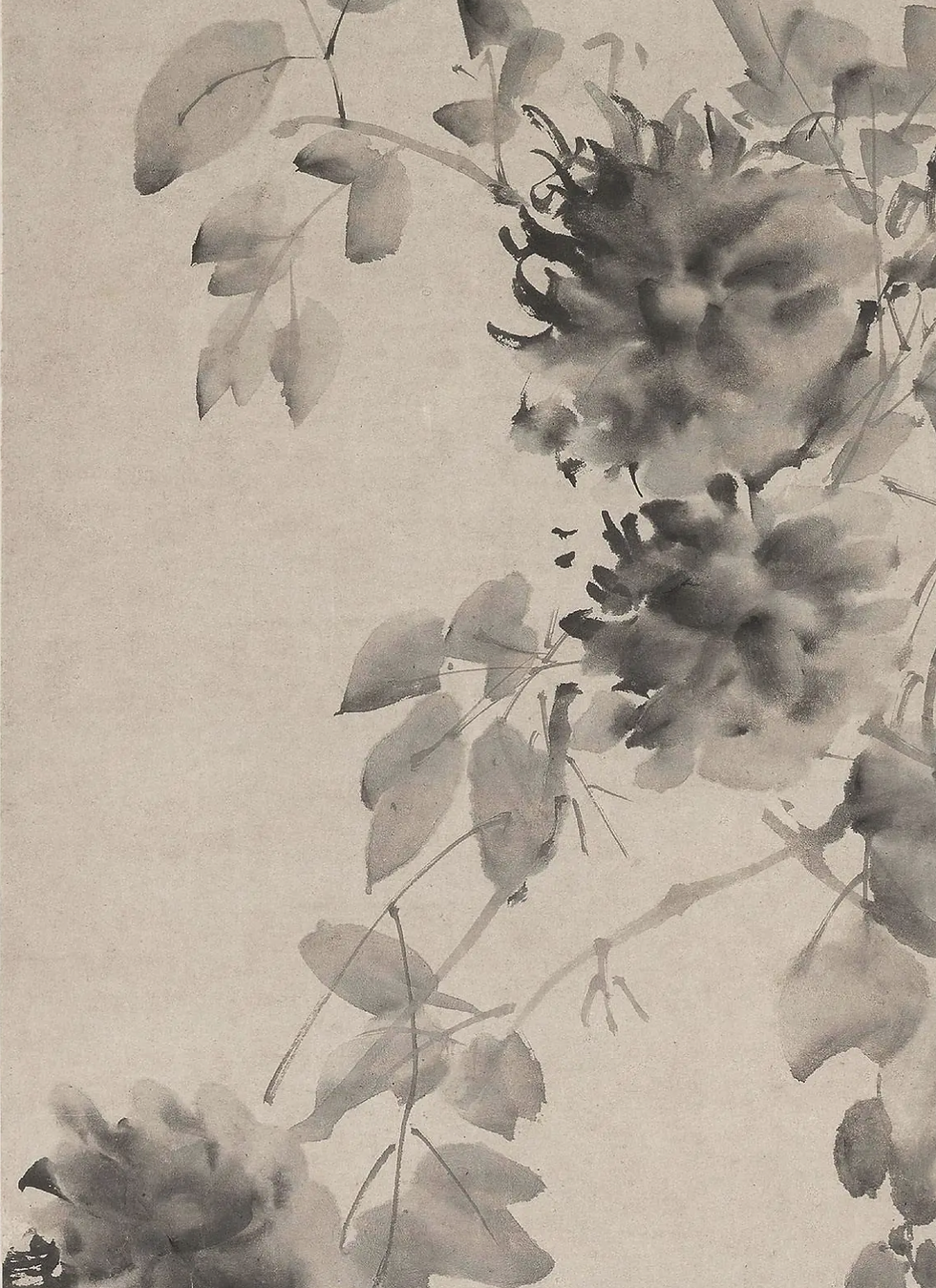
Xu Wei (徐渭, 1521–1593), Peonies in Ink (水墨牡丹图), Ming dynasty. Ink on paper, 109.2 × 33 cm. Palace Museum, Beijing.
徐渭 (Xu Wei), a poet, calligrapher, dramatist, and painter of formidable individuality transformed Ming-dynasty flower painting through his vigorous handling of ink. In Peonies in Ink, petals are gathered from broad, saturated applications of the brush, while stems and leaves are established through more economical lines. The flower remains recognizable, although its appearance is determined as much by variations in ink density and movement as by its botanical structure. His achievement lies in the manner in which recognizable form, calligraphical movement, and the physical behaviour of ink are created as inseparable elements.
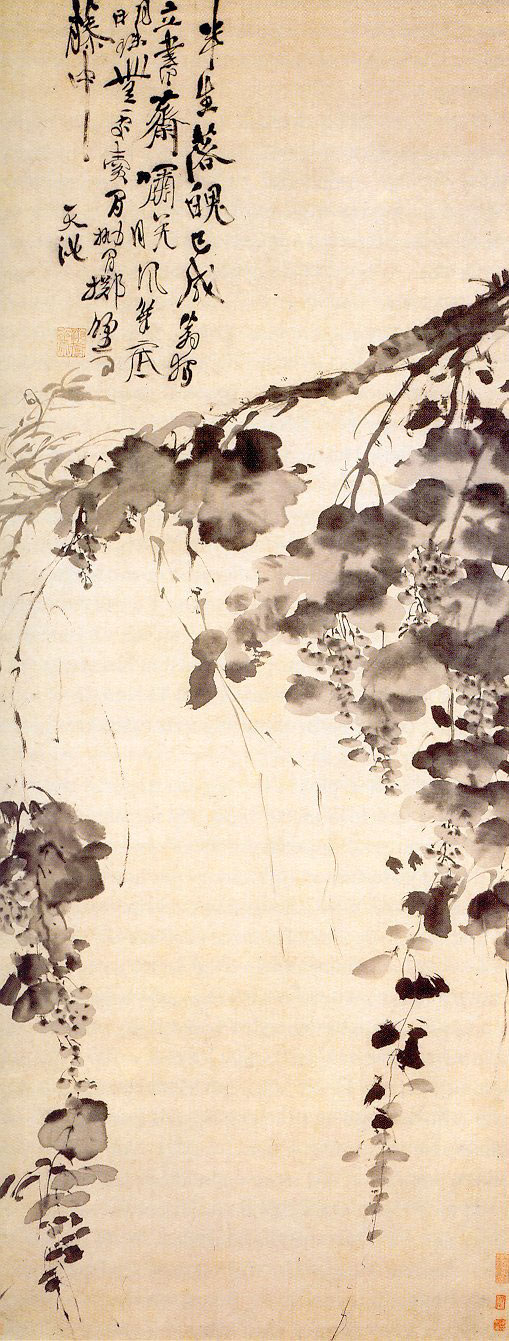
His Grapes in Ink offers an even more searching example. Vines twist across the paper, leaves emerge from spreading washes, and clusters of grapes gather in tonal concentrations that seem almost to dissolve at their edges. The subject is unmistakable, although little effort has been made to describe each grape as an independent volume, the life of the image emerges through the relationship between the growth patterns of the plant and the changing properties of the ink.
The accompanying poem begins with Xu Wei reflecting upon a life of frustration and solitude. Its final two lines read:
The pearls beneath his brush find no buyer; they are left scattered among the wild vines. (笔底明珠无处卖,闲抛闲掷野藤中。)
The grapes become pearls, and the pearls suggest something precious whose value has gone unrecognized. The poem allows personal disappointment to alter the painting without requiring the grapes to abandon their physical identity. Yet the poetic inscription does not merely explain an otherwise obscure image. Writing and painting operate together, each altering our experience of the other.
The effect is more complex than the familiar proposition that an artist expresses feelings through natural objects. The grapes possess formal and material qualities that cannot be reduced, nor is the painting's emotional significance detachable from its particular subject. Xu Wei has established a relationship in which object, gesture, language, and personal circumstance remain mutually implicated.
The behaviour of ink introduces another complication. Water does not respond to the brush with perfect obedience. Its movement through absorbent paper (rice paper) depends upon moisture, pressure, timing, and the qualities of the surface. An unexpected diffusion may alter a form that seemed settled just a moment too early. The painter must recognize whether such a development should remain, be modified, or become the occasion for another decision. What appears spontaneous often requires extraordinary judgment. But we should resist attributing creative intention to the materials themselves, its physical properties only become artistically consequential through the decisions of someone who understands them. The resulting image records an encounter in which neither intention nor material behaviour alone can account for everything that has occurred.

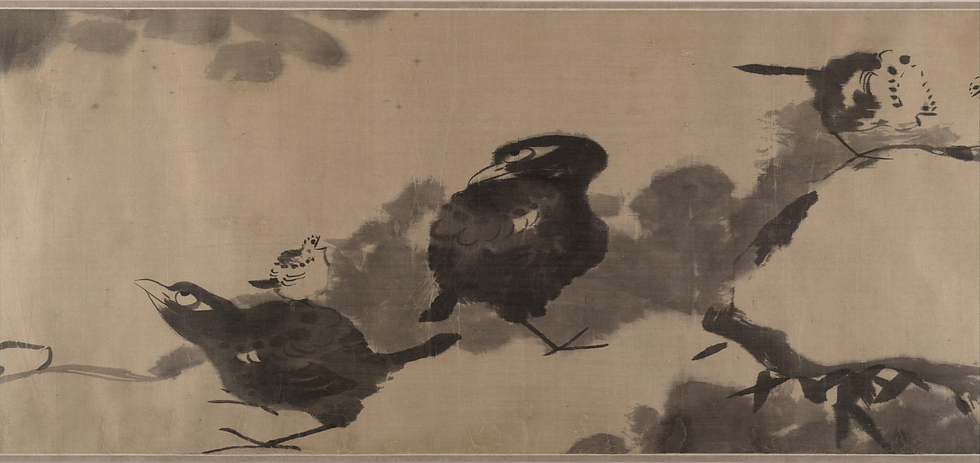
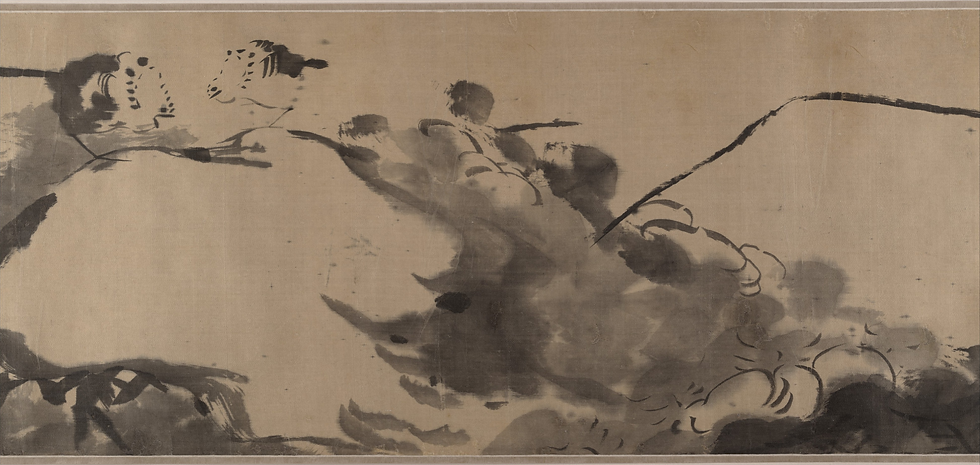
In the work of 八大山人 (Bada Shanren), these questions acquire an altogether different psychological intensity. Born 朱耷 (Zhu Da) into a branch of the Ming imperial family, he lived through the dynasty's collapse and the establishment of Qing rule. (Ming Dynasty stretched from 1368-1644, while Qing Dynasty formally took over the imperial courts in 1644 and lasted until 1912.) He took refuge in Buddhist monastic life before eventually supporting himself through painting and calligraphy. The peculiar personalities of his birds and fish have often been interpreted in relation to political displacement, estrangement, and his enduring loyalty to the fallen dynasty.
In Birds in a Lotus Pond, a torn lotus leaf, an outlined rock, and several small birds occupy a remarkably sparse pictorial field. Their expressions resemble something almost human. The black mass of the damaged leaf acquires a formal authority far beyond its modest botanical subject, while the surrounding space creates an atmosphere of uncertainty. The painting invites psychological interpretation, yet its emotional character cannot be located in any single gesture or symbol.
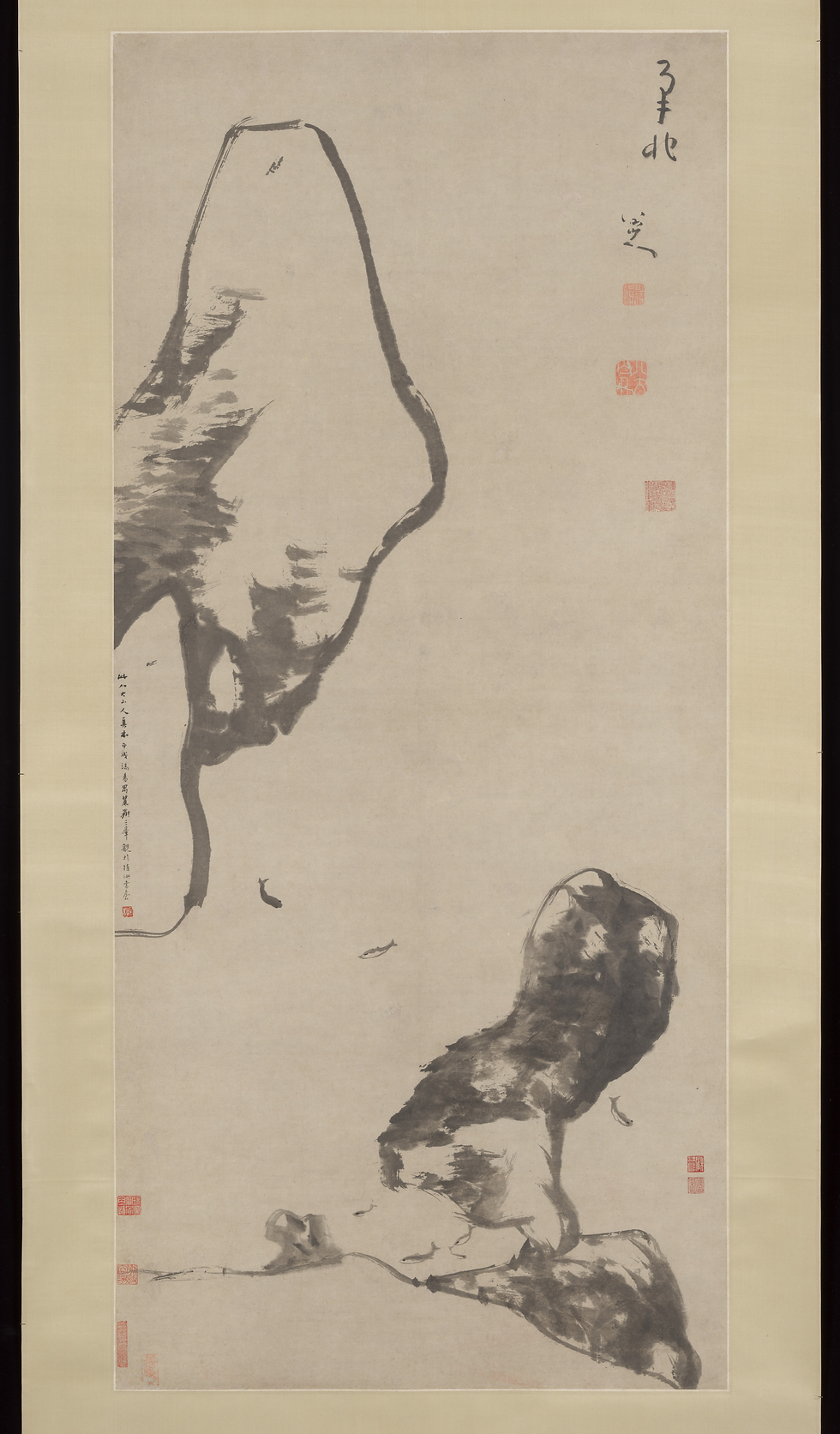
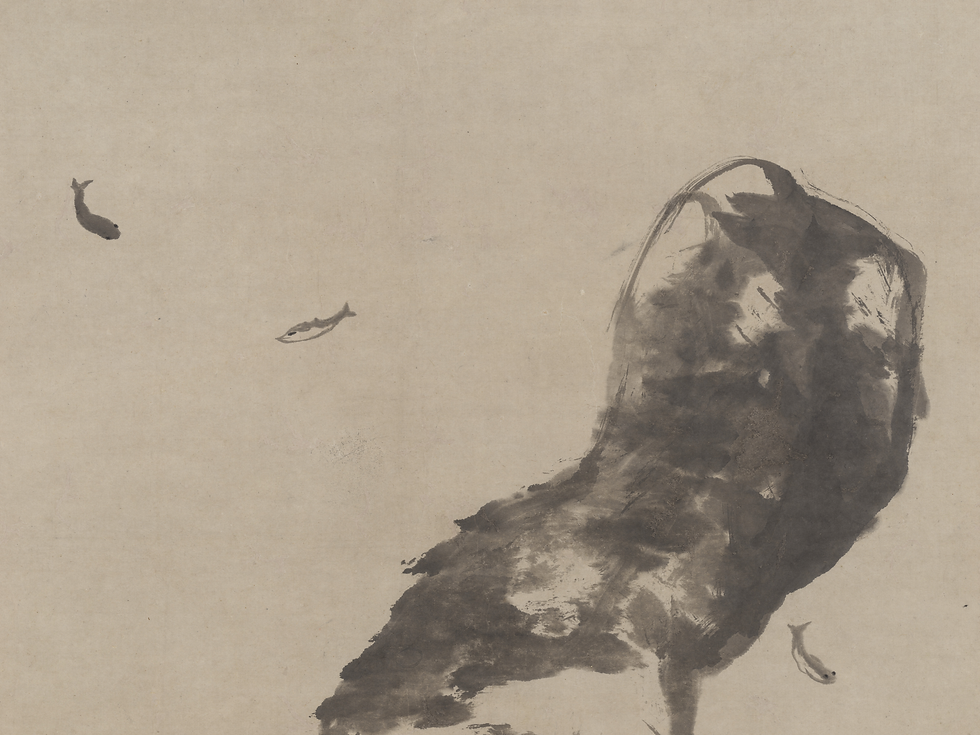
His Fish and Rocks, painted in 1699, is still more unsettling. Two substantial rock formations occupy the composition, while seven small fish establish the suggestion of a body of water. Six are depicted in profile and one from above. The absence of a horizon leaves the relationships between space and object unresolved. We recognize a pond, yet the usual coordinates by which we understand such a place have been quietly disturbed.
The unpainted paper is essential. The Chinese practice of 留白 (liúbái) leaving blank space, allows the untouched surface to participate actively in an image. Its significance arises from the relationships established by the painted forms. In Bada Shanren's composition, the fish cause us to recognize the surrounding emptiness as water, although nothing has been added to describe the water itself. One might say that the painting gives us enough information to recognize a world while withholding sufficient information to stabilize it, so the viewer is compelled to participate in its construction, encountering the image through the uncertainty that the artist has deliberately preserved. This is where the language of spirit, intention, and expressive freedom must be treated critically. But how much belongs to the painter's intention, how much to inherited symbolism, and how much to the interpretation we bring to the work?
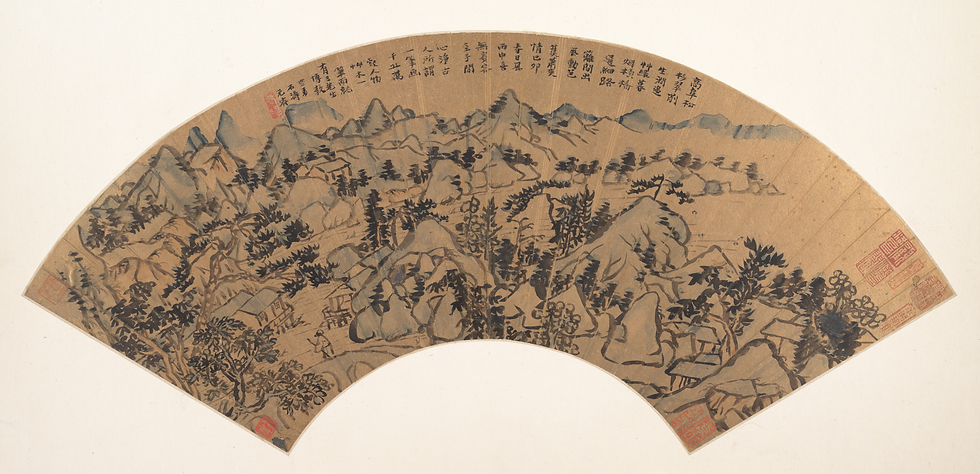
Shitao (石涛) approached the question of artistic freedom through a more fundamental understanding of creation. In his influential treatise Sayings on Painting by the Bitter Gourd Monk (苦瓜和尚画语录), he introduced the concept of 一画 (yīhuà) the One Stroke, describing it as 众有之本,万象之根, “the foundation of all existence and the root of the myriad forms.” The One Stroke should not be understood merely as the first mark upon a sheet of paper, nor as the possibility of completing a painting with a single continuous line. It expresses a principle that is at once practical and philosophical: just as the multiplicity of the natural world can be understood as emerging from an underlying unity, the innumerable strokes of a painting must arise from, and remain connected through, a coherent creative vision. Mountains, trees, figures, and rivers may each require different treatments, yet their forms belong to the same pictorial world, brought into being through the relationship between the painter's mind, hand, and understanding of nature.
Shitao took this principle further in his proposition 以无法生有法 (yǐ wúfǎ shēng yǒufǎ), literally, “to give rise to method from no method.” The apparent paradox is central to his philosophy. He was not advocating the abandonment of artistic discipline, but questioning the assumption that established conventions could provide an adequate answer to every artistic problem. Rather than allowing inherited formulas to dictate the act of painting, the artist must develop an appropriate method through an independent encounter with the subject and the demands of the work itself. In his Landscape of 1699, Shitao returned to the One Stroke as the principle through which mountains, valleys, figures, and bamboo could be brought into a unified composition. The significance of 一画 (yīhuà) One Stroke lies in this relationship between unity and invention: the many forms within a painting arise through individual acts of the brush, yet acquire coherence through an underlying creative principle. Artistic freedom therefore depends upon the painter's command of tradition without being confined by it, allowing knowledge and invention to operate together.
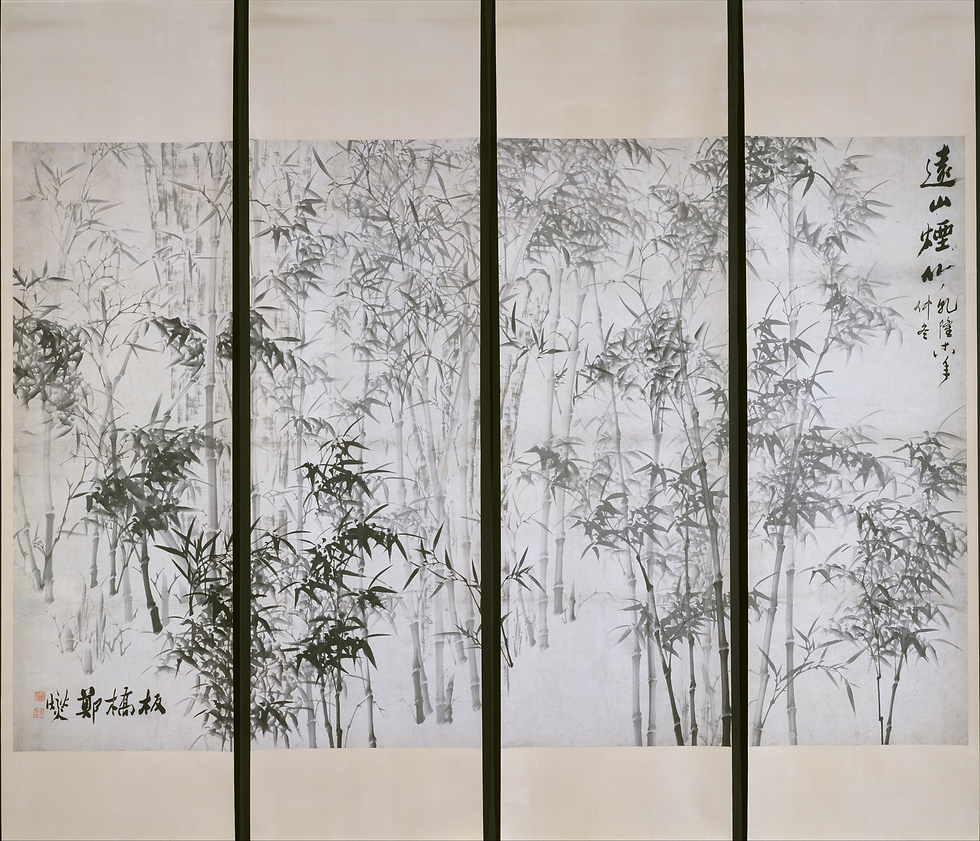
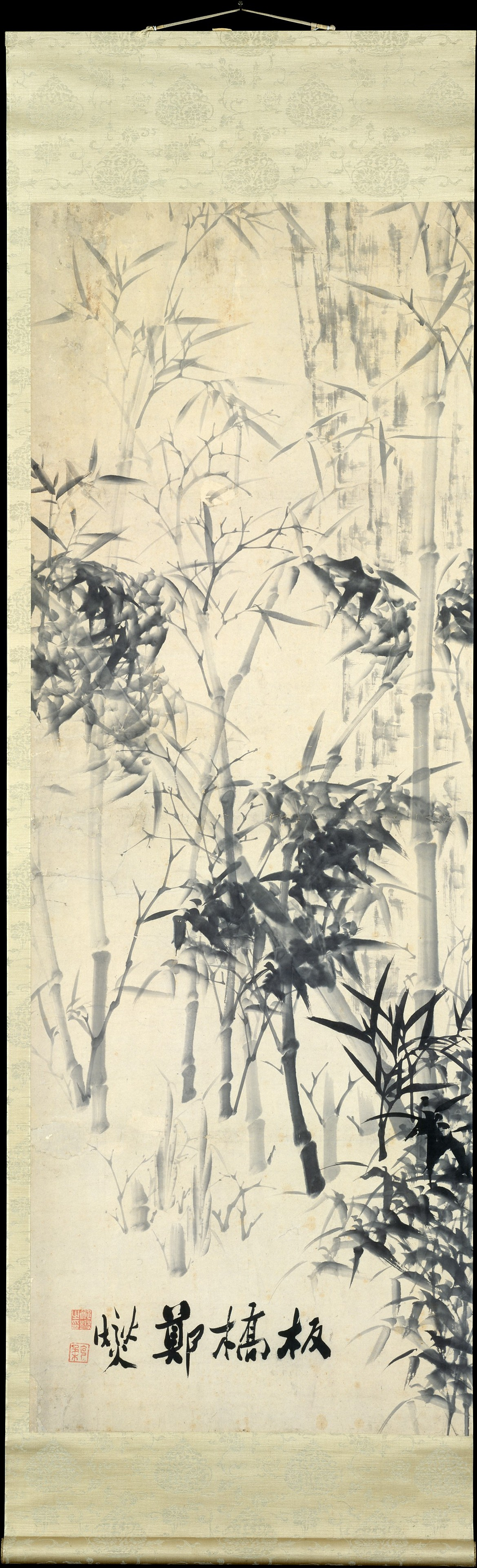
The eighteenth-century painter 郑燮 (Zheng Xie, also known as Zheng Banqiao, 郑板桥) articulated this relationship through his writing about bamboo. He distinguished among 眼中之竹 (yǎn zhōng zhī zhú) the bamboo in the eye, 胸中之竹 (xiōng zhōng zhī zhú) the bamboo in the mind, and 手中之竹 (shǒu zhōng zhī zhú) the bamboo in the hand. What the painter sees is altered through mental apprehension, and what the mind apprehends is transformed again through the physical act of painting. The three are intimately connected, yet they are never simply identical. This is a significant development of Su Shi's earlier formulation. The complete bamboo within the mind does not arrive unchanged upon the paper, painting possesses its own intelligence, shaped by the encounter between intention, skill, material, and the unforeseen demands of a particular work.
Perhaps the significance of 写意 (xiěyì) lies in the questions it makes possible rather than in the establishment of another artistic category. It allows us to examine how an image can remain faithful to a subject while departing from its outward appearance, how inherited conventions can become instruments of individual freedom, and how the act of painting may reveal possibilities that neither observation nor prior intention had fully anticipated.
In the end, much of 写意 (xiěyì) remains unmistakably representational. However freely the brush moves, the subjects retain their identities. Xu Wei's grapes are still grapes, and Bada Shanren's fish remain fish, even as their forms take on meanings far beyond their physical appearances. But what of those paintings that seem to straddle the uncertain territory between representation and abstraction? And what of the many works throughout Western art history that inhabit a similar realm? Abstraction, after all, is not merely the removal of recognizable objects from a painting. For many artists, the transformation of form becomes a means of bringing forth the aura, emotion, or power of a subject, something that a precise depiction of the encounter might never fully communicate. A painting may depart considerably from outward resemblance while remaining profoundly concerned with the reality from which it arose. In some works, the subject seems almost to dissolve into gesture, colour, or movement, yet something of its presence persists. How much of the recognizable world must remain before we consider a painting abstract, and does abstraction necessarily mean that the artist has moved away from reality? These questions extend well beyond 写意
(xiěyì), into a vast and fascinating territory of art history that deserves a discussion of its own.
Water, meanwhile, is inseparable from 写意 (xiěyì). It is essential to the preparation of ink, to its dilution and movement, and to the way it penetrates the fibres of paper, allowing the image to acquire a life of its own. The painter may guide its course, but cannot entirely determine where it will travel or how it will settle. Water itself seems to possess a life that cannot be confined to any single form. When my mother and I have a discussion about water, I was struck by the extraordinary range of its nature, its unpredictability, its resilience, and its capacity for both creation and destruction. Over time, it can pierce stone and reshape the land. It nourishes the earth, sustains entire civilizations, and makes life possible, yet it can also flood, drown, and destroy. Its gentleness does not diminish its power, nor does its destructive capacity negate its generosity.
There is something profoundly familiar about this when we consider our own lives, which are so often unpredictable, full of adventures and possibilities we never imagined, but also of circumstances we could neither anticipate nor prevent. We make our plans, pursue our intentions, and exercise whatever influence we can, yet there are limits to what we are able to change. There must be a certain willingness to surrender to what lies beyond our control, although surrender itself requires discernment. We must learn to accept what cannot be changed while retaining the courage and responsibility to change what can. Perhaps the painter working in 写意 (xiěyì) encounters something of this same predicament with every movement of the brush. There is intention, there is discipline, and there is the freedom to act, but there is also the unpredictable life of water and ink, which may offer possibilities the painter had never conceived. Knowing when to intervene, when to allow something to unfold, and when to accept what has already taken form may be among the most difficult accomplishments of both painting and living. What emerges is not always what we intended, and it need not always be beautiful or welcome. Yet even within those uncertainties, there remains the possibility of discovery, of finding something that no amount of planning could have brought into existence. Perhaps this is what has stayed with me most from my conversation with my mother: that the art of 写意 (xiěyì), so deeply concerned with the relationship between intention and what ultimately takes form, has something to teach us about the nature of living itself.
CONTACT US
4-258 East 1st Ave,
Vancouver, BC (Second Floor)
GALLERY HOURS
Tuesday - Saturday,
11:30 AM - 5:30 PM
or by appointment
我们提供中文服务,让我们带您走入艺术的界。